




DRAM: Inside the Hottest ETF in the Marketplace Today
Key Points
As AI is developed and data centers are built, demand for memory to keep things running has skyrocketed.
The Roundhill Memory ETF is the first exchange-traded fund designed to target these memory providers.
About 75% of the portfolio is invested in the industry's three major players: Samsung, SK Hynix, and Micron.
- 10 stocks we like better than Roundhill ETF Trust - Roundhill Memory ETF ›
The Roundhill Memory ETF (NYSEMKT: DRAM) was launched on April 2. Less than six weeks later, it was up nearly 100%. Today, it already has more than $9 billion in assets.
That kind of performance just doesn't happen in typical exchange-traded funds (ETFs). It happens when the correctly themed fund is launched into a market where the underlying demand is huge, supply is tight, and investors are only starting to realize the opportunity.
Will AI create the world's first trillionaire? Our team just released a report on the one little-known company, called an "Indispensable Monopoly" providing the critical technology Nvidia and Intel both need. Continue »
The Roundhill Memory ETF is the first fund built exclusively around memory chip companies. Unlike other semiconductor ETFs that have some memory exposure, it's a pure-play portfolio. That's a distinction that matters a lot right now.
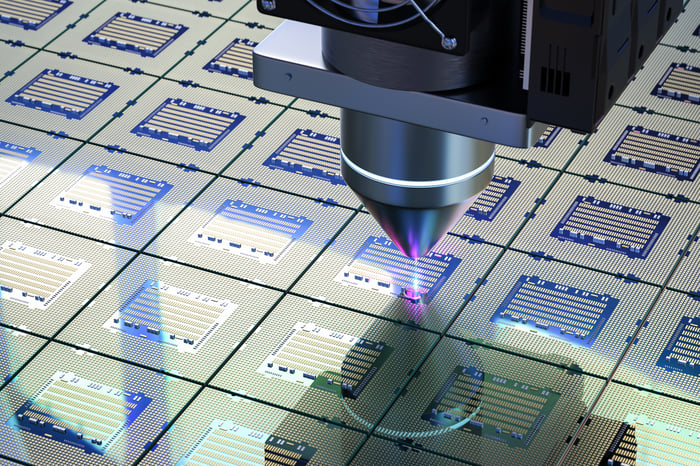
Source: Getty Images.
How DRAM shapes its portfolio
A lot of AI-themed ETFs are really just large-cap tech ETFs in disguise. They have Nvidia, Microsoft, and Alphabet as their top holdings and add some semiconductor names further down. Investors who buy those funds are essentially getting a broad tech index with an artificial intelligence (AI) label on it.
The Roundhill Memory ETF, however, takes a different approach. Its selection process specifically targets the companies involved in the development or manufacture of semiconductor memory products. That includes DRAM, NAND flash, specialty memory, and embedded memory. By requiring that the companies in the fund get 50% or more of their revenue from this industry, it's a high bar to clear. And only a handful of stocks make the cut.
There are three big names in the memory space: Samsung Electronics (OTC: SSNLF), SK Hynix, and Micron Technology (NASDAQ: MU). Within this portfolio, they account for a combined 75% of total assets. You'll also get some ancillary exposure to names such as Sandisk and Seagate Technology, but this is pretty much a three-stock portfolio.
The memory-demand story
As Roundhill notes on the fund's website, "Memory is a critical bottleneck of the AI revolution, supported by a secular shift toward data-intensive applications and sustained demand growth."
The opportunity is simple. Every company that's building out its AI infrastructure needs memory in order to operate. Every graphics processing unit that goes into a data center needs high-bandwidth memory stacked alongside it. As workloads scaled up in 2025 and capacity requirements grew, the three largest holdings of this fund found themselves with more demand for memory than they could handle.
This supply demand imbalance has driven up prices, expanded margins, and sent the share prices of these stocks significantly higher. Not only is the demand for semiconductor chips expected to remain red hot for the foreseeable future, but the demand for memory could also end up being even greater.
It's a bit more challenging to suggest that the Roundhill Memory ETF is a short-term buy given that it's already doubled in just a matter of weeks. But there's no doubting the underlying demand that still makes this ETF a longer-term buy-and-hold. Investors should expect a fair amount of volatility with this fund, so you should be prepared to hold on in order to allow time for the narrative to play out.
This is a smart, targeted AI play in an industry that's likely to be backed by significant demand for the foreseeable future.
Should you buy stock in Roundhill ETF Trust - Roundhill Memory ETF right now?
Before you buy stock in Roundhill ETF Trust - Roundhill Memory ETF, consider this:
The Motley Fool Stock Advisor analyst team just identified what they believe are the 10 best stocks for investors to buy now… and Roundhill ETF Trust - Roundhill Memory ETF wasn’t one of them. The 10 stocks that made the cut could produce monster returns in the coming years.
Consider when Netflix made this list on December 17, 2004... if you invested $1,000 at the time of our recommendation, you’d have $483,476!* Or when Nvidia made this list on April 15, 2005... if you invested $1,000 at the time of our recommendation, you’d have $1,362,941!*
Now, it’s worth noting Stock Advisor’s total average return is 998% — a market-crushing outperformance compared to 207% for the S&P 500. Don't miss the latest top 10 list, available with Stock Advisor, and join an investing community built by individual investors for individual investors.
See the 10 stocks »
*Stock Advisor returns as of May 19, 2026.
David Dierking has no position in any of the stocks mentioned. The Motley Fool has positions in and recommends Alphabet, Micron Technology, Microsoft, and Nvidia. The Motley Fool has a disclosure policy.
Recommended Articles


