




SpaceX Roadshow as Early as June, OpenAI and Anthropic Second-Half IPOs, Big Three May Drain 2026 AI Listing Demand
TradingKey - The 2026 U.S. IPO market is set to witness the most crowded listing window in history. Elon Musk's SpaceX will launch its IPO roadshow in June, OpenAI plans to list in the fourth quarter, and Anthropic aims to debut in October. The three companies could raise a combined total of over $240 billion, launching a near-simultaneous 'all-out offensive' on public market investors.
SpaceX: How the Largest IPO in History Rewrites the Rules?
SpaceX's IPO plans are advancing at a breakneck speed. On the evening of April 6 ET, SpaceX disclosed a detailed proposal during an online meeting with its banking team: it plans to launch the IPO roadshow during the week of June 8 and invite 1,500 retail investors to a major event on June 11. The company expects to release its IPO prospectus in late May.
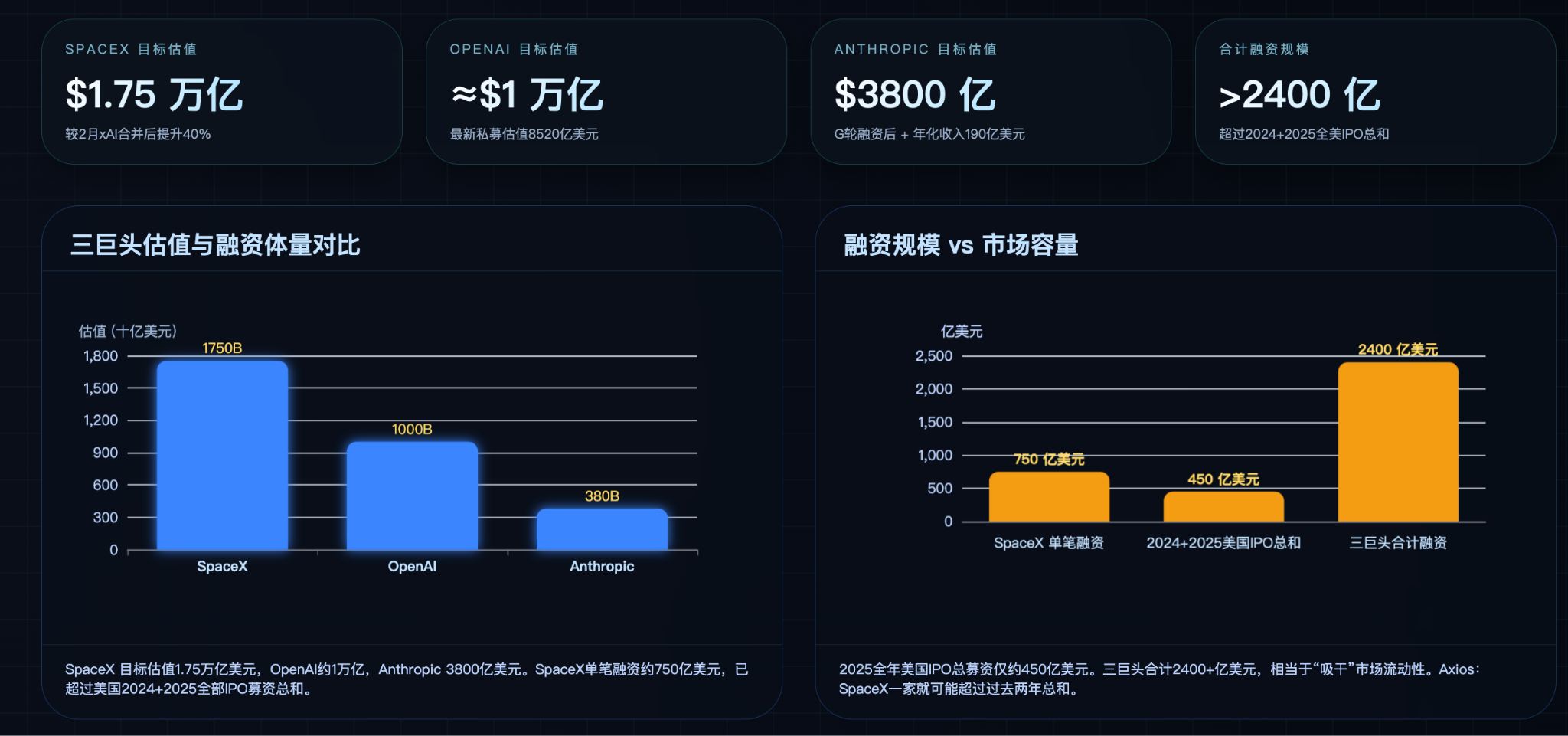
In terms of fundraising scale, SpaceX plans to raise approximately $75 billion through this IPO, with a target valuation reaching up to $1.75 trillion, a significant increase from the $1.25 trillion set during its merger with xAI in February. Axios previously noted that the scale of this single SpaceX transaction could exceed the total proceeds of all U.S. IPOs in 2024 and 2025 combined.
SpaceX CFO Bret Johnsen stated clearly during the meeting: "Retail investors will be a critical part of this IPO, with their participation exceeding that of any previous offering." Musk aims to reserve up to 30% of the shares for retail investors, whereas the industry standard is typically only 5% to 10%. This unprecedented arrangement serves both as Musk's way of "giving back" to long-term supporters and as "strategic positioning" to absorb massive market liquidity.
By early 2026, SpaceX's revenue reached approximately $15 billion to $16 billion, with profits of about $8 billion. Its core assets have transformed from a pure-play rocket launch company into a "Musk Universe" conglomerate spanning the Starlink satellite network, Starship rockets, and xAI artificial intelligence.
OpenAI and Anthropic: The AI Titans' IPO Race
Compared to SpaceX's definitive timeline, the listing schedules for OpenAI and Anthropic remain fluid, though their windows overlap significantly.
OpenAI plans to conduct an IPO as early as the fourth quarter of 2026, targeting a valuation of approximately $1 trillion. Just days ago, OpenAI completed an unprecedented private funding round totaling $122 billion, with its post-money valuation reaching $852 billion, marking the largest single private financing in Silicon Valley history.
However, internal disagreements between OpenAI's CEO and CFO persist regarding the IPO timing. CFO Sarah Friar believes the company is not yet ready for a listing and holds reservations about the $600 billion five-year spending plan. Bloomberg reports that OpenAI's influence in the secondary market is waning, with one firm stating that after contacting hundreds of institutions, "not a single one was interested in buying OpenAI."
Anthropic plans to go public as early as October, potentially raising more than $60 billion in what would be the world's second-largest IPO. The company completed a $30 billion Series G funding round in February, reaching a valuation of $380 billion. Notably, its annualized revenue has surpassed $19 billion, and its enterprise market share for large models has hit 32%, overtaking OpenAI's 25%.
Goldman Sachs, JPMorgan Chase, and Morgan Stanley are expected to be the leading candidates to underwrite the two companies.
The Big Three May Drain Market Liquidity
Based on available data, the fundraising scale of the three companies has reached historic highs. With SpaceX at approximately $75 billion, OpenAI (whose fundraising could reach tens to hundreds of billions based on a $1 trillion valuation), and Anthropic at over $60 billion, the total scale is conservatively estimated to exceed $240 billion. In contrast, total U.S. IPO proceeds for the full year of 2025 were only about $45 billion. Axios stated that SpaceX's fundraising alone could surpass the combined U.S. IPO proceeds of the past two years.
More concerning is the extreme concentration of the time window. SpaceX's June roadshow, Anthropic's October listing, and OpenAI's fourth-quarter IPO mean that from June through the end of the year, global capital market liquidity will be continuously absorbed by these three 'whales'.
Fortune magazine reported: 'SpaceX, OpenAI, and Anthropic could reboot the IPO market, but they could also drain it dry.'
Crunchbase data shows that in the first quarter of 2026, global investors poured approximately $300 billion into around 6,000 startups, setting a single-quarter record in venture capital history. Roughly 80% of global capital flowed into AI-related sectors, significantly higher than the approximately 50% for the full year of 2025.
Can retail investors purchase it?
The "Big Three" have all recognized the same issue: institutional investors alone cannot absorb such massive financing requirements.
Consequently, Musk plans to allocate 30% of SpaceX's placement to retail investors, an unprecedented move for an offering of this magnitude.
Meanwhile, OpenAI is also following suit. CFO Friar stated on April 9 that the company plans to reserve a portion of shares for retail investors in its IPO; it has already raised over $3 billion from individual investors in its most recent private placement, where demand was "very strong." Friar also revealed that the company initially targeted only $1 billion but ended up tripling that goal.
Anthropic has yet to announce a specific retail allocation plan, but given its similarly vast fundraising scale, turning to retail investors is almost an inevitable move.
What should investors focus on?
For investors, several key signals merit ongoing attention:
- SpaceX's IPO pricing and its post-offering performance will serve as a "bellwether" for the broader market. If SpaceX successfully lists at a valuation exceeding $1.75 trillion and maintains steady growth, it will clear valuation hurdles for OpenAI and Anthropic's listings; conversely, if SpaceX falls below its IPO price or faces a valuation haircut post-listing, the other two will face significant valuation pressure. Given current sentiment, SpaceX is highly likely to be chased by the secondary market due to its "Musk halo," yet investors should remain cautious about whether the stock price is sustainable. A frenzy that deviates sharply from fundamentals would overdraw growth trajectories for years to come, undermining long-term price sustainability.
- Whether internal IPO disagreements at OpenAI will be resolved in the coming months is critical. If the CFO’s cautious stance prevails, OpenAI’s IPO timeline could be delayed until 2027, thereby providing more breathing room for the market.
- The "divergence in preference" among institutional investors regarding these three companies is intensifying. Reports indicate that some institutions claim to have billions of dollars ready to purchase Anthropic shares, while "not a single one is willing to buy OpenAI." Musk noted he was not surprised. This divergence suggests that these three giants are not "on equal footing."
2026 will mark the peak of the AI capital feast and could serve as a stress test for market resilience. As Gené Teare, head of research at Crunchbase, observed, the market is currently "between two worlds"—the chasm between high-valuation unicorns of the SaaS era and early-stage AI firms is being pushed toward a tipping point by these trillion-dollar IPOs.
Recommended Articles


