




Joby vs. Archer Aviation: Which eVTOL Stock Wins in 2026?
Key Points
eVTOLs are flying air taxis focused on alleviating congested, high-traffic transportation routes.
The U.S. military has also expressed interest in leveraging low-altitude eVTOLs for stealth missions.
Joby and Archer are both well capitalized and have made meaningful progress with aviation regulators.
- 10 stocks we like better than Joby Aviation ›
Electric vertical takeoff and landing aircraft, or eVTOLs, have the potential to redefine the transportation industry. These battery-powered flying taxis lift straight up like helicopters but cruise quietly at low altitudes -- meant to bypass gridlocked highways, facilitate medical evacuations, and give militaries agile solutions in disaster zones.
With urban environments swelling and sustainability standards on the rise, the mobility market is ripe for disruption. Let's explore how Joby Aviation (NYSE: JOBY) and Archer Aviation (NYSE: ACHR) are competing to transform daily commutes, logistics operations, and defense missions alike.
Will AI create the world's first trillionaire? Our team just released a report on the one little-known company, called an "Indispensable Monopoly" providing the critical technology Nvidia and Intel both need. Continue »

Image source: Joby Aviation.
Joby Aviation is a certified leader with real-world momentum
Joby's edge starts with its progress with the Federal Aviation Administration (FAA). The company recently started flight tests on its first FAA-conforming aircraft and is entering the final stages of type certification. Beyond its work with public sector officials, Joby has forged a number of interesting partnerships poised to add strategic value once the company begins to scale.
Joby has long collaborated with Toyota Motor, which brings deeply embedded manufacturing expertise to the table. Moreover, the company's acquisition of Blade Air Mobility's passenger business and integrations with Uber Technologies provide Joby with additional infrastructure and revenue streams in high-demand urban corridors.
In addition, partnering with incumbent commercial airliners such as Delta Air Lines adds another layer of route potential beyond cities. Finally, the company also entered the defense market via its ties with the U.S. Air Force and L3Harris. This segment helps diversify Joby's business beyond civilian markets.
While building eVTOLs is capital-intensive, Joby's balance sheet remains in a solid position. The company ended 2025 with roughly $1.4 billion in cash and investments, which was bolstered by a $1.2 billion raise earlier this year. This liquidity provides ample runway for production ramp-ups as Joby moves toward revenue-generating commercial passenger services.
Archer Aviation is a cash-rich challenger with strong backing
Like its counterpart, Archer has also made impressive strides with the FAA. Last month, investors learned that Archer's Midnight aircraft was the eVTOL to secure 100% FAA acceptance of its "Means of Compliance." This paves the way for Archer to finalize the acceptance of remaining FAA certifications -- ultimately clearing a path to achieve Type Inspection Authorization (TIA) activities.
Also like Joby, Archer has complemented its own manufacturing capabilities with a number of strategic and financial partners. Most notably, Stellantis is leveraging its expertise in the automotive landscape to support Archer's aircraft production. The value proposition here is that outsourcing some of its research and development (R&D) to Stellantis may lower Archer's capital expenditure (capex) burden compared to building everything in-house.
On the defense side, Archer collaborates with Anduril on hybrid VTOLs and Palantir Technologies on designing next-generation aviation systems.
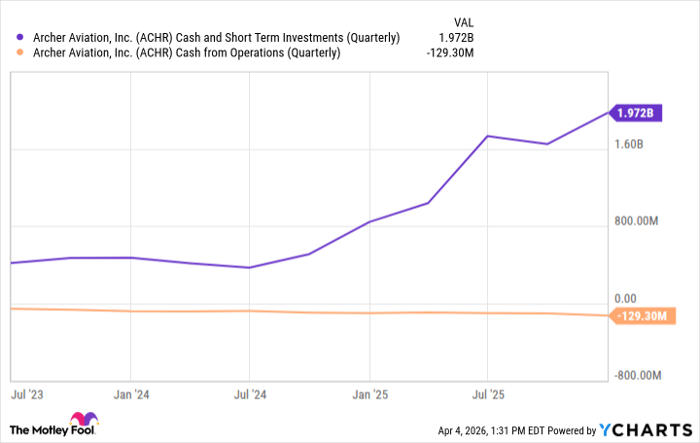
ACHR Cash and Short Term Investments (Quarterly) data by YCharts
Financially, Archer is in decent shape -- boasting roughly $2 billion in liquidity as of the end of December. This profile should provide adequate runway to offset cash burn as the company moves toward revenue generation.
The verdict: Joby is the superior eVTOL stock for 2026
Between the two companies, I think Joby emerges as the stronger pick for 2026. While Archer's cash stockpile and manufacturing partnerships offer optionality and mitigate liquidity risk, Joby leads in FAA certification -- a variable that I see as the most important foundation as each company vies for commercial traction.
Furthermore, Joby's integrations with Uber and Blade could help the company reach meaningful revenue milestones before Archer -- whose business seems to index more on future concepts rather than concrete, near-term tailwinds.
While both companies are well funded, Joby appears to have the edge when it comes to competitive advantages in the high-stakes eVTOL arena. For this reason, I see Joby as the smarter bet for near-term gains.
Should you buy stock in Joby Aviation right now?
Before you buy stock in Joby Aviation, consider this:
The Motley Fool Stock Advisor analyst team just identified what they believe are the 10 best stocks for investors to buy now… and Joby Aviation wasn’t one of them. The 10 stocks that made the cut could produce monster returns in the coming years.
Consider when Netflix made this list on December 17, 2004... if you invested $1,000 at the time of our recommendation, you’d have $532,929!* Or when Nvidia made this list on April 15, 2005... if you invested $1,000 at the time of our recommendation, you’d have $1,091,848!*
Now, it’s worth noting Stock Advisor’s total average return is 928% — a market-crushing outperformance compared to 186% for the S&P 500. Don't miss the latest top 10 list, available with Stock Advisor, and join an investing community built by individual investors for individual investors.
See the 10 stocks »
*Stock Advisor returns as of April 8, 2026.
Adam Spatacco has positions in Palantir Technologies. The Motley Fool has positions in and recommends L3Harris Technologies, Palantir Technologies, and Uber Technologies. The Motley Fool recommends Delta Air Lines and Stellantis. The Motley Fool has a disclosure policy.
Recommended Articles


