




Should You Add a Defense ETF to Your Portfolio in April?
Key Points
NATO's "5% of GDP" defense spending target by 2035 will send investment into this sector soaring.
The U.S. Department of Defense's budget proposal for 2027 is likely to exceed $1 trillion.
Three of the largest aerospace & defense ETFs produce different ways to invest in this sector.
- 10 stocks we like better than iShares Trust - iShares U.s. Aerospace & Defense ETF ›
The current war in Iran has disrupted the global geopolitical landscape and the outlook for U.S. stocks. It has also sent defense stocks soaring.
Over the past year, these three of the biggest aerospace & defense ETFs have outperformed the Vanguard S&P 500 ETF by more than 2x:
Will AI create the world's first trillionaire? Our team just released a report on the one little-known company, called an "Indispensable Monopoly" providing the critical technology Nvidia and Intel both need. Continue »
- iShares U.S. Aerospace & Defense ETF (NYSEMKT: ITA)
- Invesco Aerospace & Defense ETF (NYSEMKT: PPA)
- State Street SPDR S&P Aerospace & Defense ETF (NYSEMKT: XAR)
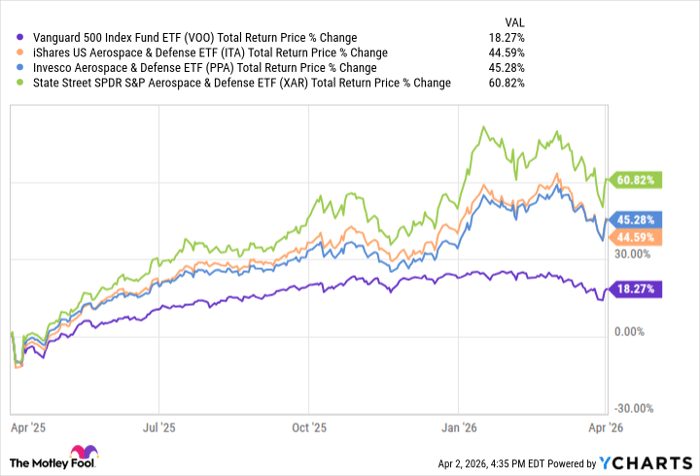
VOO Total Return Price data by YCharts
Whether it's a global conflict or the need to be prepared for the new artificial intelligence (AI) driven world, the demand for defense and cybersecurity is likely to only increase in the coming years.
Let's take a look at the investment case for this sector and which of the three ETFs listed above might serve you best.

Image source: Getty Images.
Key takeaways
- Approximately $2.6 trillion is expected to be spent on global defense in 2026. One-third will come from the United States.
- The White House's proposed 2027 defense budget could be as much as $1.5 trillion.
- All three of the major aerospace & defense ETFs were down at least 13% from their highs, presenting a potential "buy-low" opportunity.
- Invesco Aerospace & Defense ETF, iShares U.S. Aerospace & Defense ETF, and State Street SPDR S&P Aerospace & Defense ETF each offer a distinct risk/reward profile and portfolio.
Why defense spending is just getting started
Countries are already spending trillions of dollars on defense, but that number is only going to keep growing.
The biggest driver will be NATO member nations' agreement to invest at least 5% of their annual gross domestic product (GDP) in defense by 2035. Most nations are still operating under the previous 2% of GDP guidance, so a jump to 5% over the next decade would represent significant investment growth in the defense sector.
This type of worldwide defense spending should deliver steady business for defense companies for years to come.
Defense ETF comparison: ITA vs. PPA vs. XAR
| Metric | ITA | PPA | XAR |
|---|---|---|---|
| Expense ratio | 0.38% | 0.58% | 0.35% |
| AUM | $13.7B | $8.0B | $5.9B |
| Weighting method | Market-cap | Market-cap | Equal-weight |
| Cap size tilt | Large-caps | Large- and mid-caps | All-cap |
| 12-month return | 44.6% | 45.3% | 60.8% |
| Morningstar rating | 4 stars | 5 stars | 5 stars |
| Best use | Tilt toward leaders | Broader exposure | Higher risk, higher upside |
Source: fund websites
While all of these ETFs have "aerospace & defense" in their names, their underlying strategy produce very different portfolios.
The reasons for choosing each:
- ITA: You want to focus more on the industry's leaders and take advantage of higher liquidity.
- PPA: You want broader exposure to more individual companies within the sector and invest in some higher-potential mid-cap names.
- XAR: You want exposure to large-, mid-, and small-cap names and are willing to take on a little more risk to get higher returns.
With elevated geopolitical risks becoming the norm instead of the exception, investing in defense stocks could be a solid long-term growth play.
Should you buy stock in iShares Trust - iShares U.s. Aerospace & Defense ETF right now?
Before you buy stock in iShares Trust - iShares U.s. Aerospace & Defense ETF, consider this:
The Motley Fool Stock Advisor analyst team just identified what they believe are the 10 best stocks for investors to buy now… and iShares Trust - iShares U.s. Aerospace & Defense ETF wasn’t one of them. The 10 stocks that made the cut could produce monster returns in the coming years.
Consider when Netflix made this list on December 17, 2004... if you invested $1,000 at the time of our recommendation, you’d have $532,929!* Or when Nvidia made this list on April 15, 2005... if you invested $1,000 at the time of our recommendation, you’d have $1,091,848!*
Now, it’s worth noting Stock Advisor’s total average return is 928% — a market-crushing outperformance compared to 186% for the S&P 500. Don't miss the latest top 10 list, available with Stock Advisor, and join an investing community built by individual investors for individual investors.
See the 10 stocks »
*Stock Advisor returns as of April 8, 2026.
David Dierking has no position in any of the stocks mentioned. The Motley Fool has positions in and recommends Vanguard S&P 500 ETF. The Motley Fool has a disclosure policy.
Recommended Articles


