




This Is the Cheapest "Magnificent Seven" Stock Right Now. Is it a Value Play or Value Trap?
Key Points
Investors appear to be at somewhat of a crossroads with artificial intelligence (AI).
Although they clearly see the technology's potential, they are also concerned about excessive spending on AI infrastructure.
Given the sell-off, investors are likely taking a hard look at the group, especially some of the cheaper names in the "Magnificent Seven."
- These 10 stocks could mint the next wave of millionaires ›
The once seemingly invincible "Magnificent Seven" stocks have not fared well this year. The Roundhill Magnificent Seven ETF has fallen by more than 9%, underperforming the broader market. Investors may see this as a buying opportunity, given that most still see immense potential with artificial intelligence (AI).
But one should never buy a stock or an exchange-traded fund (ETF) simply because it is down. Valuation is also important. This is the cheapest Magnificent Seven stock right now. Is it a value play or a value trap?
Will AI create the world's first trillionaire? Our team just released a report on the one little-known company, called an "Indispensable Monopoly" providing the critical technology Nvidia and Intel both need. Continue »

Image source: Getty Images.
Investors go back and forth on AI capex
One reason investors are concerned about the Magnificent Seven despite being bullish on AI is that the group continues to spend heavily on AI infrastructure. Based on forecasts from earlier this year, the group could make close to $700 billion in capital expenditures, a staggering amount that marks a significant increase after a big year of capex in 2025.
Investors are struggling to see how these companies will deliver good returns on these investments, which has effectively pushed down valuations across the group.
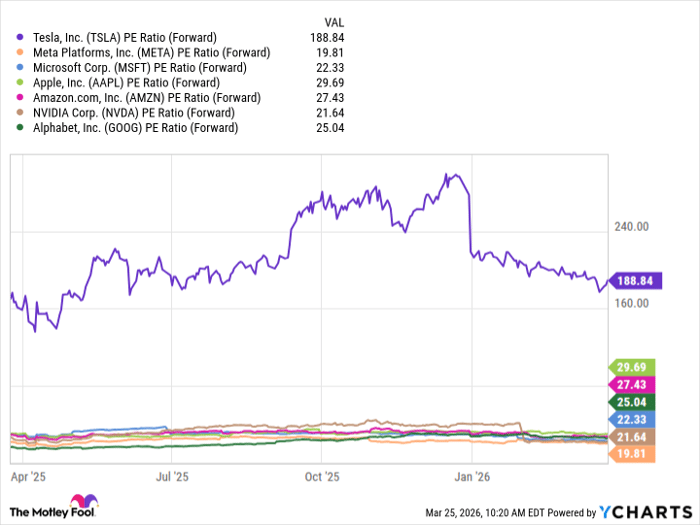
TSLA PE Ratio (Forward) data by YCharts
As you can see, Meta Platforms (NASDAQ: META) has the lowest valuation, trading for less than 20 times forward earnings (as of March 25). Meta has also projected tremendous capex in 2026, in the range of $115 billion to $135 billion, a 73% boost from last year. This is largely intended to support AI infrastructure, including spending on third-party cloud providers and depreciation associated with AI data centers.
Meta Chief Executive Officer Mark Zuckerberg said that the company wants to achieve superintelligence, which is AI more intelligent than humans, not just in problem-solving capabilities but also in things like social intelligence.
The interesting thing about Meta's decline this year is that the stock initially ripped after the company reported its 2025 fourth-quarter earnings in January, which included the capex projection.
That's because one could argue that Meta's most obvious way to benefit from AI is in its ad business. Meta can use AI to better tailor ads on its platform to users, resulting in higher engagement and more reasons for companies to advertise on its various social platforms. In 2025, Meta reported a 24% year-over-year increase in revenue, almost all of which is advertising.
Where investors might get worried is that Zuckerberg tends to go all in when he sees big opportunities. For instance, the company changed its name from Facebook to Meta Platforms in a huge bet on the metaverse. But recently, Meta announced it is scaling back its Metaverse division, which has so far posted tens of billions in losses.
So despite success so far, investors may have concerns about Zuckerberg investing too much in an undisciplined a manner when it comes to AI. With multi-hundred-billion-dollar investments, AI can't just produce good returns; it has to generate stellar returns.
Value play or value trap?
Last year, Alphabet was the value play of the Magnificent Seven. The company overcame hurdles, including a high-profile lawsuit from the U.S. Department of Justice and the challenge of proving that its AI models could compete. Class A shares of the stock are now up more than 75% during the past year, so it's obviously been a great outcome for investors.
If Meta's ad revenue keeps growing as it did in 2025, the stock will certainly move higher. But it will also be somewhat dependent on AI sentiment, whether the market believes broader spending in the sector can continue, and if investors can gain more visibility into the returns this spending generates.
Obviously, investors need to ensure Zuckerberg is making disciplined bets, but despite all the criticism, he has built one of the strongest and largest companies in the world. I think investors can, at the very least, make a small bet on this value play of the Magnificent Seven.
Where to invest $1,000 right now
When our analyst team has a stock tip, it can pay to listen. After all, Stock Advisor’s total average return is 884%* — a market-crushing outperformance compared to 179% for the S&P 500.
They just revealed what they believe are the 10 best stocks for investors to buy right now, available when you join Stock Advisor.
See the stocks »
*Stock Advisor returns as of March 31, 2026.
Bram Berkowitz has no position in any of the stocks mentioned. The Motley Fool has positions in and recommends Alphabet, Amazon, Apple, Meta Platforms, Microsoft, Nvidia, and Tesla and is short shares of Apple. The Motley Fool has a disclosure policy.
Recommended Articles


