




Stocks Are Plummeting, but There's a Major Silver Lining for Investors Right Now
Key Points
Major market indexes are reaching new lows for 2026, leaving many investors discouraged.
While recession odds are increasing, there's no guarantee the U.S. will face a recession this year.
The right investing strategy can help you make the most of volatility.
- These 10 stocks could mint the next wave of millionaires ›
The S&P 500 (SNPINDEX: ^GSPC) sank to its lowest point of the year last week, falling by around 8.5% from its highest point and inching closer to correction territory. The Nasdaq Composite (NASDAQINDEX: ^IXIC) is already in a correction, having fallen by more than 12% from its peak.
With stock prices falling by the day and economists warning of an increased risk of a U.S. recession, many investors are feeling discouraged right now. While the bad news is that nobody knows what the market will do, there's a major silver lining for investors.
Will AI create the world's first trillionaire? Our team just released a report on the one little-known company, called an "Indispensable Monopoly" providing the critical technology Nvidia and Intel both need. Continue »
Image source: Getty Images.
Will the U.S. enter a recession in 2026?
To be clear, the U.S. is not in a recession yet. Major indexes are not in bear market territory either, which is generally defined as a prolonged downturn of at least 20%.
There's also no guarantee that we'll get there, as there's always a chance that stocks could recover. Economists at Goldman Sachs predict a 30% chance of a recession in the next year, noting that the economy is resilient and a recession is not inevitable.
Much of this volatility is spurred by rising oil prices, and with the situation in Iran continuing to unfold, it's impossible to predict exactly how this war will affect the economy and the stock market.
The hidden perk of a downturn
That said, if the economy worsens and stock prices continue to slide, it could create a lucrative buying opportunity.
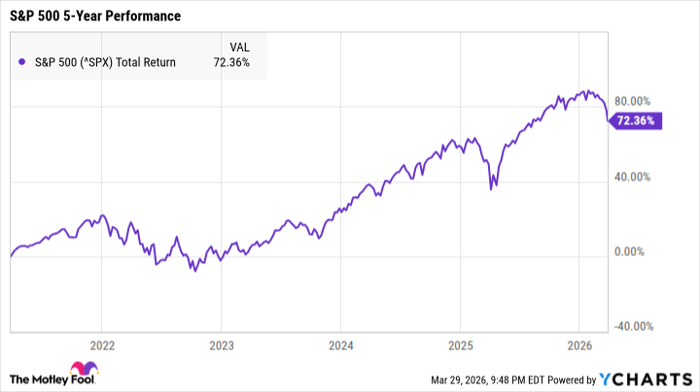
The market has experienced staggering growth in the past several years, with the S&P 500 surging by more than 72% in the past five years alone. The downside to all of these record highs, however, is that stocks are incredibly costly right now.
Five years ago, for example, Nvidia (NASDAQ: NVDA) cost just under $13 per share. As of this writing, it's now more than $167 per share. The same is true for broad-market index funds and ETFs. The Vanguard S&P 500 ETF (NYSEMKT: VOO), for instance, has soared from around $364 per share five years ago to around $583 per share now.
^SPX data by YCharts
Of course, this is fantastic news for those who invested five years ago and have been watching their investments grow. But surging prices also make it far more expensive to buy into the market right now -- especially for those on a tight budget who can't afford to spend hundreds of dollars on a single share.
Buying during the market's low points will not only save you money in the short term. Strong stocks will recover eventually, and by holding your investments through the rough patches, you'll be well positioned to earn potentially lucrative returns when prices increase once again.
Market volatility is daunting, but the right strategy can help you make the most of it. In the wise words of Warren Buffett: "Bad news is an investor's best friend. It lets you buy a slice of America's future at a marked-down price."
Where to invest $1,000 right now
When our analyst team has a stock tip, it can pay to listen. After all, Stock Advisor’s total average return is 884%* — a market-crushing outperformance compared to 179% for the S&P 500.
They just revealed what they believe are the 10 best stocks for investors to buy right now, available when you join Stock Advisor.
See the stocks »
*Stock Advisor returns as of March 31, 2026.
Katie Brockman has positions in Vanguard S&P 500 ETF. The Motley Fool has positions in and recommends Nvidia and Vanguard S&P 500 ETF. The Motley Fool has a disclosure policy.
Recommended Articles


