




Why Buying the Market Dip Right Now Could Be the Best Financial Decision of 2026
Key Points
The S&P 500 soared 78% over the past three years -- but in recent times, the index has lost that positive momentum.
Investors have worried about the geopolitical situation and the future of AI growth.
- 10 stocks we like better than S&P 500 Index ›
The S&P 500 has delivered more downs than ups in recent weeks, as a variety of uncertainties have weighed on investors' minds -- from questions about the artificial intelligence (AI) growth opportunity to the war in Iran.
This is a complete turnaround from the market situation that's reigned over the past three years. During that time, investors piled into AI stocks, excited about growth prospects, and the optimism spread to other growth stocks -- this helped the S&P 500 soar to multiple record highs and deliver a total gain of more than 78% over the past three calendar years.
Will AI create the world's first trillionaire? Our team just released a report on the one little-known company, called an "Indispensable Monopoly" providing the critical technology Nvidia and Intel both need. Continue »
As the market roared higher, it may have seemed much more tempting to invest than it does right now. But, even though this may sound strange, it actually is a better idea to get in on the market when times are tough than when stocks are on the rise. Here's why buying the market dip right now could be the best financial decision of 2026.

Image source: Getty Images.
Uncertainties weigh on stocks
So, as mentioned, the S&P 500 has been quite volatile in recent times as investors grapple with various uncertainties. When will the war in Iran end? Will the growth of AI down the road support the high spending levels we've seen recently? We don't know the exact answers to those questions. But we do know that times of geopolitical turmoil generally result in resolution. And as for AI, so far the information we have shows that demand for the technology is high -- and it's delivering results for those who use it.
Problems of various sizes come and go over time, and history shows us something very important: The market may move with these issues, but even in the worst of situations, such as a market crash, the S&P 500 has always bounced back and delivered a win to investors over time.
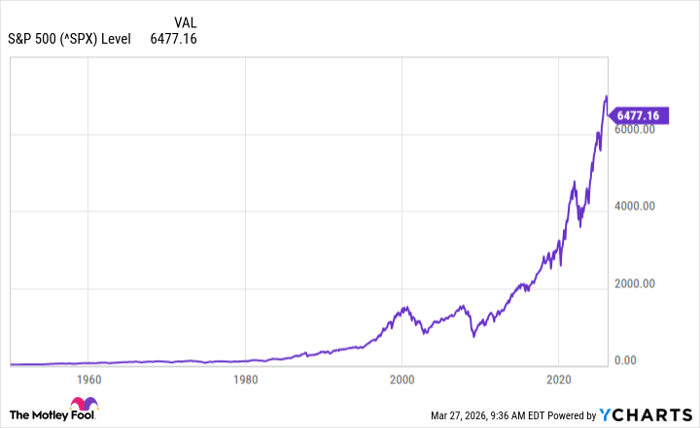
^SPX data by YCharts
Buying stocks on sale
This means that stock prices, which might be down today, won't stay this way forever. And this is exactly why it's a smart idea to buy stocks now rather than wait for them to climb. I like to compare the situation to shopping -- it's always better to pick up an item on sale than when it's at full price.
Of course, when you're bargain hunting during market declines, it's important to examine the quality of a stock. Certain companies with financial troubles, poor business models, or a lack of a competitive advantage, just to name a few examples, may not recover.
But solid companies with a track record of growth and strong prospects well into the future are well-positioned to recover from tough times. And if you buy these players now, you could see explosive gains over the long run. That's why buying the market dip right now could be your best financial decision of the year.
Should you buy stock in S&P 500 Index right now?
Before you buy stock in S&P 500 Index, consider this:
The Motley Fool Stock Advisor analyst team just identified what they believe are the 10 best stocks for investors to buy now… and S&P 500 Index wasn’t one of them. The 10 stocks that made the cut could produce monster returns in the coming years.
Consider when Netflix made this list on December 17, 2004... if you invested $1,000 at the time of our recommendation, you’d have $503,861!* Or when Nvidia made this list on April 15, 2005... if you invested $1,000 at the time of our recommendation, you’d have $1,026,987!*
Now, it’s worth noting Stock Advisor’s total average return is 884% — a market-crushing outperformance compared to 179% for the S&P 500. Don't miss the latest top 10 list, available with Stock Advisor, and join an investing community built by individual investors for individual investors.
See the 10 stocks »
*Stock Advisor returns as of March 29, 2026.
Adria Cimino has no position in any of the stocks mentioned. The Motley Fool has no position in any of the stocks mentioned. The Motley Fool has a disclosure policy.
Recommended Articles


