




Did Fed Chair Jerome Powell Throw President Donald Trump Under the Bus Concerning Inflation for a Second Straight FOMC Meeting?
Key Points
The prospect of lower interest rates has been a foundational catalyst for a historically expensive stock market.
Fed Chair Jerome Powell has homed in on goods-sector inflation (spurred by tariffs) in each of the last two Federal Open Market Committee (FOMC) meetings.
A comprehensive analysis by four New York Fed economists of how Trump's China tariffs (2018-2019) impacted stocks and the U.S. economy paints a worrisome picture.
- 10 stocks we like better than S&P 500 Index ›
For years, Wall Street's bull market rally has seemed impenetrable. The benchmark S&P 500 (SNPINDEX: ^GSPC) has rallied by at least 16% in six of the last seven years, while the ageless Dow Jones Industrial Average (DJINDICES: ^DJI) and technology-driven Nasdaq Composite (NASDAQINDEX: ^IXIC) have also reached record heights.
Several factors have played a role in the stock market's outperformance, including the rise of artificial intelligence (AI), the advent of quantum computing, better-than-expected corporate earnings, and President Donald Trump's Tax Cuts and Jobs Act, which permanently lowered the peak marginal corporate income tax rate to 21%.
Will AI create the world's first trillionaire? Our team just released a report on the one little-known company, called an "Indispensable Monopoly" providing the critical technology Nvidia and Intel both need. Continue »
But an argument can be made that the prospect of lower interest rates is at or near the top of the list of catalysts fueling Wall Street's bull market. Unfortunately, this rate-easing cycle isn't guaranteed to continue, thanks in part to President Trump's tariff and trade policy.
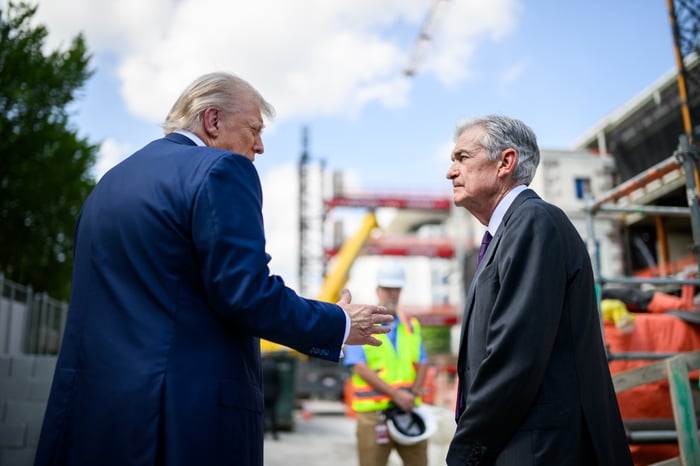
President Donald Trump speaking with Fed Chair Jerome Powell. Image source: Official White House Photo by Daniel Torok.
Fed Chair Jerome Powell singles out Trump's tariffs yet again at the March FOMC meeting
On March 18, the Federal Open Market Committee (FOMC) -- the 12-person body, including Fed Chair Jerome Powell, responsible for setting the nation's monetary policy -- chose to keep the federal funds target rate unchanged. It was the second consecutive meeting in which the FOMC kept rates unchanged, after three straight meetings with quarter-point rate cuts to end 2025.
The Federal Reserve holding pat on interest rates in the March meeting wasn't a surprise. Since the start of the Iran war on Feb. 28, oil prices have skyrocketed, resulting in higher transportation costs for consumers and businesses. When the March inflation report is released on April 10, we'll almost certainly see a meaningful uptick in the prevailing inflation rate.
But this wasn't the big takeaway of the March FOMC meeting. Rather, it was Powell's commentary on President Trump's tariffs.
While delivering remarks following the Jan. 28 FOMC meeting, Powell explained that the reason inflation has been somewhat elevated largely reflects "inflation in the goods sector, which has been boosted by the effects of tariffs." Powell's commentary notes that disinflation had been observed in the services sector. In other words, sticky inflation was prominently blamed on Trump's tariffs at the January meeting.
At the recently completed March FOMC meeting, Powell offered a similar take. While acknowledging the uncertainties associated with the Iran war, the Fed chair noted that elevated core Personal Consumption Expenditures "largely reflect inflation in the goods sector," with Trump's tariffs again footing the blame.
In response to a question about the inflation rate topping the Fed's long-term target of 2% for nearly five straight years, Powell had this to say:
The thing that's really important that we see this year is progress on inflation through a reduction in goods inflation, as the one-time effects on price of tariffs go through the system, go through the economy. That's the main thing we're looking for going into this exercise. And we need to be seeing that to, you know, to sort of understand we actually are making progress. Because on net, we didn't make progress.
In short, Donald Trump's tariffs are proving stickier and more challenging than anticipated, which is only going to complicate the Fed's rate-easing cycle as energy commodities ascend to the heavens in the wake of the Iran war.
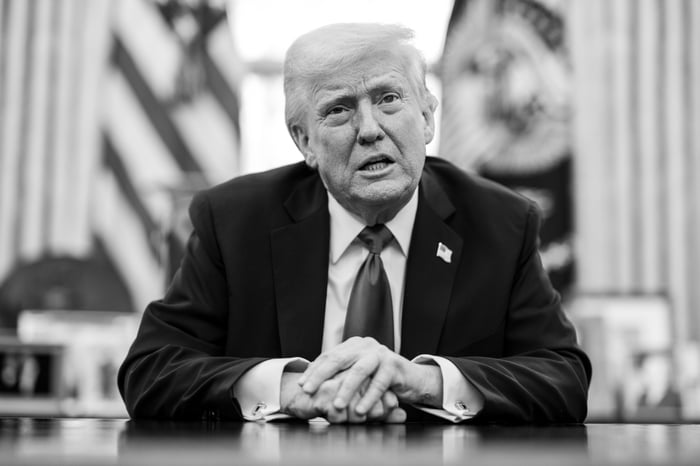
President Trump speaking with reporters in the Oval Office. Image source: Official White House Photo.
Historically, tariffs have been troublesome for Wall Street and businesses
If the central bank chooses to shelve its rate-easing cycle or completely reverses course and puts rate hikes on the table, it could prove disastrous in the short run for a historically pricey stock market. Given the recent pullbacks in the Dow Jones Industrial Average, S&P 500, and Nasdaq Composite, we're already witnessing some of these jitters take hold.
But even if the Fed stays the course, historical precedent suggests tariffs will undermine equities and corporate America to some degree.
In December 2024, four New York Federal Reserve economists, writing for Liberty Street Economics, published a study ("Do Import Taxes Protect U.S. Firms?") that detailed the subsequent effects of President Trump's China tariffs in 2018-2019 on the stock market and businesses.
The economists found that Trump's China tariffs led to average, across-the-board declines in employment, labor productivity, sales, and profits for businesses affected by these tariffs from 2019 to 2021. Although the past doesn't guarantee the future, Liberty Street's analysis showed that tariffs had a lasting negative impact on corporate America.
What may be even more noteworthy is Liberty Street's findings on input tariffs, which are duties placed on goods used to complete the manufacture of a product in the U.S. (e.g., steel).
One of President Trump's goals in imposing tariffs is to make U.S.-manufactured goods more price-competitive with those being imported. Tariffs are also designed to encourage multinational corporations to manufacture their goods destined for the U.S. in this country.
But the study's authors found that input tariffs were hurting U.S. businesses by driving up domestic production costs. This lack of differentiation between input and output tariffs (duties on finished products imported into the country) proved troublesome for U.S. companies years ago, and it may be the case yet again.
The Fed has a challenging road ahead, and Trump's tariffs aren't making things easy for the central bank, or a historically expensive stock market.
Should you buy stock in S&P 500 Index right now?
Before you buy stock in S&P 500 Index, consider this:
The Motley Fool Stock Advisor analyst team just identified what they believe are the 10 best stocks for investors to buy now… and S&P 500 Index wasn’t one of them. The 10 stocks that made the cut could produce monster returns in the coming years.
Consider when Netflix made this list on December 17, 2004... if you invested $1,000 at the time of our recommendation, you’d have $503,268!* Or when Nvidia made this list on April 15, 2005... if you invested $1,000 at the time of our recommendation, you’d have $1,049,793!*
Now, it’s worth noting Stock Advisor’s total average return is 898% — a market-crushing outperformance compared to 182% for the S&P 500. Don't miss the latest top 10 list, available with Stock Advisor, and join an investing community built by individual investors for individual investors.
See the 10 stocks »
*Stock Advisor returns as of March 28, 2026.
Sean Williams has no position in any of the stocks mentioned. The Motley Fool has no position in any of the stocks mentioned. The Motley Fool has a disclosure policy.
Recommended Articles


