




President Donald Trump Has Dug a Nearly $169 Billion Hole for Social Security
Key Points
Although Social Security is in no danger of bankruptcy or insolvency, its financial outlook has been deteriorating for decades.
President Trump's flagship tax and spending law is expected to constrain Social Security's primary income stream and potentially speed up the timeline to sweeping benefit cuts.
However, ongoing demographic shifts are primarily responsible for the program's financial shortcomings.
- The $23,760 Social Security bonus most retirees completely overlook ›
In February, more than 70 million people collected a Social Security benefit check, 54 million of whom are retired workers. For many of these retirees, Social Security income isn't a luxury -- it's nothing short of a necessity.
According to 24 years of annual surveys from Gallup, 80% to 90% of retirees rely on their monthly benefit, in some capacity, to make ends meet. These polls demonstrate how imperative it is for lawmakers, including President Donald Trump, to strengthen Social Security's foundation for current and future beneficiaries.
Will AI create the world's first trillionaire? Our team just released a report on the one little-known company, called an "Indispensable Monopoly" providing the critical technology Nvidia and Intel both need. Continue »
Unfortunately, Trump's flagship tax and spending law, the "big, beautiful bill," has dug an even deeper hole for America's foremost retirement program.

President Trump delivering remarks. Image source: Official White House Photo by Joyce N. Boghosian.
Social Security's long-term financial outlook has been deteriorating for decades
Since the first Social Security retired-worker benefit check was mailed in January 1940, the Social Security Board of Trustees has been publishing annual reports detailing the current and forward-looking financial health of this leading social program.
The Trustees Report allows anyone to track how Social Security generated every dollar of income the previous year, as well as trace where those dollars ended up. However, the Trustees' short-term (10-year) and long-term (75-year) forecasts often command more attention.
On the one hand, the Trustees Report has been cautioning of a long-term funding obligation shortfall since 1985. Put simply, projected income collected over the 75 years following a report is believed to be insufficient to cover outlays (mostly benefits, but also administrative expenses to operate Social Security). The 2025 Board of Trustees Report estimates that this long-term unfunded obligation has swelled to $25.1 trillion.
But this isn't the biggest concern for Social Security or its beneficiaries. The more immediate issue is the projected exhaustion of the asset reserves for the Old-Age and Survivors Insurance trust fund (OASI). The OASI is responsible for doling out monthly benefits to retired workers and the survivors of deceased workers.
According to the 2025 Trustees Report, the OASI's asset reserves -- excess income collected since inception that's invested in special-issue, interest-bearing government bonds, as required by law -- are expected to be depleted by 2033.
It's important to note that the OASI doesn't need a penny in its asset reserves to continue making payments to eligible beneficiaries. Social Security is in absolutely no danger of bankruptcy, insolvency, or halting benefits for current or future retirees.
However, the depletion of the program's asset reserves would signal that the existing payout schedule, inclusive of cost-of-living adjustments (COLAs), isn't sustainable. If the Trustees' forecast is accurate, retired workers and survivors of deceased workers could see their monthly checks slashed by up to 23% in seven years.
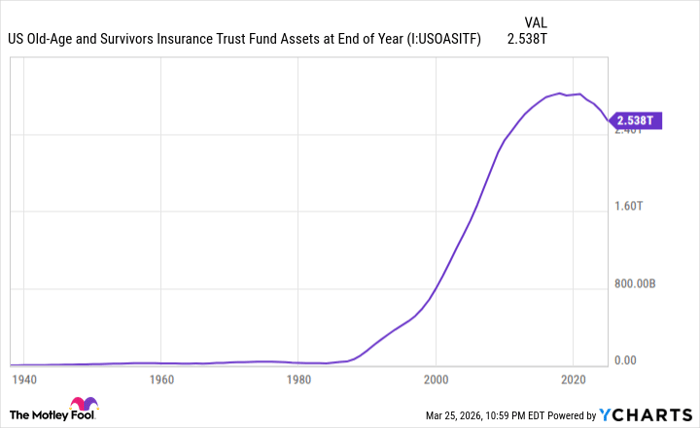
The OASI's asset reserves may be gone by 2033. US Old-Age and Survivors Insurance Trust Fund Assets at End of Year data by YCharts.
Trump's flagship tax and spending law just made Social Security's funding hole even deeper
You might be wondering how President Trump fits into all of this. The answer lies with the signing of his flagship tax and spending law on July 4, 2025.
For some Americans, the big, beautiful bill means extra cash in their pockets. While this is far from a comprehensive list, the most impactful piece of legislation passed during his second, non-consecutive term:
- Increases the standard deduction for eligible seniors aged 65 and over by $6,000 ($12,000 for those filing jointly) from tax years 2025 through 2028.
- Provides eligible workers with the ability to deduct up to $25,000 in annual tips from tax years 2025 through 2028.
- Provides eligible workers with a partial deduction of up to $12,500 on overtime pay ($25,000 for couples filing jointly) from tax years 2025 through 2028.
But while the big, beautiful giveth to some, it taketh away from Social Security.
According to an analysis from the Social Security Administration's Office of the Actuary (OACT), which was prompted by a request from Senate Banking Committee member Ron Wyden (D-OR), the big, beautiful bill is projected to increase costs for the combined OASI and Disability Insurance trust fund by $168.6 billion from 2025 through 2034. This is a roundabout way of saying that reduced payroll tax income collected by Social Security from 2025 through 2028 is going to widen an already large unfunded obligation.
Furthermore, the OACT's analysis suggests that Trump's tax and spending law will shift the OASI's asset reserve depletion date forward to the fourth quarter of 2032. In other words, we're now potentially six years away from sweeping benefit cuts.

Image source: Getty Images.
Ongoing demographic shifts are a considerably bigger problem for Social Security
Based solely on the OACT's analysis, Trump is harming, not helping, Social Security. But when stepping back and examining the catalysts that have fueled the program's estimated $25.1 trillion long-term funding shortfall, the big, beautiful bill is playing a relatively small role.
At the heart of Social Security's deteriorating financial outlook is a host of ongoing demographic shifts.
Some of these changes have been well documented, such as the ongoing retirement of baby boomers and the increase in longevity since retired-worker benefits began in January 1940. Baby boomers leaving the labor force puts pressure on the worker-to-beneficiary ratio. Meanwhile, Social Security was never designed to pay benefits for decades.
However, the most damaging demographic shifts are arguably occurring out of the spotlight.
For example, the U.S. birth rate dropped to an all-time low in 2024, according to the Centers for Disease Control and Prevention. A historically low birth rate would be expected to further pressure the worker-to-beneficiary ratio in the coming decades.
Net legal migration into the U.S. has also declined noticeably since the late 1990s. Since most legal migrants are young and will spend decades in the labor force, Social Security counts on a steady stream of net migration into the country. Fewer migrants coming to the U.S. translates into less payroll tax income.
Lastly, income inequality is a problem. When the Social Security Amendments of 1983 were signed into law, approximately 90% of earned income (wages and salary, but not investment income) was subject to the 12.4% payroll tax. As of 2024, roughly 83% of earned income was applicable to the payroll tax. Over time, more wages and salaries are escaping the payroll tax.
Donald Trump's big, beautiful bill isn't helping Social Security -- but tackling these ongoing demographic shifts is of far more importance.
The $23,760 Social Security bonus most retirees completely overlook
If you're like most Americans, you're a few years (or more) behind on your retirement savings. But a handful of little-known "Social Security secrets" could help ensure a boost in your retirement income.
One easy trick could pay you as much as $23,760 more... each year! Once you learn how to maximize your Social Security benefits, we think you could retire confidently with the peace of mind we're all after. Join Stock Advisor to learn more about these strategies.
View the "Social Security secrets" »
The Motley Fool has a disclosure policy.
Recommended Articles


