




Vanguard Total Stock Market Index Fund ETF Shares: Bull vs. Bear
Key Points
The Vanguard Total Stock Market ETF holds 3,000 more stocks than an S&P 500 index fund.
The S&P 500 makes up roughly 80% of the total market cap of the U.S. stock market.
More diversification doesn't automatically mean more stability.
- 10 stocks we like better than Vanguard Total Stock Market ETF ›
With $2.09 trillion in net assets, the Vanguard Total Stock Market ETF (NYSEMKT: VTI) is the largest exchange-traded fund (ETF) or index fund in the world.
The fund gives investors exposure to over 3,500 U.S. stocks, including mid- and small-cap equities. Whereas an S&P 500 (SNPINDEX: ^GSPC) index fund only includes large-cap stocks.
Will AI create the world's first trillionaire? Our team just released a report on the one little-known company, called an "Indispensable Monopoly" providing the critical technology Nvidia and Intel both need. Continue »
Here's how two longtime Fool.com contributors are thinking about the ETF in today's market.

Image source: Getty Images.
A better buy than an S&P 500 ETF
Daniel Foelber (Bull case): History tells us that buying stocks when they fall is a great way to compound wealth over time. But looking at a historical S&P 500 chart ignores the very real pain that comes with losing money -- even if it's unrealized losses on paper.
Buying a dip is hard enough. Buying and holding stocks through sell-offs -- or worse, bear markets -- takes unwavering conviction.
Preemptively making a list of high-quality stocks and ETFs that you can plug your hard-earned savings into, even during stock market sell-offs, can be a great way to filter out the noise and emotions that come with sharp downturns. The Vanguard Total Stock Market ETF definitely fits that description.
The ETF is nothing glamorous. In fact, its diversification is arguably exaggerated.
The megacap companies are so large that the S&P 500 makes up around 80% of the U.S. stock market. So even though the Vanguard Total Stock Market ETF has seven times as many holdings as the S&P 500, it still mirrors the performance of the Vanguard S&P 500 ETF (NYSEMKT: VOO) over the long term. As recent research by The Motley Fool shows, the "Magnificent Seven" stocks -- Nvidia, Alphabet, Apple, Microsoft, Amazon, Meta Platforms, and Tesla -- now make up a combined 33.3% of the S&P 500, compared to just 12.5% in 2016.
So the Vanguard S&P 500 ETF has slightly outperformed the Vanguard Total Stock Market ETF because it is more concentrated in these massive companies.
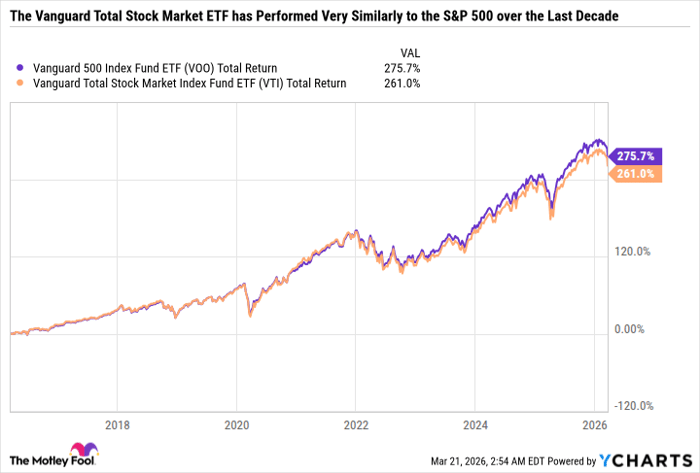
Data by YCharts.
Still, I'd rather buy the Vanguard Total Stock Market ETF than the Vanguard S&P 500 ETF simply because of its slightly higher diversification. And it helps that the two funds have identical expense ratios of just 0.03% -- the cheapest you'll find. So there's no fee-based opportunity cost of going with the Total Stock Market ETF over an S&P 500 ETF.
And finally, I like the idea of owning the entire U.S. market, rather than just the S&P 500. Especially because buying an S&P 500 ETF can duplicate existing holdings. For example, investors who already own Nvidia and don't necessarily want to add to that position may like that the Vanguard Total Stock Market ETF has a 6.2% weighting in Nvidia compared to 7.3% for the Vanguard S&P 500 ETF.
Add it all up, and the Vanguard Total Stock Market ETF is arguably the simplest and most straightforward way to buy a basket of U.S. stocks without racking up high fees.
This fund is great, but not the greatest
Anders Bylund (Bear case): I get it. The Total Stock Market Index Fund is more diversified than the classic Vanguard S&P 500 ETF. It also shares the same investor-friendly Vanguard DNA, complete with a microscopic 0.03% annual fee ratio. How can you go wrong with this top-quality ETF?
Well, it's actually hard to find a reason to prefer the Total Stock Market Index Fund over its younger but larger S&P 500 sibling. The two charts are hard to separate in a single chart, at least in a one-year perspective. With or without reinvested (and quite comparable) dividends, the two funds stand a rounding error apart:
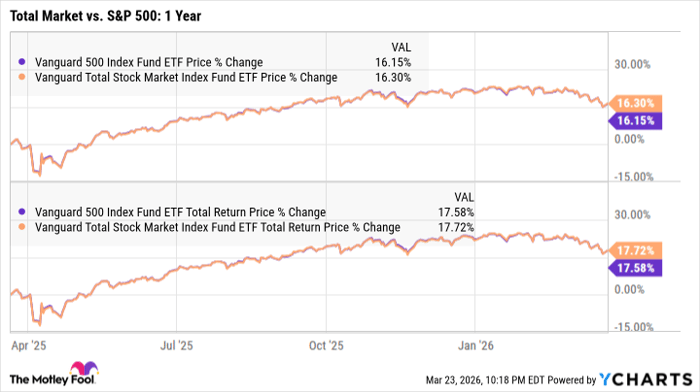
Data by YCharts.
But I can see a tiny sliver of space between the three-year lines, and when you stretch the chart to five years, it's a pretty significant gap. And the more profitable choice is consistently the S&P 500 tracker:
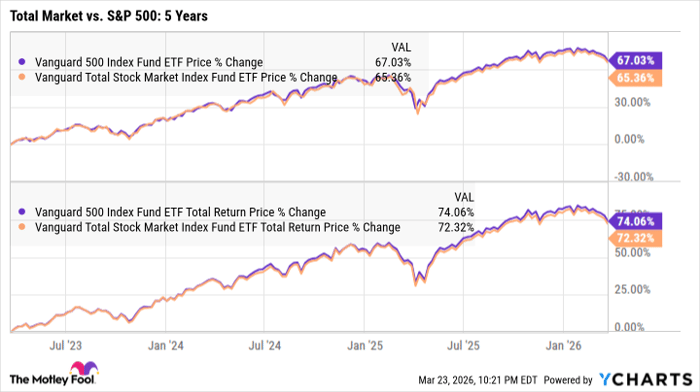
Data by YCharts.
And if you include the S&P 500 fund's entire history, starting in September of 2010 (the pioneering Total Market ETF launched in May 2001), your total return would hold an advantage of 30 percentage points:
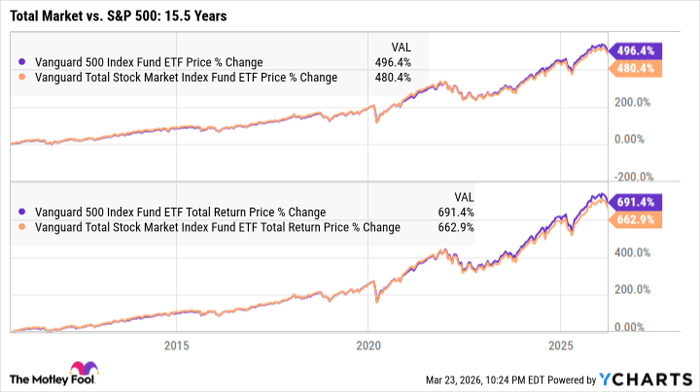
Data by YCharts.
Sure, that's still a minuscule spread. That's not the whole story, though. Holding more than 3,000 different stocks instead of roughly 500 doesn't automatically result in unbeatable stability, despite much broader diversification. The Total Market Index fund's drawdowns have been a tiny bit deeper than the S&P 500's in every market crisis since inception. Its volatility-tracking beta value is also (barely) higher, at 1.02 versus 1.01.
None of these drawbacks will make a significant difference to your long-term returns. Flip a coin, and you'll honestly be fine with either result. But you might as well just stick with the simpler, more well-known, and ultimately more profitable option, even when the differences are tiny.
So I'm not a raging grizzly bear, ripping the Total Market Index to shreds. I'm just a peaceful honey bear who prefers a slightly sweeter option. That would be the Vanguard S&P 500 ETF.
Should you buy stock in Vanguard Total Stock Market ETF right now?
Before you buy stock in Vanguard Total Stock Market ETF, consider this:
The Motley Fool Stock Advisor analyst team just identified what they believe are the 10 best stocks for investors to buy now… and Vanguard Total Stock Market ETF wasn’t one of them. The 10 stocks that made the cut could produce monster returns in the coming years.
Consider when Netflix made this list on December 17, 2004... if you invested $1,000 at the time of our recommendation, you’d have $497,659!* Or when Nvidia made this list on April 15, 2005... if you invested $1,000 at the time of our recommendation, you’d have $1,095,404!*
Now, it’s worth noting Stock Advisor’s total average return is 912% — a market-crushing outperformance compared to 185% for the S&P 500. Don't miss the latest top 10 list, available with Stock Advisor, and join an investing community built by individual investors for individual investors.
See the 10 stocks »
*Stock Advisor returns as of March 27, 2026.
Anders Bylund has positions in Alphabet, Amazon, Nvidia, and Vanguard S&P 500 ETF. Daniel Foelber has positions in Nvidia. The Motley Fool has positions in and recommends Alphabet, Amazon, Apple, Meta Platforms, Microsoft, Nvidia, Tesla, Vanguard S&P 500 ETF, and Vanguard Total Stock Market ETF and is short shares of Apple. The Motley Fool has a disclosure policy.
Recommended Articles


