




Recession Fears Are Back: Here Is Why That Should Not Change Your Strategy
Key Points
Investing during a recession isn't as risky as some people think.
Continuing to buy consistently can maximize your long-term earnings.
A well-diversified portfolio is key to surviving volatility.
- 10 stocks we like better than S&P 500 Index ›
Rising oil prices have rattled the markets, and more than 40% of Americans now believe we may be headed toward an "economic collapse" in the next decade, according to a March 2026 poll from YouGov.
It's important to clarify that there's no way to know for certain whether the U.S. will face a recession or a bear market in 2026. But the good news is that no matter what's coming for the market, it doesn't have to affect your investing strategy. Here's why.
Will AI create the world's first trillionaire? Our team just released a report on the one little-known company, called an "Indispensable Monopoly" providing the critical technology Nvidia and Intel both need. Continue »
Image source: Getty Images.
The hidden advantage of investing during a recession
Investing during periods of volatility can be unnerving, and nobody likes watching a portfolio sink as stock prices plunge. However, while it may sound counterintuitive, recessions are among the best times to invest.
Save for the nine-month bear market in 2022 and a few corrections here and there, the market has been consistently reaching new highs for more than a decade. That's not a bad thing, but it does make it an incredibly expensive time to buy.
The S&P 500 (SNPINDEX: ^GSPC) has dipped by close to 5% so far this year, as of this writing. Some investors may see that as a negative, but optimists view it as a chance to buy an S&P 500 index fund or ETF for 5% off. Some individual stocks have seen their prices drop by 10%, 20%, or more in recent months, offering even deeper discounts for investors.
Will you lose money by investing right now?
On the surface, it may not make much sense to buy into the market when stock prices are falling. But keep in mind that the market's long-term performance is far more important than its short-term ups and downs.
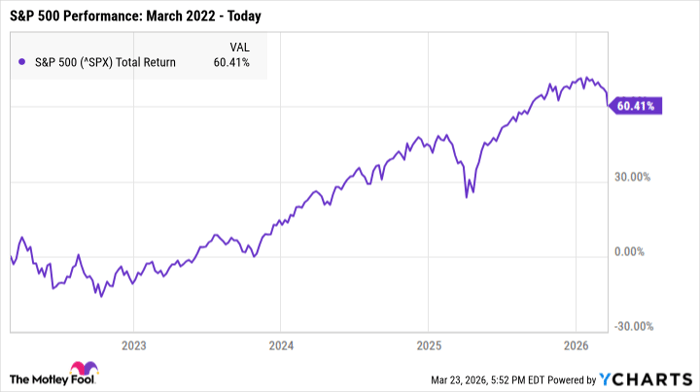
For example, say you had invested in an S&P 500 index fund in March 2022. The market was already about two months into a bear market that would last most of that year, and many investors feared we were headed toward a full-blown recession by 2023. By today, though, you'd have earned total returns of just over 60%.
^SPX data by YCharts
This is a trend history has repeated over and over, and the longer your time frame, the better your chances of earning positive total returns despite short-term volatility.
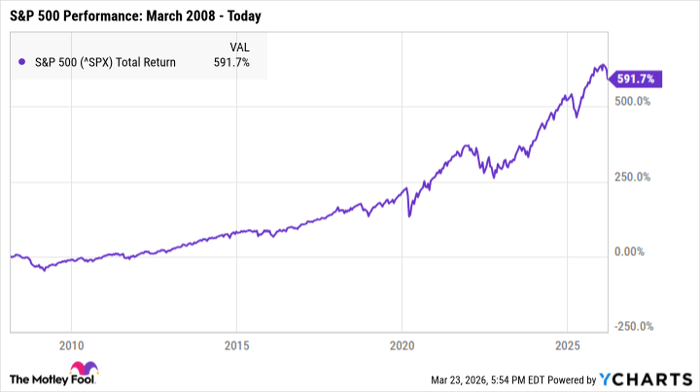
Say you'd invested in an S&P 500 index fund in March 2008, for instance. The Great Recession officially began in December 2007 and would last until mid-2009. Your investment would have taken a significant hit throughout the rest of 2008, but by today, you'd have earned total returns of nearly 600%.
^SPX data by YCharts
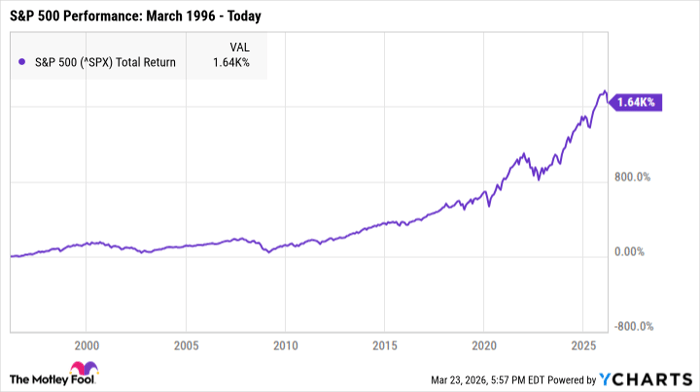
And what if you'd started investing 30 years ago in March 1996? Since then, the market has experienced the dot-com bubble and resulting bear market, the Great Recession, the COVID-19 crash, and plenty of smaller corrections along the way.
Despite all that volatility, the S&P 500 has delivered total returns of more than 1,600% over that period.
^SPX data by YCharts
Recessions can take a toll on your portfolio in the near term, but even the most severe downturns generally last for only a year or two. For long-term investors, that's a blip on the radar and shouldn't change your overall strategy.
How to prepare for a recession
While you don't need to stop investing during a recession, it is wise to ensure your portfolio is well-prepared to weather volatility.
A properly diversified portfolio is key to surviving a bear market or recession. If all of your money is tied up in four or five stocks and even one of them crashes hard, it could wreck your entire portfolio. Similarly, if you're investing in dozens of stocks but they're all from the same industry, your portfolio could be in trouble if that sector stumbles.
Investing in at least 25 stocks from a variety of industries can better protect against risk. For even simpler diversification, you could buy a single broad market fund -- such as an S&P 500 index fund or ETF -- to invest in hundreds or even thousands of stocks at once.
Finally, it's crucial to ensure you're investing only in strong stocks and funds. Stocks that are more hype than substance will struggle to pull through tough economic times, while healthy companies with strong foundations are more likely to thrive despite volatility.
Recessions are daunting, and it's tempting to pull back right now. However, by continuing to invest consistently, you can set yourself up for potentially lucrative long-term gains.
Should you buy stock in S&P 500 Index right now?
Before you buy stock in S&P 500 Index, consider this:
The Motley Fool Stock Advisor analyst team just identified what they believe are the 10 best stocks for investors to buy now… and S&P 500 Index wasn’t one of them. The 10 stocks that made the cut could produce monster returns in the coming years.
Consider when Netflix made this list on December 17, 2004... if you invested $1,000 at the time of our recommendation, you’d have $503,592!* Or when Nvidia made this list on April 15, 2005... if you invested $1,000 at the time of our recommendation, you’d have $1,076,767!*
Now, it’s worth noting Stock Advisor’s total average return is 913% — a market-crushing outperformance compared to 185% for the S&P 500. Don't miss the latest top 10 list, available with Stock Advisor, and join an investing community built by individual investors for individual investors.
See the 10 stocks »
*Stock Advisor returns as of March 25, 2026.
Katie Brockman has no position in any of the stocks mentioned. The Motley Fool has no position in any of the stocks mentioned. The Motley Fool has a disclosure policy.
Recommended Articles


