




Amazon Stock: Time to Bail or Time to Buy?
Key Points
Amazon is investing heavily to capture the growing demand for AI infrastructure services.
It should be able to grow revenue steadily over the next decade, along with rising profit margins.
The stock looks cheap and a good value for any investor buying today with a time horizon of a decade.
- 10 stocks we like better than Amazon ›
The S&P 500 index is still close to all-time highs, despite current geopolitical upheaval. However, under the hood, there has been significant pain for investors not invested in the hottest artificial intelligence (AI) stocks over the last few years. Even Amazon (NASDAQ: AMZN) has significantly underperformed the index over the last five years, despite benefiting from the AI boom.
With the stock stuck around $200 -- close to where it traded in 2021 -- investors are likely growing impatient with the e-commerce and cloud computing giant. Is it time to bail on Amazon? Or is now the perfect time to buy the stock for your portfolio?
Will AI create the world's first trillionaire? Our team just released a report on the one little-known company, called an "Indispensable Monopoly" providing the critical technology Nvidia and Intel both need. Continue »
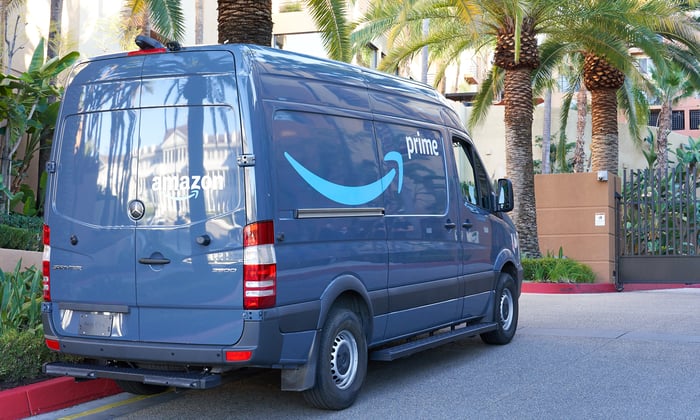
Image source: Amazon.
Tremendous AI demand, margin expansion
AI demand has lifted all players in the cloud computing space, including Amazon. Amazon Web Services (AWS) saw 24% revenue growth last quarter and will likely see accelerating growth in the year ahead. Over the next decade, Amazon management believes AWS can grow from $129 billion in revenue to $600 billion by 2036, an impressive feat for the massive infrastructure player.
Investors are nervous about Amazon's heavy investments that are hurting cash flow today. However, these have historically led to strong returns on investment and should help Amazon's earnings grow significantly in the years ahead.
What's more, Amazon's retail division is running smoothly right now. It grew revenue by 10% year over year in North America last quarter and has profit margins of 6.9% over the last 12 months, with plenty of room for continued expansion. Advertising revenue, third-party seller services, and subscriptions are growing quickly, with all three offering high margins that should improve Amazon retail's overall profit picture.
Is the stock cheap?
Combining the margin expansion story with the massive revenue opportunity at AWS, it becomes clear that Amazon has a nice earnings growth story for the next decade. AWS is becoming a larger piece of the pie and has fantastic operating margins of 35%, which are much better than the retail division.
Revenue of $638 billion last year could grow to $1 trillion or more within a few years' time, with plenty of room to expand to an even larger base over the next decade. Right now, Amazon's consolidated operating margin is 11.8%, a record high. If that figure can expand to 15% while revenue grows to $1 trillion, Amazon will be generating $150 billion in operating earnings a few years down the line.
Given its market capitalization of $2.2 trillion, Amazon's stock looks like a good value. Stay patient with this stock; long-term investors will be rewarded by holding Amazon over the next decade.
Should you buy stock in Amazon right now?
Before you buy stock in Amazon, consider this:
The Motley Fool Stock Advisor analyst team just identified what they believe are the 10 best stocks for investors to buy now… and Amazon wasn’t one of them. The 10 stocks that made the cut could produce monster returns in the coming years.
Consider when Netflix made this list on December 17, 2004... if you invested $1,000 at the time of our recommendation, you’d have $503,592!* Or when Nvidia made this list on April 15, 2005... if you invested $1,000 at the time of our recommendation, you’d have $1,076,767!*
Now, it’s worth noting Stock Advisor’s total average return is 913% — a market-crushing outperformance compared to 185% for the S&P 500. Don't miss the latest top 10 list, available with Stock Advisor, and join an investing community built by individual investors for individual investors.
See the 10 stocks »
*Stock Advisor returns as of March 25, 2026.
Brett Schafer has no position in any of the stocks mentioned. The Motley Fool has positions in and recommends Amazon. The Motley Fool has a disclosure policy.
Recommended Articles


