




Here's How Micron Technology, Nvidia, and AMD Could Help This Unstoppable ETF Turn $250,000 Into $1 Million in 10 Years
Key Points
The iShares Semiconductor ETF holds 30 of the world's top semiconductor stocks, and it has averaged returns of 30% per year over the last decade.
Its largest holdings include Micron, Nvidia, and Advanced Micro Devices, which are three of the most important suppliers of AI chips and components.
The iShares Semiconductor ETF could turn $250,000 into $1 million over the next decade, even if its growth rate slows from here.
- 10 stocks we like better than iShares Trust - iShares Semiconductor ETF ›
Most artificial intelligence (AI) development happens inside large data centers, where vast numbers of advanced chips and networking components process mountains of information at a lightning-fast pace to train models.
Nvidia (NASDAQ: NVDA), Advanced Micro Devices (NASDAQ: AMD), and Micron Technology (NASDAQ: MU) are three of the most important suppliers of AI data center hardware. There's more demand for their wares than they can supply now, a condition that has been driving their revenues and their stock prices higher.
Will AI create the world's first trillionaire? Our team just released a report on the one little-known company, called an "Indispensable Monopoly" providing the critical technology Nvidia and Intel both need. Continue »
Those companies are three of the five largest holdings in the iShares Semiconductor ETF (NASDAQ: SOXX), which is an exchange-traded fund (ETF) that invests in 30 of the chip industry's top companies. It has delivered blistering returns over the last 10 years. Here's how it could turn an investment of $250,000 into $1 million over the next 10 years.
Image source: Getty Images.
Hardware is at the center of the AI boom
The iShares Semiconductor ETF exclusively invests in U.S.-listed companies that design, manufacture, and distribute chips and tech components, and many of those stand to benefit from the ongoing AI revolution.
Graphics processing units (GPUs) are the primary parallel processors used to power AI development. Nvidia's Blackwell GPUs have led the industry in processing power, but the company's next-generation Vera Rubin architecture, which will ship to customers in the second half of 2026, will deliver another leap forward in performance. AMD is one of Nvidia's closest competitors, and although its chips aren't as popular, it is slowly gaining market share.
Micron is one of the world's top suppliers of high-bandwidth memory (HBM), which needs to sit alongside GPUs in data centers to facilitate the rapid flow of information. Without access to enough rapidly accessible memory, GPUs handling data-heavy analysis workloads would have to repeatedly pause while waiting to receive more data. This would create a poor experience for anyone using AI chatbots or agents, which is why Micron's memory products are being deployed alongside both Nvidia and AMD chips.
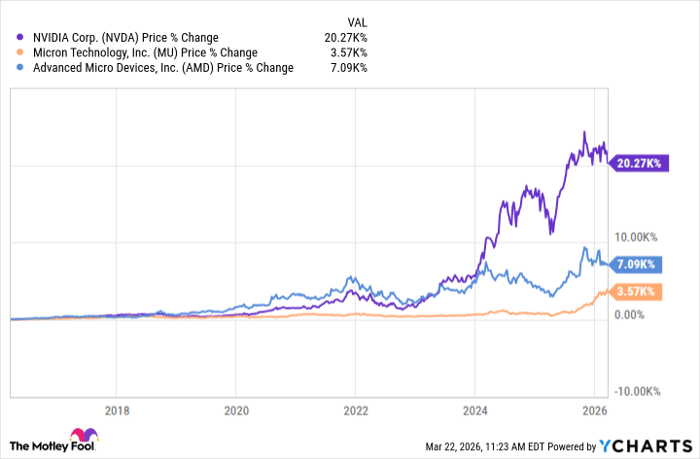
Nvidia, AMD, and Micron have delivered astonishing returns for their shareholders over the last 10 years. Micron was the worst performer of the three, yet investors who bought its stock a decade ago still would have booked a gain of 3,570% -- multiplying their original investment by almost 37 times. (And that doesn't even factor in the stock's dividend payouts, which admittedly, were fairly small.)
NVDA data by YCharts.
The three stocks have a combined weighting of 23.2% in the iShares Semiconductor ETF:
|
Stock |
iShares ETF Portfolio Weighting |
|---|---|
|
1. Micron Technology |
8.7% |
|
2. Nvidia |
8.2% |
|
3. Broadcom |
8.2% |
|
4. Advanced Micro Devices |
6.3% |
|
5. Applied Materials |
6.0% |
Data source: iShares. Portfolio weightings are accurate as of March 20, 2026, and are subject to change.
Turning $250,000 into $1 million over the next decade
The iShares Semiconductor ETF has generated a compound annual return of 12.8% since its inception in 2001 and an accelerated annualized return of 30.1% over the last 10 years. Semiconductor demand from companies in the cloud computing and AI industries has fueled a lot of its recent growth.
Here's how long it could take for the iShares ETF to turn an investment of $250,000 into $1 million, based on three different average annual returns:
|
Starting Balance |
Compound Annual Return |
Time to Reach $1 Million |
|---|---|---|
|
$250,000 |
12.8% |
12 Years |
|
$250,000 |
21.4% (midpoint) |
8 Years |
|
$250,000 |
30.1% |
6 Years |
Calculations by author.
It's unrealistic to expect any ETF to produce returns of over 30% per year indefinitely. Semiconductor and infrastructure spending is already at record levels because of AI, and even some of the industry's biggest customers are quickly burning through their cash flows and turning to debt financing to fund more hardware purchases -- which simply isn't sustainable over the long term.
With that said, Nvidia CEO Jensen Huang believes there is so much demand for computing capacity from AI developers that data center operators could be spending up to $4 trillion per year on infrastructure by 2030. If he's right, then it's certainly possible for the iShares ETF to continue delivering above-average returns for the foreseeable future.
The iShares Semiconductor ETF can still turn $250,000 into $1 million in under a decade if its average annual return falls to 21.4%. And it can help investors join the million-dollar club in around 12 years, even if its yearly return reverts to the long-term average of 12.8% -- but I think that type of deceleration is unlikely, because even after the AI infrastructure spending boom inevitably winds down, emerging industries like autonomous vehicles, robotics, and quantum computing could fuel a fresh wave of semiconductor spending.
Should you buy stock in iShares Trust - iShares Semiconductor ETF right now?
Before you buy stock in iShares Trust - iShares Semiconductor ETF, consider this:
The Motley Fool Stock Advisor analyst team just identified what they believe are the 10 best stocks for investors to buy now… and iShares Trust - iShares Semiconductor ETF wasn’t one of them. The 10 stocks that made the cut could produce monster returns in the coming years.
Consider when Netflix made this list on December 17, 2004... if you invested $1,000 at the time of our recommendation, you’d have $503,592!* Or when Nvidia made this list on April 15, 2005... if you invested $1,000 at the time of our recommendation, you’d have $1,076,767!*
Now, it’s worth noting Stock Advisor’s total average return is 913% — a market-crushing outperformance compared to 185% for the S&P 500. Don't miss the latest top 10 list, available with Stock Advisor, and join an investing community built by individual investors for individual investors.
See the 10 stocks »
*Stock Advisor returns as of March 25, 2026.
Anthony Di Pizio has no position in any of the stocks mentioned. The Motley Fool has positions in and recommends Advanced Micro Devices, Applied Materials, Micron Technology, Nvidia, and iShares Trust-iShares Semiconductor ETF. The Motley Fool recommends Broadcom. The Motley Fool has a disclosure policy.
Recommended Articles


