




The Fed Is Worried About Trump-Fueled Inflation. Are Your Stocks Safe?
Key Points
The Federal Reserve is concerned about tariffs and higher oil prices driving inflation higher.
The Fed faces a dilemma because economic growth has also slowed.
The safest stocks in this environment are energy stocks, utility stocks, consumer staples stocks, and some healthcare stocks.
- 10 stocks we like better than AbbVie ›
Inflation has been "boosted by tariffs," Federal Reserve Chairman Jerome Powell said in his press conference last week. However, he and the other Federal Open Market Committee (FOMC) members are uncertain how long it will take for tariffs to make their way through the economy.
Powell also stated that inflation has risen in recent weeks, likely due to "the substantial rise in oil prices caused by supply disruptions in the Middle East." He described the situation as an "oil shock." When asked whether this oil shock would be temporary, Powell replied, "Nobody knows."
Will AI create the world's first trillionaire? Our team just released a report on the one little-known company, called an "Indispensable Monopoly" providing the critical technology Nvidia and Intel both need. Continue »
The Fed chair never mentioned President Donald Trump by name. But he didn't have to. Most observers are aware that the president is the common denominator behind the factors driving inflation higher. Tariffs weren't nearly as much of an inflationary threat before Trump returned to the White House. Higher oil prices are the direct result of the attack on Iran authorized by the president.
The Fed is at least a little worried about Trump-fueled inflation. Is your stock portfolio safe?
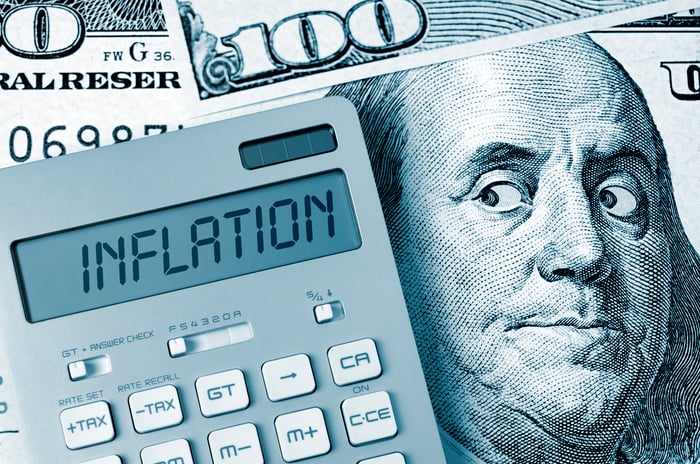
Image source: Getty Images.
The Fed's dilemma
Don't look to the Federal Reserve to easily get the economy and investors out of this jam. The reality is that the Fed faces a dilemma with the current dynamics.
Importantly, the Fed can't do much about tariff-driven inflation. Why? The inflation caused by tariffs isn't due to high demand for products and services. The Fed can raise interest rates to cool demand, but that approach simply doesn't work with tariff-driven inflation.
Skyrocketing oil prices complicate everything. Higher energy costs impact all sectors of the economy. The disruption of traffic through the Strait of Hormuz, therefore, is driving inflation higher across the board.
Sure, the Fed could raise interest rates to dampen demand and help keep inflation from getting out of control. However, there's another problem: economic growth is faltering. In February, U.S. GDP growth slowed to 1.4%, well below expectations. The Fed's job isn't only to contain inflation and stabilize prices; it also seeks to maximize employment. Rate hikes could further weaken the economy and reduce jobs.
Which stocks are most -- and least safe -- today?
Which stocks in your portfolio are most at risk in what could become a period of stagflation? Growth stocks with high valuations and minimal profits are probably near the top of the list. These stocks' valuations depend heavily on discounting future earnings. If interest rates are higher than expected, the present value of companies' future earnings will be lower -- causing their valuations to drop.
Consumer discretionary stocks are also at greater risk than most. When consumers tighten their purse strings, they cut back on discretionary spending first. Also, small-cap stocks tend to be more sensitive to economic slowdowns and interest rates.
The good news is that some types of stocks will likely be relatively safe (or at least safer) in a higher-inflation, lower-growth environment. The most obvious candidates are energy stocks that benefit from higher oil prices.
I think Chevron (NYSE: CVX) is an especially good pick. It's the world's third-largest energy company and the largest producer of natural gas in the U.S. Chevron also pays an attractive dividend. Quality dividend stocks could hold up better than most as investors seek stability.
Utility stocks are also usually safe havens for investors. Utilities generate dependable cash flow and are insulated from competition. They typically pay solid dividends.
While consumer discretionary stocks will probably be riskier, consumer staples stocks are likely to become more appealing to many investors. Walmart (NASDAQ: WMT), for example, could experience less volatility than most stocks. The company's low prices should ensure that customers continue shopping at its stores.
Many healthcare stocks also remain resilient during inflationary periods, especially those whose products are must-haves for patients. AbbVie (NYSE: ABBV) looks like a good healthcare stock to own. Patients will continue taking the drugmaker's therapies regardless of what happens with the economy. Like Walmart, AbbVie is also a Dividend King (stocks with at least 50 consecutive dividend increases).
Don't panic, but be prepared
To be sure, the Fed isn't panicking. Neither should you. However, it's important to be prepared in case higher inflation persists for longer than anyone wants.
Don't abandon stocks, but do be highly selective about which stocks you buy and hold. Review how exposed your portfolio is to inflation-sensitive sectors. Focus on stocks with durable demand, financial stability, and strong pricing power.
Should you buy stock in AbbVie right now?
Before you buy stock in AbbVie, consider this:
The Motley Fool Stock Advisor analyst team just identified what they believe are the 10 best stocks for investors to buy now… and AbbVie wasn’t one of them. The 10 stocks that made the cut could produce monster returns in the coming years.
Consider when Netflix made this list on December 17, 2004... if you invested $1,000 at the time of our recommendation, you’d have $503,592!* Or when Nvidia made this list on April 15, 2005... if you invested $1,000 at the time of our recommendation, you’d have $1,076,767!*
Now, it’s worth noting Stock Advisor’s total average return is 913% — a market-crushing outperformance compared to 185% for the S&P 500. Don't miss the latest top 10 list, available with Stock Advisor, and join an investing community built by individual investors for individual investors.
See the 10 stocks »
*Stock Advisor returns as of March 25, 2026.
Keith Speights has positions in AbbVie and Chevron. The Motley Fool has positions in and recommends AbbVie, Chevron, and Walmart. The Motley Fool has a disclosure policy.
Recommended Articles


