




How Trump Accidentally Killed the Resurrected Chevy Bolt Before It Even Got Rolling
Key Points
Trump's administration made significant changes to emissions policy, EV tax credits, and automotive tariffs.
Losing the tax credit diminished the Chevrolet Bolt's value to GM.
Without the Bolt, GM must find a new model to connect with new GM consumers.
- 10 stocks we like better than General Motors ›
However you feel about President Donald Trump, there's no denying he certainly shook things up in the automotive industry. Trump adjusted the United States' vehicle emissions policy, giving automakers more freedom. He also ended the $7,500 federal electric vehicle (EV) tax credit and added new auto tariffs intended to protect domestic automakers from the Chinese expansion. It was an attempt to encourage manufacturing investment in the U.S. market.
Unfortunately, for some investors and/or fans of General Motors' (NYSE: GM) Chevrolet Bolt, the additional complications appear to have ended the Bolt's resurrection before it really got rolling. Here's what happened, and why it matters.
Will AI create the world's first trillionaire? Our team just released a report on the one little-known company, called an "Indispensable Monopoly" providing the critical technology Nvidia and Intel both need. Continue »
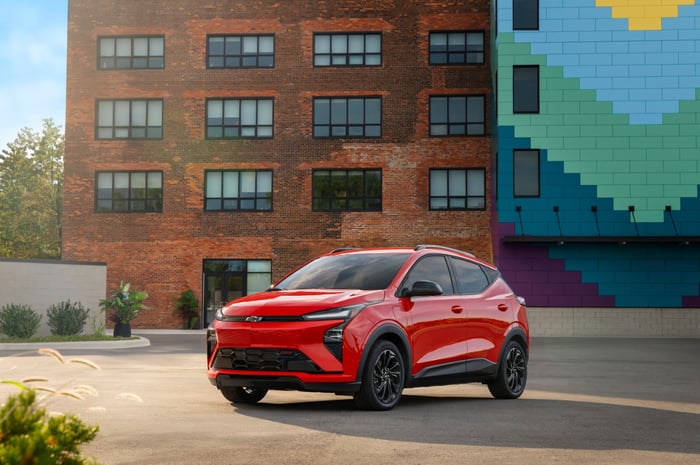
Image source: General Motors.
Roller coaster recap
GM's Chevy Bolt EV has one of the more intriguing histories of any model under the automaker's umbrella. GM CEO Mary Barra once lauded the Bolt as a "real game changer" in the EV industry and an "EV for everyone." When the Bolt hit the scene in 2016, the EV industry was still being reenergized, causing a bumpy start. After years of lackluster performance and a fire-related recall, the Bolt finally recorded a 50% sales surge in 2022, followed by selling a record 62,000 units in 2023 -- and then it was promptly discontinued.
Of course, as we know now, the Bolt was discontinued until it wasn't. Part of the reason behind GM refusing to entirely give up on the Bolt was that it accomplished a couple of valuable goals for the automaker. Firstly, the original Bolt EV checked in with a highly affordable price tag under $30,000, a mark EV makers are still aiming for to this day.
Secondly, the Bolt EV attracted new customers, known in the auto industry as "conquesting," which is an expensive task: 75% of Bolt owners formerly owned non-GM vehicles. Lastly, after the Bolt EV brought in new consumers to the brand, it made them loyal. About 72% of Bolt consumers stayed with GM brands for their next vehicle, and 56% stuck with Chevrolet specifically.
So, what happened?
Believing the Bolt could still be a valuable part of GM's broader EV strategy, the automaker saw an opportunity to make the second-generation Bolt at its Kansas City, Kansas, assembly plant, which began work last November. However, in large part due to changing policy, the Bolt's resurrection will be short-lived, with GM announcing it would be a "limited run" and some analysts predicting production could be phased out as soon as January.
"The car was developed to take advantage of the federal incentives, but once they went away, the Bolt wasn't worth GM's time and money," said Sam Fiorani, vice president of global vehicle forecasting at AutoForecast Solutions, according to Automotive News.
GM's revived Bolt was positioned to succeed where its previous form did, as well as where it didn't. While the previous generation struggled with profitability, the new version was anticipated to be profitable. With a price tag still under $30,000, it had a chance to continue bringing in new consumers and turning them loyal to GM. Ford was the No. 2 EV seller in the U.S. from 2021 to 2024, before being overtaken by Chevrolet.
It's important for GM's future EV endeavors and pipeline of consumers that the brand finds a new model to carry on what the Bolt accomplished, even if its revival was short-lived.
Should you buy stock in General Motors right now?
Before you buy stock in General Motors, consider this:
The Motley Fool Stock Advisor analyst team just identified what they believe are the 10 best stocks for investors to buy now… and General Motors wasn’t one of them. The 10 stocks that made the cut could produce monster returns in the coming years.
Consider when Netflix made this list on December 17, 2004... if you invested $1,000 at the time of our recommendation, you’d have $495,179!* Or when Nvidia made this list on April 15, 2005... if you invested $1,000 at the time of our recommendation, you’d have $1,058,743!*
Now, it’s worth noting Stock Advisor’s total average return is 898% — a market-crushing outperformance compared to 183% for the S&P 500. Don't miss the latest top 10 list, available with Stock Advisor, and join an investing community built by individual investors for individual investors.
See the 10 stocks »
*Stock Advisor returns as of March 23, 2026.
Daniel Miller has positions in General Motors. The Motley Fool recommends General Motors. The Motley Fool has a disclosure policy.
Recommended Articles


