




Palantir Has an $11.2 Billion Revenue Backlog, a $10 Billion Army Deal, and a 61% Growth Forecast. Is It a Buy for 2026?
Key Points
Palantir's Foundry, Gotham, and Apollo software platforms have been in high demand over the last few years.
2025 was a landmark year for the company, featuring billion-dollar contracts and record growth.
Trading at a P/E ratio of 241, Palantir stock appears expensive.
- 10 stocks we like better than Palantir Technologies ›
Artificial intelligence (AI) became the biggest trend on Wall Street a few years ago, and there has been no shortage of stocks riding its tailwinds. While some of these companies were deserving of the enthusiasm they have received, others have benefited more from meme-driven narratives rooted in AI hype.
Perhaps no other stock has become as controversial as Palantir Technologies (NASDAQ: PLTR) over the last three years. At the dawn of the AI revolution, it was valued at a modest $12 billion. Today, the company's market cap is closing in on $400 billion -- making it one of the largest enterprise software businesses in the world.
Will AI create the world's first trillionaire? Our team just released a report on the one little-known company, called an "Indispensable Monopoly" providing the critical technology Nvidia and Intel both need. Continue »
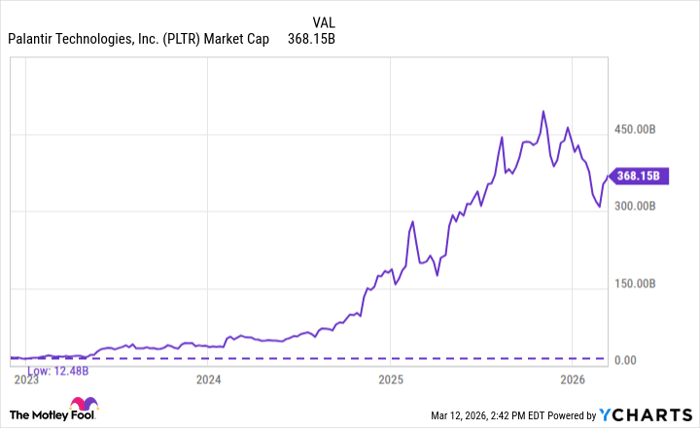
PLTR Market Cap data by YCharts.
Let's unpack Palantir's performance over the last few years. From there, I'll dive into the company's valuation profile to help assess if the company's premium is justified.
What Palantir does differently
Palantir is generally described as a specialist in data analytics. At a high level, that's not a unique function to offer. The software-as-a-service (SaaS) industry is riddled with tools that can plug into workflows and synthesize data into nicely formatted dashboards.
Here's the problem: Such dashboards are often backward-looking, or display information summarized in ways that make it challenging for leaders to get actionable insights out of it.
This is where Palantir differentiates itself. Through its Foundry platform, Palantir can build detailed ontologies for decision-makers. Ontologies are visualizations that illustrate an organization's data inputs at a granular level. What's even better is that these models can be tweaked in real time -- allowing clients to simulate specific changes or situations and see how they would impact the business and its customers.
This feature is making Palantir a mission-critical piece of infrastructure for companies across a variety of industries -- among them, health care, retail, manufacturing and logistics, financial services, energy, and defense operations.
Image source: Getty Images.
How has AI impacted Palantir's growth?
I like to use the public launch date of ChatGPT to mark the start of the AI revolution. OpenAI released its flagship model on Nov. 30, 2022. In that year, Palantir's revenue grew by 24% to $1.9 billion. Moreover, at the end of 2022, the company boasted 367 customers across its commercial and government sectors.
Fast-forward to 2025: Revenue grew by 56% year over year to $4.5 billion as the company's customer count reached 954.
While 2025 featured a number of high-profile deals, perhaps none was greater for the company than the contract it inked with the U.S. Army, which will be worth up to $10 billion over the next decade. Furthermore, per the company's 10-K filing, Palantir ended 2025 with $11.2 billion in total remaining performance obligations -- an increase of 105% year over year.
With growth of this magnitude in just a few short years, demand for Palantir's AI services has clearly been a transformative catalyst for the company.
Is Palantir stock a buy?
Given those figures, it's natural that growth investors would flock to Palantir stock. The question for investors today, however, is whether the shares have become overbought.
If you look at the company's valuation profile in isolation, you'd definitely think the stock is overpriced. After all, how can a company reasonably justify a price-to-sales (P/S) ratio of 87 and a price-to-earnings (P/E) multiple of 241? Even for a high-growth software stock, this seems excessive.
However, there is an important attribute to Palantir that should not be overlooked: The company's ontology approach makes it a category disruptor in the data analytics arena. What I mean by that is while rival offerings such as Snowflake Databricks or Microsoft Fabric are capable for storage infrastructure, they fall short when it comes to helping enterprises build end-to-end data operating systems.
This dynamic creates unique arbitrage opportunities for Palantir, which has demonstrated an ability to cross-sell its offerings to its clients. A customer may begin its relationship with the company by signing a deal to use Foundry, and then later expand into Gotham or Apollo (depending on the specific use case). Against this backdrop, Palantir has built a structural moat that virtually no other SaaS provider has been able to compete with at scale.
Considering the company's robust growth over the last few years, and management's guidance for that growth to further accelerate to 61% in 2026, I think Palantir stock is positioned to continue delivering market-beating gains over the next several years.
For this reason, Palantir could be seen as a compelling long-term buy for investors looking to build a durable AI-themed portfolio.
Should you buy stock in Palantir Technologies right now?
Before you buy stock in Palantir Technologies, consider this:
The Motley Fool Stock Advisor analyst team just identified what they believe are the 10 best stocks for investors to buy now… and Palantir Technologies wasn’t one of them. The 10 stocks that made the cut could produce monster returns in the coming years.
Consider when Netflix made this list on December 17, 2004... if you invested $1,000 at the time of our recommendation, you’d have $508,877!* Or when Nvidia made this list on April 15, 2005... if you invested $1,000 at the time of our recommendation, you’d have $1,115,328!*
Now, it’s worth noting Stock Advisor’s total average return is 936% — a market-crushing outperformance compared to 189% for the S&P 500. Don't miss the latest top 10 list, available with Stock Advisor, and join an investing community built by individual investors for individual investors.
See the 10 stocks »
*Stock Advisor returns as of March 18, 2026.
Adam Spatacco has positions in Microsoft and Palantir Technologies. The Motley Fool has positions in and recommends Microsoft, Palantir Technologies, and Snowflake. The Motley Fool has a disclosure policy.
Recommended Articles


