




Oracle Agrees That AI Is Challenging the SaaS Model. Here's Why Oracle Thinks It's the Disruptor, Not the Disrupted.
Key Points
Oracle is increasingly well positioned to benefit from AI through its infrastructure software segment and by embedding AI into its applications.
Oracle’s leverage adds risk to the investment thesis.
- 10 stocks we like better than Oracle ›
Software-as-a-service (SaaS) companies are being challenged by artificial intelligence (AI) models that can perform tasks previously dependent on enterprise software. And as AI-powered tools enable users to do more with less, enterprise clients may need fewer subscriptions, potentially slowing user growth for SaaS giants.
The sell-off in software companies has intensified in 2026, with many high-profile names from Salesforce to ServiceNow hitting multi-year lows.
Will AI create the world's first trillionaire? Our team just released a report on the one little-known company, called an "Indispensable Monopoly" providing the critical technology Nvidia and Intel both need. Continue »
Application software is a key part of Oracle's (NYSE: ORCL) business. But the company is now a major player in infrastructure software as well, with Oracle Cloud Infrastructure (OCI) on track to make up the vast majority of Oracle's revenue over the next few years.
Here's why Oracle believes it can thrive in the AI age, and whether the growth stock is a buy now.

Image source: Getty Images.
Oracle's bold bet comes at a high price
Oracle has transitioned from a software licensing business to a high-margin, subscription-based database and database management software company, to now a major player in cloud computing, with OCI building new, fast, and ultra-efficient data centers specifically engineered for high-performance computing and AI applications.
The numbers speak for themselves. In Oracle's latest quarter (third-quarter fiscal 2026), cloud infrastructure-as-a-service and SaaS revenue was $8.9 billion -- up 44% year over year. Cloud computing now makes up a little over half of Oracle's total revenue. And Oracle is forecasting total revenue to jump to $90 billion in fiscal 2027, up from an expected $67 billion in fiscal 2026.
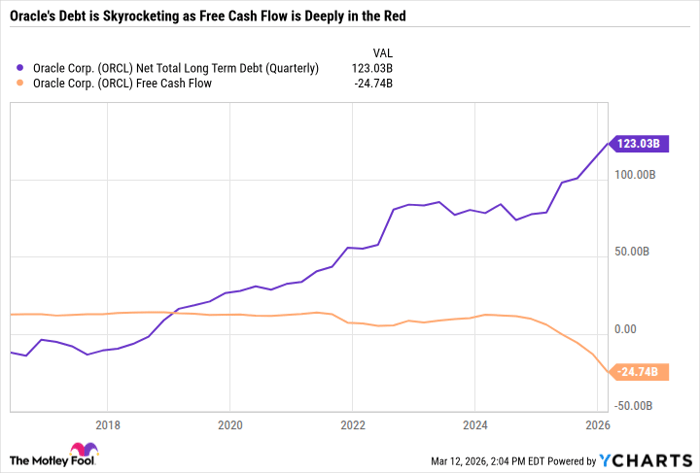
ORCL Net Total Long Term Debt (Quarterly) data by YCharts
Oracle's data center spending is reflected in its soaring capital expenditures (capex). But operating cash flow isn't growing nearly as quickly. As a result, Oracle's debt has exploded higher, especially in the last year, while free cash flow (FCF) has fallen off a cliff.
Oracle is so much more than just a software company
Oracle embeds AI agents into Oracle cloud applications, including enterprise resource management agents for payments and planning, human capital management agents for recruiting and career development, supply chain management agents for inventory and cost management, and more.
Oracle co-CEO Mike Sicilia said the following on the March 10 third-quarter fiscal 2026 earnings call:
So, yes, we think AI is disruptive -- we do -- but we think we are the disruptor because we are actually embedding the AI right into our applications, full stop, again at no additional cost. These are features that come in the application suite as part of quarterly upgrades, as part of a regular cadence. So I am actually -- rather than thinking that AI spells the death of SaaS, at least for Oracle Corporation -- I think it actually helps our SaaS position and helps us get to market even more quickly.
Oracle has an impeccable business model. Its combination of building cloud infrastructure on OCI and a highly differentiated SaaS model makes it well positioned to benefit from AI.
The risk to the investment thesis isn't AI, but rather whether Oracle's spending has gone too far and if it can return to positive FCF quickly enough to restore order to its balance sheet.
Investors who are comfortable with these risks may want to buy the stock, whereas others may want to wait for the game plan to play out.
Should you buy stock in Oracle right now?
Before you buy stock in Oracle, consider this:
The Motley Fool Stock Advisor analyst team just identified what they believe are the 10 best stocks for investors to buy now… and Oracle wasn’t one of them. The 10 stocks that made the cut could produce monster returns in the coming years.
Consider when Netflix made this list on December 17, 2004... if you invested $1,000 at the time of our recommendation, you’d have $508,877!* Or when Nvidia made this list on April 15, 2005... if you invested $1,000 at the time of our recommendation, you’d have $1,115,328!*
Now, it’s worth noting Stock Advisor’s total average return is 936% — a market-crushing outperformance compared to 189% for the S&P 500. Don't miss the latest top 10 list, available with Stock Advisor, and join an investing community built by individual investors for individual investors.
See the 10 stocks »
*Stock Advisor returns as of March 18, 2026.
Daniel Foelber has positions in Oracle and has the following options: short March 2026 $240 calls on Oracle. The Motley Fool has positions in and recommends Oracle, Salesforce, and ServiceNow. The Motley Fool has a disclosure policy.
Recommended Articles


