




BYD Just Announced 5-Minute EV Charging. Should Tesla Investors Be Concerned?
Key Points
EV owners are likely to jump at the chance to have a car that "fills up" as quickly as possible.
This makes Tesla's proprietary battery-making efforts vulnerable.
- 10 stocks we like better than BYD Company ›
Waiting around for an electric vehicle (EV) to charge can be irritating. But that irritation might have just been greatly reduced by Chinese EV and hybrid maker BYD (OTC: BYDDY). Earlier this month, it revealed its Blade Battery 2.0 and Flash Charging system. Used together, the company claims, they can bring a compatible vehicle from a 10% charge to 70% in roughly five minutes and from 20% to 97% in approximately 12.
This would suggest BYD has a game-changing EV product on its hands. Is it reasonable for Tesla (NASDAQ: TSLA) investors to be worried, and maybe even consider selling their stock?
Will AI create the world's first trillionaire? Our team just released a report on the one little-known company, called an "Indispensable Monopoly" providing the critical technology Nvidia and Intel both need. Continue »
BYD's charging aims to be quick as lightning
First, a note. Tesla and BYD are not direct competitors in the U.S., where the former is prominent and the latter is effectively unavailable. That's mainly because our government has slapped a 100% tariff on EVs built in the Asian country.
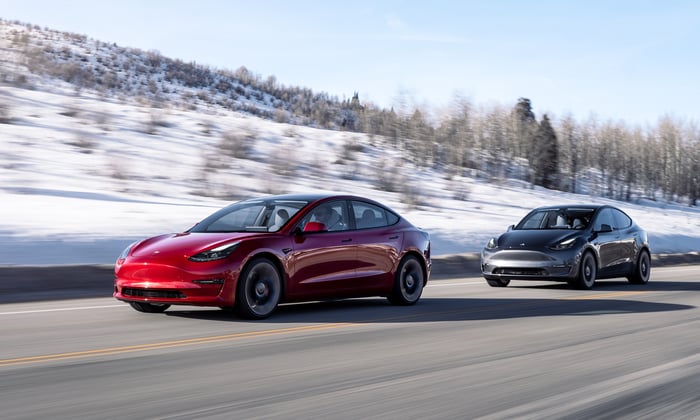
Image source: Tesla.
The two are actually collaborators in some respects. Like BYD, Tesla is working hard to develop its in-house battery unit, but its strategy differs substantially from its vertically integrated Chinese peer. The American auto maker manufactures some batteries in-house, supplementing them with products from outside manufacturers -- including BYD. All of BYD's cars, meanwhile, use BYD batteries.
Tesla's latest battery cell, the 4680, is extremely reliable and has a relatively long range when charged. Its charging time is slower than that of Blade Battery 2.0. However, in contrast to the 12 minutes it takes for BYD's power pack to charge from 10% to 97%, Tesla batteries need 20 to 25 minutes.
Will most EV owners prefer a battery that offers plenty of range, even if it means longer charging times? Or will they favor a lower-range product that charges more quickly and gets them on the road before they finish their takeout coffee?
It's got the power
I'd imagine the average consumer would go for No. 2. Americans, in particular, don't like to wait.
I think, then, Blade Battery 2.0 could be a meaningful threat to Tesla's battery-making efforts. But that's the catch; since Tesla is open to components from outside manufacturers, if a competing battery technology proves too competitively powerful, the company could try to adopt it (albeit at the expense of its vaunted Supercharger network). Tesla doesn't sell its batteries to others, so it doesn't have business to lose with such goods.
The threat might turn out to be more reputational. Assuming Blade Battery 2.0 does what BYD claims, the company's reputation as a cutting-edge EV maker will be enhanced. Already very competitive on price in the markets where it and Tesla square off, this could drain business from the U.S. company and boost BYD's share.
One item to note here: Infrastructure is currently a roadblock for Blade Battery 2.0 internationally. In China, BYD is building out a network of 1,500-kilowatt charging hubs needed for the product's fast charging. However, there are precious few in other markets, and such a build-out would cost time and capital.
So, if I were a Tesla investor, I wouldn't worry about BYD's battery putting a heavy zap on the company's business, at least not for some time. I'd be more concerned about Tesla's other headwinds; its clumsy pivot to more modestly priced models, for one, and the endless distractions of CEO Elon Musk at a time when managerial focus seems essential.
Should you buy stock in BYD Company right now?
Before you buy stock in BYD Company, consider this:
The Motley Fool Stock Advisor analyst team just identified what they believe are the 10 best stocks for investors to buy now… and BYD Company wasn’t one of them. The 10 stocks that made the cut could produce monster returns in the coming years.
Consider when Netflix made this list on December 17, 2004... if you invested $1,000 at the time of our recommendation, you’d have $514,000!* Or when Nvidia made this list on April 15, 2005... if you invested $1,000 at the time of our recommendation, you’d have $1,105,029!*
Now, it’s worth noting Stock Advisor’s total average return is 930% — a market-crushing outperformance compared to 187% for the S&P 500. Don't miss the latest top 10 list, available with Stock Advisor, and join an investing community built by individual investors for individual investors.
See the 10 stocks »
*Stock Advisor returns as of March 14, 2026.
Eric Volkman has no position in any of the stocks mentioned. The Motley Fool has positions in and recommends Tesla. The Motley Fool recommends BYD Company. The Motley Fool has a disclosure policy.
Recommended Articles


