




What Are the Chances of a U.S. Recession in 2026?
Key Points
While hard to determine with any certainty, the odds were higher after oil spiked last weekend.
If the Strait of Hormuz remains blocked, the odds of an economic downturn will certainly grow.
- These 10 stocks could mint the next wave of millionaires ›
With the ongoing war in the Middle East and the price of oil elevated -- Brent crude touched $120 last weekend before retreating to around $87 in recent days, still far above the $71 level it was at before the war began -- there are suddenly murmurings about the possibility of a recession this year.
And for good reason. According to the Federal Reserve, "nearly all post-World War II recessions in the United States were preceded by, or accompanied by, a sharp increase in energy prices relative to the aggregate price level."
Will AI create the world's first trillionaire? Our team just released a report on the one little-known company, called an "Indispensable Monopoly" providing the critical technology Nvidia and Intel both need. Continue »
Why? Well, higher oil prices have historically been the most important energy source for industrialized economies like the United States. Oil also goes into other products like plastics and fertilizer, among many other manufactured goods.
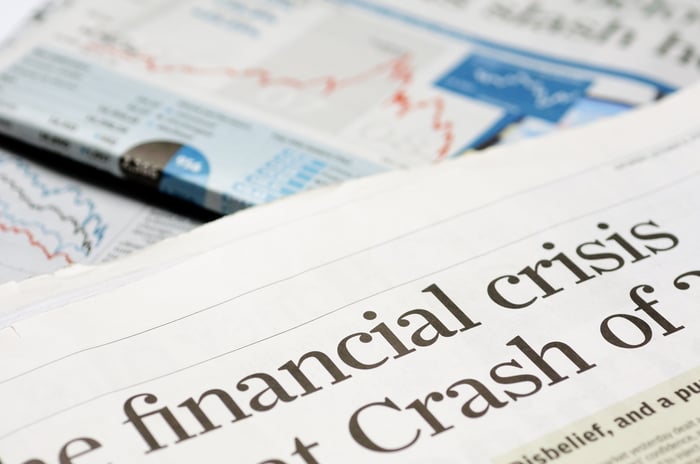
Image source: Getty Images.
But the U.S. economy is much better positioned today to withstand the body blows of sharply higher oil prices than it was in the past. In 2018, the U.S. became a net exporter of oil for the first time in decades. So it is no longer as dependent on oil imports from the Middle East and other oil-rich regions of the globe. Also, rising productivity over the years means the U.S. economy can produce the same or more output with less energy.
Still, oil is priced at the global level, so a surge in global energy prices won't spare the U.S., meaning people will still pay more at the gas pump, and they'll have less money to spend on other items. And consumer spending accounts for about two-thirds of GDP.
The odds of a recession remain low but are rising
So what are the chances of a recession this year? Polymarket, the world's largest prediction market, currently puts the chances of a recession at 29%. That's down from the 37% chance it assigned to recession on March 8, when the oil price was above $100 a barrel.
But it's still significantly higher than the 21% level just before the war began on Feb. 27. And it will likely move higher again if the Strait of Hormuz, through which flows about 20% of the world's oil, remains close for an extended period.
And will we know a recession when we see it? Well, a recession is generally defined as two consecutive quarters of negative economic growth, and technically a recession is identified and dated by the National Bureau of Economic Research (NBER), which uses multiple factors beyond GDP growth to determine a recession. So, often a recession is not declared until well after it begins.
Still, if the economy begins to contract, people will feel it via layoffs and lost income and business, as consumers and businesses begin to tighten their belts and layoffs rise. The U.S. economy is large, resilient, and relatively closed -- i.e., it is less exposed to international trade than other nations. All that said, investors should hope for a quick resolution to the current conflict.
Where to invest $1,000 right now
When our analyst team has a stock tip, it can pay to listen. After all, Stock Advisor’s total average return is 933%* — a market-crushing outperformance compared to 188% for the S&P 500.
They just revealed what they believe are the 10 best stocks for investors to buy right now, available when you join Stock Advisor.
See the stocks »
*Stock Advisor returns as of March 13, 2026.
The Motley Fool has a disclosure policy.
Recommended Articles


