




Claiming Social Security at 62? How to Know If the Math Works for You.
Key Points
Filing for Social Security at 62 will reduce your payments by up to 30%.
For many retirees, that results in a reduction of hundreds of dollars per month.
Before you file, it's wise to consider how claiming early will affect your finances.
- The $23,760 Social Security bonus most retirees completely overlook ›
The age you begin taking Social Security will have a profound effect on your retirement, sometimes influencing your benefit amount by hundreds of dollars per month.
The average retiree collects roughly $2,000 per month in benefits, but the earlier you file, the less you'll receive. Here's how to determine whether claiming at 62 is right for your retirement.
Will AI create the world's first trillionaire? Our team just released a report on the one little-known company, called an "Indispensable Monopoly" providing the critical technology Nvidia and Intel both need. Continue »
How your age affects your benefit amount
Your benefit amount is based on three main factors: the length of your career, your lifetime earnings, and the age you begin claiming Social Security.
To receive the full benefit you're entitled to based on your work history, you'll need to file at your full retirement age (FRA). Your FRA will depend on your birth year, but it's between ages 66 and 67 for everyone.
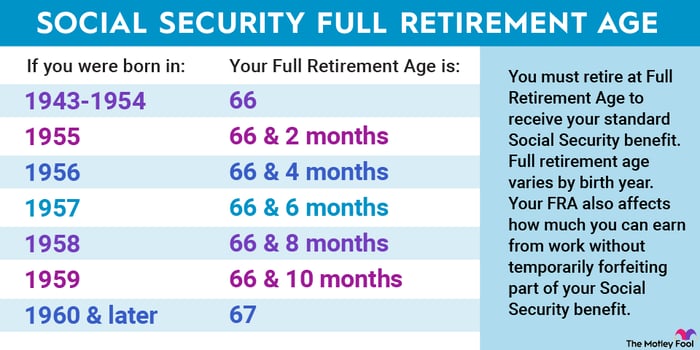
Image source: The Motley Fool.
The earlier you file, the smaller your monthly payments will be. Filing at age 62 will reduce your benefits by 30% if you have an FRA of 67. These reductions are permanent, too, so expect to receive smaller checks for the rest of your life if you file early.
According to data from the Social Security Administration, the average retiree collects around $592 more per month at age 67 than at 62. At age 70, that difference jumps to $851 per month.
| Age | Average Monthly Benefit Among Retired Workers |
|---|---|
| 62 | $1,424 |
| 63 | $1,436 |
| 64 | $1,478 |
| 65 | $1,607 |
| 66 | $1,807 |
| 67 | $2,016 |
| 68 | $2,052 |
| 69 | $2,097 |
| 70 | $2,275 |
Data source: Social Security Administration. Table by author.
This doesn't necessarily mean that claiming early is wrong, as your filing decision will depend on your unique situation. However, finances will be a major factor to consider, as your claiming age can have an enormous impact on your monthly income.
Is claiming at 62 right for you?
If you're considering filing as early as possible at age 62, you'll likely need a hefty nest egg to make up for the smaller monthly payments. Social Security was only designed to replace around 40% of pre-retirement income, so ideally, it shouldn't be your primary income source.
For many older adults, though, that's a struggle. Nearly 30% of retirees rely on their benefits as their only source of income, according to The Motley Fool's annual Social Security Cost-of-Living Adjustment Survey. In addition, around 54% of retirees report having to return to work because Social Security isn't enough to fund their retirement.
There's also a possibility that benefit cuts could be coming. According to the Social Security Board of Trustees' latest estimates, the program's trust funds are expected to run out by 2034. At that point, Social Security's income sources will only be enough to cover around 81% of scheduled benefits, meaning payments could be slashed by nearly 20% in the next decade if nothing changes.
If you can swing it financially, claiming early can give you a head start on early retirement. But if you're going to be relying heavily on Social Security to make ends meet, make sure you know how filing at 62 will affect the size of your checks.
The $23,760 Social Security bonus most retirees completely overlook
If you're like most Americans, you're a few years (or more) behind on your retirement savings. But a handful of little-known "Social Security secrets" could help ensure a boost in your retirement income.
One easy trick could pay you as much as $23,760 more... each year! Once you learn how to maximize your Social Security benefits, we think you could retire confidently with the peace of mind we're all after. Join Stock Advisor to learn more about these strategies.
View the "Social Security secrets" »
The Motley Fool has a disclosure policy.
Recommended Articles


