




Prediction: The Trump Bull Market Will Soon End -- and More Than 150 Years of Historical Precedent Explains Why
Key Points
The Dow Jones Industrial Average, S&P 500, and Nasdaq Composite have thrived under President Trump, with the Dow and S&P 500 generating outsize annualized returns, relative to most other presidents over the last century.
Although Wall Street's bull market rally isn't entirely attributable to Donald Trump, his tax and spending laws have had a decisive impact on share buyback activity.
This is the second-priciest stock market since 1871 -- and that means only one thing, based on what history teaches us.
- 10 stocks we like better than S&P 500 Index ›
From a numbers perspective, Wall Street is booming with President Donald Trump in the White House. During his first, non-consecutive term (Jan. 20, 2017 – Jan. 20, 2021), the ageless Dow Jones Industrial Average (DJINDICES: ^DJI), broad-based S&P 500 (SNPINDEX: ^GSPC), and growth stock-dependent Nasdaq Composite (NASDAQINDEX: ^IXIC) rallied 57%, 70%, and 142%, respectively.
Since Trump's second term started on Jan. 20, 2025, it's been more of the same. Through the closing bell on March 2, the Dow, S&P 500, and Nasdaq Composite have, respectively, gained 12%, 15%, and 16%.
Will AI create the world's first trillionaire? Our team just released a report on the one little-known company, called an "Indispensable Monopoly" providing the critical technology Nvidia and Intel both need. Continue »
While most presidents see the stock market advance during their term in the Oval Office, the annualized return for Wall Street's major stock indexes under Trump has been among the best of any president, looking back more than a century. But at the same time, when things seem too good to be true for the stock market, they often are.

President Trump delivering a speech. Image source: Official White House Photo.
Although plenty of catalysts may still give the Trump bull market legs, more than 150 years of historical precedent point to the high likelihood of this bull market ending sooner, rather than later.
The stock market is hitting all-time highs under Donald Trump
Before digging into the time-tested headwind that can upend the Trump bull market rally, we first need to lay the foundation for how the Dow Jones Industrial Average, S&P 500, and Nasdaq Composite reached their all-time highs.
To begin with, not every upside catalyst on Wall Street is related to President Trump. For instance, the rise of artificial intelligence (AI) and the advent of quantum computing are, arguably, the hottest stock market trends.
Analysts at PwC believe AI can create $15.7 trillion in global economic value by 2030, while Boston Consulting Group is looking for quantum computers to add $450 billion to $850 billion to worldwide economic value come 2040. These are high-ceiling addressable markets that tend to get investors excited.
The bull market rally is also being fueled by the Federal Reserve's ongoing rate-easing cycle. Federal Open Market Committee decisions that set the federal funds target rate are made independently of the president.
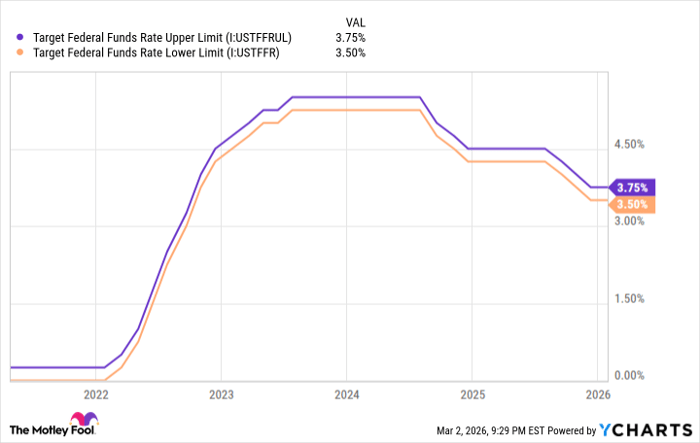
Target Federal Funds Rate Upper Limit data by YCharts.
If the nation's central bank continues to lower interest rates, it should spur businesses to borrow, which can lead to an increase in hiring, acquisition activity, and capital spent on innovation. All of these factors tend to promote corporate earnings growth.
But there are identifiable factors of this rally that have President Trump's proverbial fingerprints on them. For example, Trump's flagship tax and spending law from his first term, the Tax Cuts and Jobs Act, permanently lowered the peak marginal corporate income tax rate from 35% to 21% -- the lowest level since 1939.
Public companies retaining more of their earnings have led to a decisive uptick in average quarterly share buybacks from S&P 500 companies. S&P Dow Jones Indices, a division of the more familiar S&P Global, projects that cumulative buybacks by S&P 500 companies topped $1 trillion in 2025. For companies with steady or growing net income, share repurchases can boost earnings per share (EPS) and make their stock more fundamentally attractive to value-seeking investors.

Image source: Getty Images.
More than 150 years of historical precedent can trump Trump's policies
Although there isn't a data point or predictive indicator that can pinpoint when the music will stop on Wall Street, some metrics and/or correlated events have exceptional track records of forecasting the future over several decades... or perhaps more than a century.
Based solely on historical precedent, none of the president's tax and spending laws, including his seemingly ever-changing tariff and trade policy, will be able to stop the Trump bull market from ending -- and stock valuations show why.
Valuing individual stocks or the broader market is challenging. Since there isn't a one-size-fits-all approach to evaluating businesses or the stock market, there's often a wide variance of opinion regarding what constitutes "value." This is a big reason why short-term directional moves in the Dow, S&P 500, and Nasdaq Composite are so unpredictable.
However, one valuation-based metric that's been back-tested over 155 years points to an inevitable conclusion to the Trump bull market. Meet the Shiller Price-to-Earnings (P/E) Ratio, also known as the Cyclically Adjusted P/E Ratio (CAPE Ratio).
Whereas the most common valuation tool, the P/E ratio, accounts for 12 months of trailing EPS history, the Shiller P/E is based on average, inflation-adjusted EPS from the previous 10 years. Using an extensive, inflation-adjusted history of earnings ensures that shock events and recessions can't meaningfully skew the readings. The Shiller P/E provides the closest thing to an apples-to-apples valuation comparison of the S&P 500 that investors can get.
S&P 500 Shiller PE Ratio hits 2nd highest level in history 🚨 The highest was the Dot Com Bubble 🤯 pic.twitter.com/Lx634H7xKa
-- Barchart (@Barchart) December 28, 2025
Since January 1871, the CAPE Ratio has averaged 17.34 -- though it's spent almost the entirety of the last 30 years above this mark, mainly due to lower interest rates and the internet breaking down information barriers that had existed for more than a century between Wall Street and Main Street.
On March 2, the Shiller P/E clocked in at 40.02, and it's spent the last four months bouncing between 39 and 41. History shows this to be the second-priciest stock market, behind only the dot-com bubble.
What history teaches investors is that periods of extended valuation premiums aren't sustainable. There have been only six instances in 155 years where the CAPE Ratio has exceeded 30, and the previous five occurrences were all eventually followed by significant declines in the Dow Jones Industrial Average, S&P 500, and Nasdaq Composite.
But there's a catch with the Shiller P/E: it's not a timing tool. Though it can help guestimate how far Wall Street's major stock indexes will eventually fall -- the S&P 500 would be expected to drop at least 33% from its high -- it doesn't offer any clues as to the precise timeline of when a stock market correction, bear market, or crash could take shape.
Nevertheless, this valuation tool has a flawless track record of foreshadowing eventual trouble on Wall Street. Historical precedent doesn't mince words: the Trump bull market is running on borrowed time.
Should you buy stock in S&P 500 Index right now?
Before you buy stock in S&P 500 Index, consider this:
The Motley Fool Stock Advisor analyst team just identified what they believe are the 10 best stocks for investors to buy now… and S&P 500 Index wasn’t one of them. The 10 stocks that made the cut could produce monster returns in the coming years.
Consider when Netflix made this list on December 17, 2004... if you invested $1,000 at the time of our recommendation, you’d have $534,008!* Or when Nvidia made this list on April 15, 2005... if you invested $1,000 at the time of our recommendation, you’d have $1,090,073!*
Now, it’s worth noting Stock Advisor’s total average return is 949% — a market-crushing outperformance compared to 192% for the S&P 500. Don't miss the latest top 10 list, available with Stock Advisor, and join an investing community built by individual investors for individual investors.
See the 10 stocks »
*Stock Advisor returns as of March 8, 2026.
Sean Williams has no position in any of the stocks mentioned. The Motley Fool has positions in and recommends S&P Global. The Motley Fool has a disclosure policy.
Recommended Articles


