




Forget Polymarket: 1 AI Stock That's a Smarter Bet Than Any Prediction Market
Key Points
Polymarket is a platform that allows people to place bets on just about any topic.
Prediction markets are different than investing given their binary outcomes.
Owning blue chip stocks is a far superior method of generating durable wealth.
- 10 stocks we like better than Nvidia ›
Have you ever forgotten to buy something while you were out at the store? In today's world, that's not such a big deal -- after all, Amazon can have that item on your doorstep the next day. Or what about not wanting to cook once you get home because that "quick meeting" extended your time at the office? No worries, DoorDash can deliver a meal straight to your home.
People are becoming increasingly reliant on instant gratification. This concept is swiftly extending beyond consumer goods thanks to a company called Polymarket. This allows users to bet on just about anything -- from sports games to elections and even company product launches. As someone who has dabbled with Polymarket, I'll be the first to admit that the dopamine from winning a bet is awesome.
Will AI create the world's first trillionaire? Our team just released a report on the one little-known company, called an "Indispensable Monopoly" providing the critical technology Nvidia and Intel both need. Continue »
But does that mean rolling the dice is a sustainable method of making money in the long run? Let's dig into the key differences between steering your capital into a binary outcome platform such as Polymarket versus investing in a stock such as artificial intelligence (AI) chipmaker Nvidia (NASDAQ: NVDA).
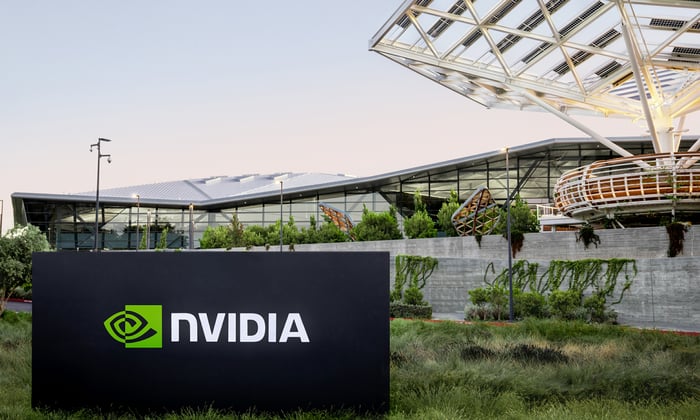
Image source: Nvidia.
Save the allure of binary betting for speculators
Polymarket has captured the attention of numerous demographics due to its focus on gamifying any topic. What most people don't think about before placing a bet, however, is that the outcome is always binary: You're either right or wrong. No partial credit.
While betting markets can serve as a way to gauge sentiment, gambling is a zero-sum game. This means that if your bet doesn't trigger, your capital is gone. Polymarket profits from the impulsive, all-or-nothing nature of short-term cycles and narrative-driven news.
For the average person, Polymarket is a fun source of entertainment. But for a smart investor, it's a giant diversion from the lucrative power of compounding stocks.
Nvidia beats a coin toss every time
Prediction markets tend to concentrate on the idea of who might emerge victorious in a certain situation. Nvidia has already demonstrated that it's a major victor of the AI revolution.
Nvidia's graphics processing units (GPUs) have become a fundamental backbone on which generative AI applications are built. Hyperscalers such as Alphabet, Amazon, Microsoft, and Meta Platforms all use Nvidia's platform. With investments in AI infrastructure accelerating, it's a near certainty that Nvidia will continue to witness robust demand for its Blackwell and upcoming Rubin chip architectures throughout 2026 and beyond.
While Nvidia's stock price will exhibit volatility on occasion, owning a position in the semiconductor leader directly ties you to a number of secular tailwinds fueling the AI revolution -- making it a buy-and-hold opportunity. By contrast, capital deployed on Polymarket carries zero value as soon as a specific outcome expires.
Use prediction markets for information, not wealth generation
While Polymarket isn't a bulletproof way to build generational wealth, that doesn't mean the platform is a complete waste of time. Polymarket was actually quite accurate in its ability to "predict" the outcome of Nvidia's latest earnings report.
In my eyes, smart investors can use Polymarket as something of a litmus test to assess where sentiment is moving over a certain topic that may be directly (or indirectly) tied to a stock you're monitoring.
For those seeking to build durable, long-term wealth, however, the choice is clear: A position in Nvidia represents a core pillar supporting where the world is moving thanks to breakthroughs in AI. Polymarket, on the other hand, is more of a speculative thrill about what could happen right now.
Should you buy stock in Nvidia right now?
Before you buy stock in Nvidia, consider this:
The Motley Fool Stock Advisor analyst team just identified what they believe are the 10 best stocks for investors to buy now… and Nvidia wasn’t one of them. The 10 stocks that made the cut could produce monster returns in the coming years.
Consider when Netflix made this list on December 17, 2004... if you invested $1,000 at the time of our recommendation, you’d have $534,008!* Or when Nvidia made this list on April 15, 2005... if you invested $1,000 at the time of our recommendation, you’d have $1,090,073!*
Now, it’s worth noting Stock Advisor’s total average return is 949% — a market-crushing outperformance compared to 192% for the S&P 500. Don't miss the latest top 10 list, available with Stock Advisor, and join an investing community built by individual investors for individual investors.
See the 10 stocks »
*Stock Advisor returns as of March 7, 2026.
Adam Spatacco has positions in Alphabet, Amazon, Meta Platforms, Microsoft, and Nvidia. The Motley Fool has positions in and recommends Alphabet, Amazon, DoorDash, Meta Platforms, Microsoft, and Nvidia. The Motley Fool has a disclosure policy.
Recommended Articles


