




Will the Iran War Cause a Stock Market Crash? Nine Decades of History Weigh In.
Key Points
Although the Dow Jones Industrial Average, S&P 500, and Nasdaq Composite have soared over long periods, short-term directional moves in these indexes are much harder to pinpoint.
While most major geopolitical events don't lead to a stock market crash, those involving constraints on oil supply are more likely to cause turbulence on Wall Street.
The nonlinear nature of economic cycles favors long-term optimism.
- 10 stocks we like better than S&P 500 Index ›
Over the long run, Wall Street is, arguably, the world's greatest wealth creator. The benchmark S&P 500 (SNPINDEX: ^GSPC) has never declined over any rolling 20-year period, while the Dow Jones Industrial Average (DJINDICES: ^DJI) and Nasdaq Composite (NASDAQINDEX: ^IXIC) have often rallied in lockstep with the S&P 500 to record-closing highs.
However, short-term directional moves in equities are far less certain -- especially when major geopolitical events are introduced into the equation.
Will AI create the world's first trillionaire? Our team just released a report on the one little-known company, called an "Indispensable Monopoly" providing the critical technology Nvidia and Intel both need. Continue »

Image source: Getty Images.
On Feb. 28, U.S. and Israeli forces commenced military operations against Iran, which has clearly roiled equity markets. The question on investors' minds is: Will the Iran war lead to a stock market crash?
While nothing can be said with concrete certainty, nine decades of history provide invaluable insight.
Major geopolitical events can create brief periods of panic in select situations
Over the previous nine decades, there has been no shortage of major geopolitical events, including wars, terrorist attacks, assassination attempts on world leaders, invasions, and financial crises. While many of these events resulted in emotion-driven trading and heightened short-term volatility, a stock market crash was uncommon.
But among these dozens of major geopolitical events, the one variable that has increased the probability of a stock market crash is oil. When global energy supply is disrupted or at risk of being constrained by a geopolitical event, we've been more likely to see a significant short-term swoon in stocks or even a brief stock market crash.
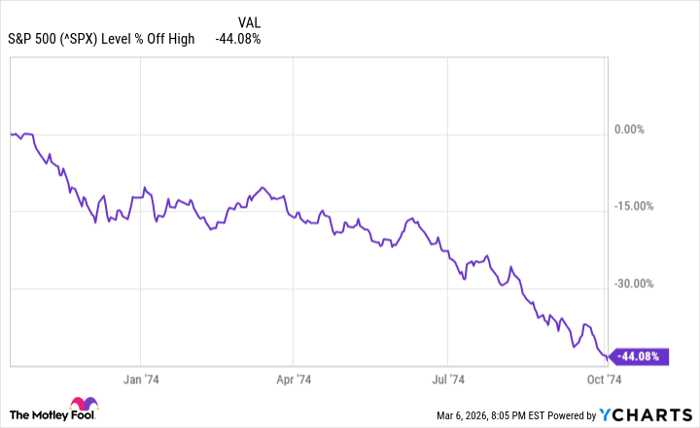
The five-month Oil Embargo of 1973 wreaked havoc on equity markets. ^SPX data by YCharts. Above chart from Oct. 16, 1973-Oct. 3, 1974.
For example, in the three weeks following Iraq's invasion of Kuwait in August 1990, the S&P 500 shed 13% of its value. In October 1973, when the Arab members of OPEC banned oil exports to select nations supporting Israel (the U.S. included), the S&P 500 lost 17% of its value in under two months, and plummeted by roughly 44% over 11.5 months.
When the supply of oil is constrained, its spot price can soar. In the wake of the Iran war commencing and the Strait of Hormuz closing to most oil exports, the spot price for West Texas Intermediate crude skyrocketed by 36% this week. Aside from increasing prices at the pump, higher oil prices are known to adversely affect hiring and compress margins across a variety of industries.
While nine decades of historical precedent don't guarantee anything, the probability of a crash event during the Iran war is higher than for most other geopolitical events.
The nonlinear nature of economic cycles favors long-term optimism
While history suggests turbulence is to be expected, decades of economic cycle data show how important it is for investors to maintain perspective.
Here's a list of major geopolitical events since WWII.
-- Ryan Detrick, CMT (@RyanDetrick) February 28, 2026
Up a median of 5% six months later. All of them felt really bad at the time. pic.twitter.com/Jb3QXL0L05
According to data compiled by Carson Group's Chief Market Strategist Ryan Detrick, the S&P 500 was higher 65% of the time one year after major geopolitical events began, since World War II. Although the average annual return of 3% was subpar, when compared to the stock market's long-term annualized return, optimism still prevailed more often than not.
What's more, data from Bespoke Investment Group shows that the average bear market (20% or greater) downturn in the S&P 500 has resolved in 286 calendar days since the start of the Great Depression (September 1929). Meanwhile, the typical S&P 500 bull market has lasted approximately 3.5 times longer (1,011 calendar days).
If a crash event does ensue from the Iran war, history implies it would be short-lived and a buying opportunity for opportunistic long-term investors.
Should you buy stock in S&P 500 Index right now?
Before you buy stock in S&P 500 Index, consider this:
The Motley Fool Stock Advisor analyst team just identified what they believe are the 10 best stocks for investors to buy now… and S&P 500 Index wasn’t one of them. The 10 stocks that made the cut could produce monster returns in the coming years.
Consider when Netflix made this list on December 17, 2004... if you invested $1,000 at the time of our recommendation, you’d have $534,817!* Or when Nvidia made this list on April 15, 2005... if you invested $1,000 at the time of our recommendation, you’d have $1,123,912!*
Now, it’s worth noting Stock Advisor’s total average return is 964% — a market-crushing outperformance compared to 192% for the S&P 500. Don't miss the latest top 10 list, available with Stock Advisor, and join an investing community built by individual investors for individual investors.
See the 10 stocks »
*Stock Advisor returns as of March 6, 2026.
Sean Williams has no position in any of the stocks mentioned. The Motley Fool has no position in any of the stocks mentioned. The Motley Fool has a disclosure policy.
Recommended Articles


