




2026 Evolution of Global Payment Industry Landscape: PayPal’s Defensive Transformation and the Rise of AI Agent Settlement Infrastructure
M&A Games Amid Valuation Inversion: The Asymmetric Competition Between Stripe and PayPal
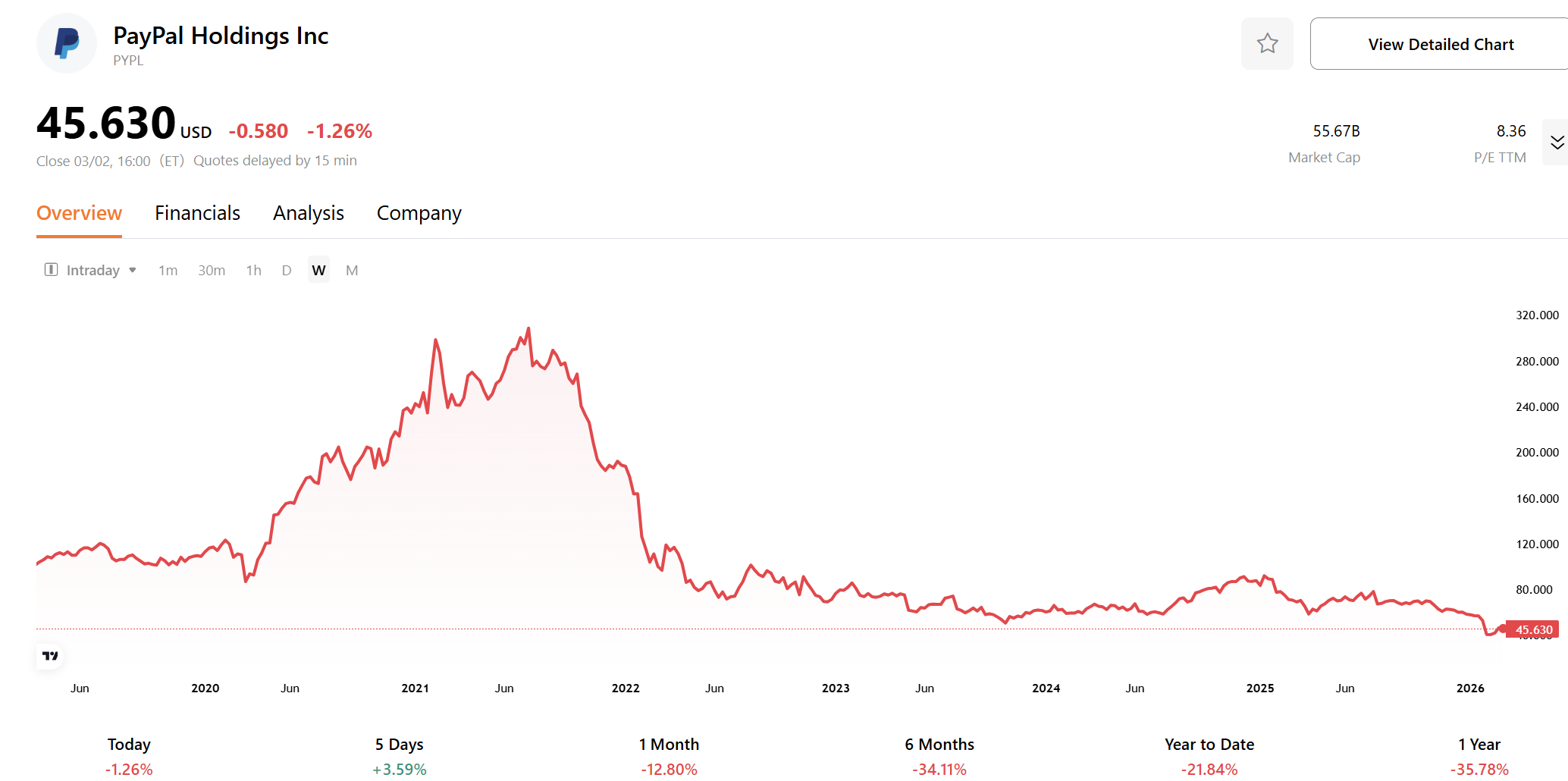
In the first quarter of 2026, a power shift capable of reshaping the industry landscape occurred in the global fintech sector. Rumors of payment giant Stripe’s intent to acquire PayPal caused significant tremors on Wall Street. While the news was initially interpreted as a mere M&A game, it conceals a deeper transfer of power over payment infrastructure and AI economic settlement rights. The essence of this asymmetric competition stems from the extreme valuation inversion within the industry.
Source: TradingKey
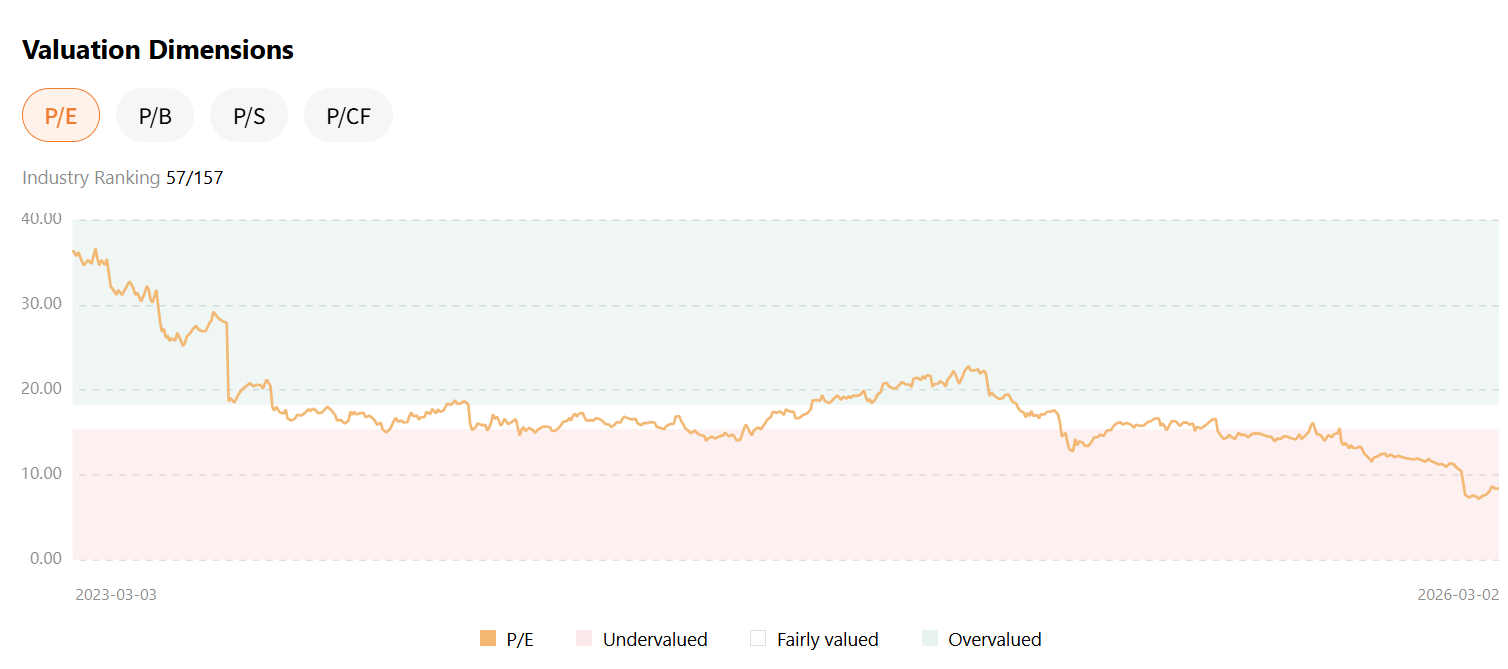
According to early 2026 market data, Stripe's valuation in its latest internal funding round climbed to $159 billion, while PayPal (PYPL), once the industry benchmark, saw its market capitalization linger at a low of $43 billion. This four-fold valuation gap not only reveals the lack of growth expectations for traditional payment platforms but also pushes PayPal to the brink of a defensive position. A Goldman Sachs industry brief noted that PayPal's current forward price-to-earnings (P/E) ratio of approximately 8.5x has broken below the lower bound of its historical valuation range, falling even lower than many stagnant traditional retail stocks. This "valuation trough" effect has directly triggered hostile takeover risks from activist investment funds, such as Elliott Management.
Source: TradingKey
Calculated via a Sum-of-the-Parts (SOTP) valuation model, the aggregate potential value of PayPal’s core assets, such as Venmo and Braintree, significantly exceeds the parent company's overall market capitalization. Therefore, PayPal's recent frequent engagements with investment banks are not for a "pursuit of sale" as speculated, but rather a typical defensive strategic maneuver. Management aims to prevent activist shareholders from forcibly spinning off Venmo by restructuring core assets or introducing strategic investors, thereby building a solid defensive barrier at historical stock price lows.
A Hardware Veteran Takes the Helm: Shifting from "Payment Buttons" to "AI Infrastructure"
Amid the fog of M&A rumors, PayPal officially completed its leadership transition on March 1, 2026, with former HP CEO Enrique Lores taking the reins. This appointment logically marks PayPal's resolute strategic pivot from the "software application layer" to the "digital infrastructure layer." Lores' deep background in hardware provides him with a unique perspective on managing complex supply chains and building high-stickiness subscription ecosystems. On the eve of the AI Agent explosion, what PayPal needs is no longer simple user interface optimization, but a "clearing engine" that is highly reliable, capable of high concurrency, and deeply integrated with the hardware layer.
According to PayPal’s published "Agentic Commerce" technical white paper, the underlying logic of the payment industry is shifting from "human-computer interaction" to "machine autonomous settlement." Gartner’s prediction model shows that by 2028, approximately 15% of global retail transactions will be autonomously decided and completed by AI Agents. This means that traditional payment incentives, such as credit card points or cashback agreements, will become completely obsolete in the face of machine logic. The core demand of the Machine-to-Machine Economy for payment media lies in only two dimensions: millisecond-level real-time settlement capability and fully programmable payment protocols.
This trend explains why PayPal is promoting its stablecoin, PYUSD, regardless of the cost. As a compliant USD token running on high-performance public chains (such as Solana or Ethereum Layer 2), PYUSD not only enables conditional payments through smart contracts but also reduces settlement costs to less than 1% of traditional payment channels. The core of PayPal's transformation lies in achieving a dimensionality reduction strike against traditional credit card networks and bank transfer systems by building a machine-oriented central clearing system.
Tangible Evidence of Trillion-Dollar Settlements: Circle’s Earnings Reveal the Machine Economy Explosion
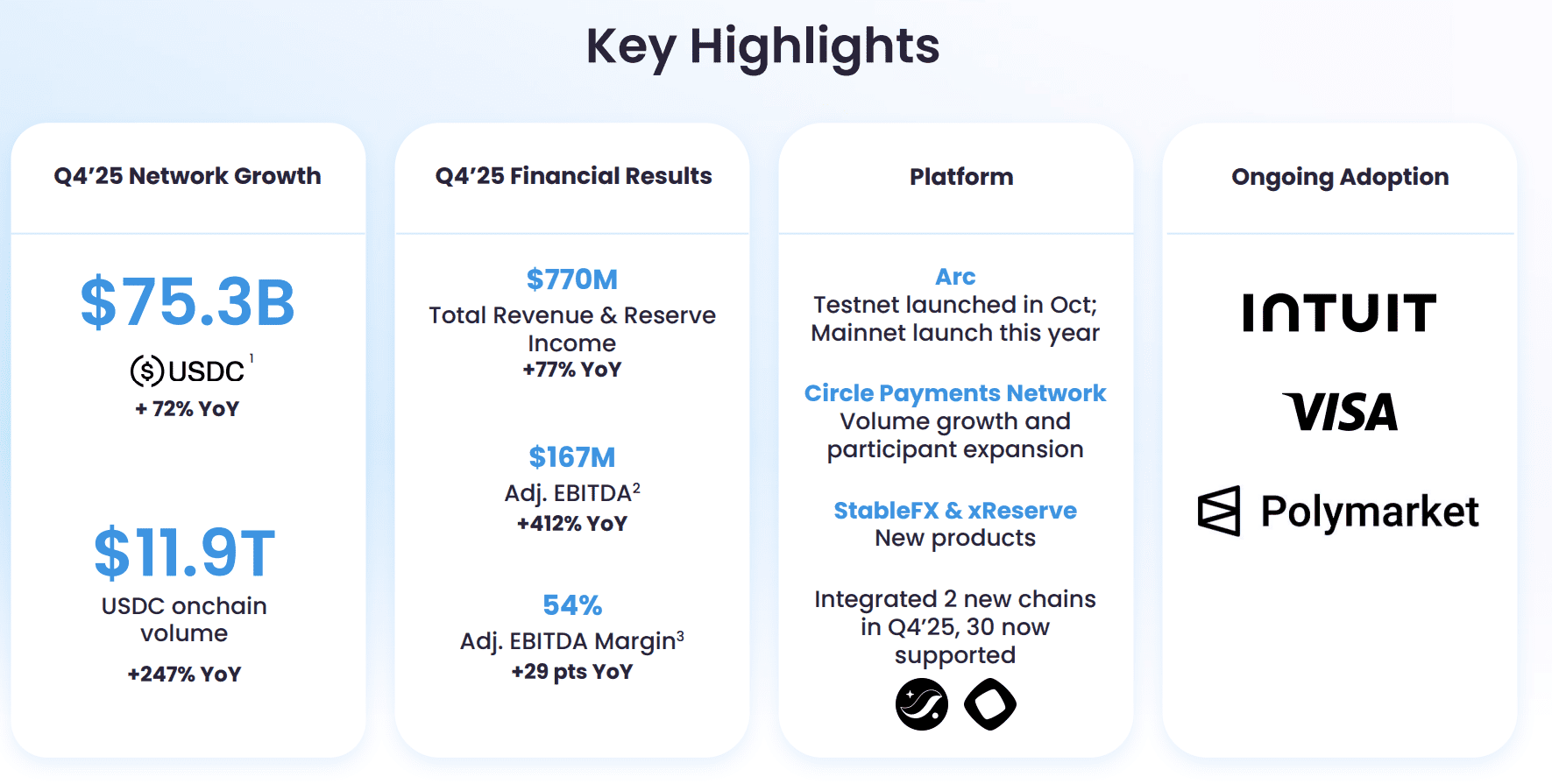
PayPal’s vision is no castle in the air; Circle’s (CRCL) Q4 earnings report, released on February 25, 2026, provides solid market evidence for this logic. The report shows that USDC circulation has climbed to $75.3 billion, a 72% increase year-over-year, while its annual on-chain transaction volume surpassed a staggering $11.9 trillion. A scale of $11.9 trillion is nearly half of the annual U.S. GDP; such a massive volume of capital flow cannot be supported by individual human transactions alone. It reflects the full-scale intervention of automated settlement in global supply chains and high-frequency AI trading.
Source: Circle
This data clarifies the vertical division of labor in the payment industry: if Circle has built the digital age's "savings vault" via USDC, then PayPal, with its 430 million active accounts and millions of merchant gateways worldwide, controls the "terminal distribution network." In the ecological closed-loop of AI Agent implementation, PYUSD and USDC are not zero-sum competitors but strategic allies jointly deconstructing the traditional Visa and Mastercard systems. Research from ARK Invest points out that as automated transactions without human participation take over networks, stablecoin settlement volume will erode traditional interbank cross-border remittance shares at a rate of over 150% per year.
US Secondary Market Simulation: Analyzing Investment Paths Under Sector Interconnectivity
Against the macro backdrop of the payment revolution, investment logic in the US secondary market should center on three sectors: "Value Reversion, Infrastructure Explosion, and Terminal Premiums."
First, for PayPal (PYPL), the core logic lies in the correction of valuation mismatch. In the technical support range of $40 to $45, PYPL's downside risk has been released through a two-year correction. With the disclosure of the new CEO's strategic blueprint and PYUSD's entry into native payment pools for AI models, its P/E ratio is expected to move from an extreme 8.5x toward the industry average of 15-18x, offering a high margin of safety and upward elasticity.
Second, as the "pick and shovel" providers for stablecoins and AI settlement, Circle (CRCL) and Coinbase (COIN) have built solid moats. As a pure-play stablecoin target, Circle directly benefits from interest income under the Federal Reserve's rate policies and the explosion in transaction volume. Meanwhile, Coinbase, as a global hub for liquidity, is positioned to capture "toll" revenue from every on-chain settlement, making it the profit harvester of the entire crypto infrastructure sector.
Finally, Block (SQ) has demonstrated aggressive performance. Its move to lay off 40% of its workforce in late February 2026 was, in fact, a drastic cleaning of operating costs using AI tools. Through a "severing the limb to save the body" style of restructuring, Jack Dorsey has transformed Block into a native AI finance company. The market's 20%+ positive reaction to its stock price is essentially a recognition of the qualitative change in its profit margins driven by AI.
A Turning Point Redefining the Civilization of Payments
2026 will go down in history as the inaugural year of the "leap in payment civilization." The M&A rumors between Stripe and PayPal are merely surface-level ice floes in the capital markets; the true underlying current is the digitalization and mechanization of global clearing sovereignty. The essence of payment is being transformed from a "social contract" into a "coded protocol." Regardless of the final capital consolidation outcome, PayPal and the stablecoin infrastructure behind it have anchored a settlement seat for the machine economy of the next decade. For investors, identifying this paradigm shift from "human-to-human payment" to "machine-to-machine payment" will be the key criterion for determining who holds the "brain tax rights" in the future financial landscape.
Recommended Articles


