




1 No-Brainer Artificial Intelligence (AI) Stock to Buy With $160 and Hold for the Long Term
Key Points
Palo Alto Networks offers a comprehensive portfolio of cybersecurity products designed to protect the entire enterprise.
The company's next-generation security products are helping businesses stop the sophisticated threats posed by artificial intelligence (AI).
Palo Alto stock looks cheap compared to its main rival, which could set the stage for upside from here.
- 10 stocks we like better than Palo Alto Networks ›
Artificial intelligence (AI) is a revolutionary technology, but it can also be extremely dangerous in the wrong hands. According to Palo Alto Networks' (NASDAQ: PANW) Unit 42 research division, some of the most severe cyberattacks are now happening four times faster than they were a year ago, with the best hackers successfully breaching networks and stealing valuable data in under one hour.
On top of that, businesses are creating new attack surfaces when they develop AI chatbots and AI agents, which hackers are actively exploiting. These are brand-new risks that didn't even exist a few short years ago.
Will AI create the world's first trillionaire? Our team just released a report on the one little-known company, called an "Indispensable Monopoly" providing the critical technology Nvidia and Intel both need. Continue »
Fortunately, Palo Alto is helping its customers stay ahead of the curve with its portfolio of advanced cybersecurity products. The company is growing rapidly, yet its stock is down nearly 30% from its all-time high amid the volatility in the broader market over the last few months. That creates an opportunity for investors who can now scoop up a single share for less than $160.

Image source: Getty Images.
AI-powered cybersecurity is the future
Palo Alto is a leader in enterprise-grade cybersecurity, offering dozens of products spread across three core platforms: cloud security, network security, and security operations. The company is weaving AI into as many of its products as possible to automate the entire security stack because malicious actors are launching attacks with machine speed, so businesses have to fight fire with fire.
Palo Alto's Cortex XSIAM platform, for example, automates everything from threat detection to incident response in security operations centers, reducing reliance on humans who can't react as fast as algorithms. In fact, Palo Alto says 60% of XSIAM customers are now remediating threats in under 10 minutes, on average, compared to days or even weeks previously.
XSIAM has been a raging success. At the conclusion of Palo Alto's fiscal 2026 second quarter (ended Jan. 31), the platform had 600 customers, up by a whopping 200% from the year-ago period, and they were each spending an average of almost $1 million annually.
Palo Alto has also launched a series of specific products to help businesses protect their valuable data when they deploy AI software, but the company says the best long-term strategy is to consolidate spending with one cybersecurity vendor. It calls this trend "platformization," and it's critical to filling security gaps that hackers constantly seek to exploit.
Historically, cybersecurity companies would specialize in a specific area like endpoint protection or identity security, so businesses had to piece together their security stack from multiple vendors. This fragmented approach won't work in the AI era, because chatbots and agents are constantly moving between different internal systems to retrieve data. Having one unified cybersecurity suite ensures businesses don't lose track of these autonomous applications, and Palo Alto has worked hard to deliver that very solution.
Strong revenue growth, fueled by AI products and platformizations
Palo Alto generated $2.6 billion in total revenue during the fiscal 2026 second quarter, which was a 15% increase from the year-ago period. However, its next-generation security (NGS) portfolio, which includes AI products like XSIAM, grew more than twice as fast. It had $6.3 billion in annual recurring revenue (ARR) at the end of the quarter, which was up 33%.
Palo Alto also significantly increased its forecast for the fiscal 2026 full year. It now expects to generate $11.3 billion in total revenue, which would be up 23% from the previous year, with $8.6 billion in NGS ARR, which would represent a whopping 54% growth. Just three months earlier, the company forecast potential fiscal 2026 revenue of $10.5 billion, with $7.1 billion in NGS ARR.
Management said platformizations were a key driver of its strong second-quarter results. It considered 1,550 of its customers to be "platformed" at the end of the quarter, up 35% from the year-ago period. Plus, those customers had a net revenue retention rate of 119%, meaning they were spending 19% more money than they were a year ago, with minimal churn.
Simply put, when customers use Palo Alto for all of their cybersecurity needs, they are likely to stick around and spend an increasing amount of money over time.
Palo Alto stock looks cheap compared to its main rival
Palo Alto stock is trading at a price-to-sales (P/S) ratio of 11.1 as I write this, a 50% discount to the valuation of its key rival in the AI-powered cybersecurity space, CrowdStrike (NASDAQ: CRWD):
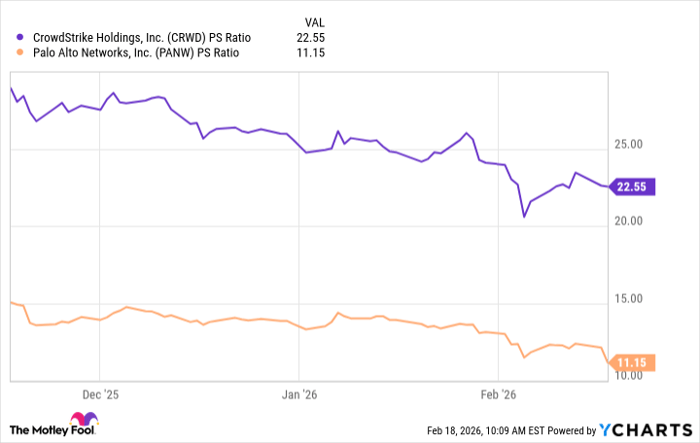
CRWD PS Ratio data by YCharts
The valuation gap doesn't make sense in my opinion, because Palo Alto's NGS segment alone is generating more ARR than CrowdStrike's entire business, which is pulling in around $4.9 billion in ARR. Plus, Palo Alto's NGS ARR grew by 33% in its recent quarter, whereas CrowdStrike's ARR increased by just 23%.
I'm not suggesting Palo Alto stock should trade at a P/S ratio of 22, but I think there is a strong possibility it closes at least some of the valuation gap to its rival, considering the significant momentum in its business. After all, management believes it can more than triple the company's NGS ARR to $20 billion by fiscal 2030, so this stock could be a great buy for long-term investors.
Should you buy stock in Palo Alto Networks right now?
Before you buy stock in Palo Alto Networks, consider this:
The Motley Fool Stock Advisor analyst team just identified what they believe are the 10 best stocks for investors to buy now… and Palo Alto Networks wasn’t one of them. The 10 stocks that made the cut could produce monster returns in the coming years.
Consider when Netflix made this list on December 17, 2004... if you invested $1,000 at the time of our recommendation, you’d have $424,262!* Or when Nvidia made this list on April 15, 2005... if you invested $1,000 at the time of our recommendation, you’d have $1,163,635!*
Now, it’s worth noting Stock Advisor’s total average return is 904% — a market-crushing outperformance compared to 194% for the S&P 500. Don't miss the latest top 10 list, available with Stock Advisor, and join an investing community built by individual investors for individual investors.
See the 10 stocks »
*Stock Advisor returns as of February 22, 2026.
Anthony Di Pizio has no position in any of the stocks mentioned. The Motley Fool has positions in and recommends CrowdStrike. The Motley Fool recommends Palo Alto Networks. The Motley Fool has a disclosure policy.
Recommended Articles


