




Boeing and Lockheed's Space Joint Venture Is Falling Apart -- and Northrop Grumman Is the Reason
Key Points
ULA's Vulcan Centaur rocket has suffered two anomalies in four flights.
Both rockets survived their anomalies, but the law of averages is not working in ULA's favor.
Meanwhile, ULA lost its CEO just a month ago.
- 10 stocks we like better than Boeing ›
United Launch Alliance is in trouble.
Formed in December 2006 from the union of the space launch businesses of Boeing (NYSE: BA) and Lockheed Martin (NYSE: LMT), ULA started life as the undisputed champion of space launch in America. It retained that title up until Elon Musk arrived on the scene with SpaceX, sending a Falcon 1 rocket to orbit in 2008, sending a Dragon capsule to space and back in 2010, completing its first commercial resupply mission in 2012, landing a rocket booster in 2015, reflying a booster in 2017, and completing a commercial crew mission in 2020.
Will AI create the world's first trillionaire? Our team just released a report on the one little-known company, called an "Indispensable Monopoly" providing the critical technology Nvidia and Intel both need. Continue »
Basically, ever since SpaceX showed up, ULA has been losing the space race.
And things are getting worse for ULA -- not better.
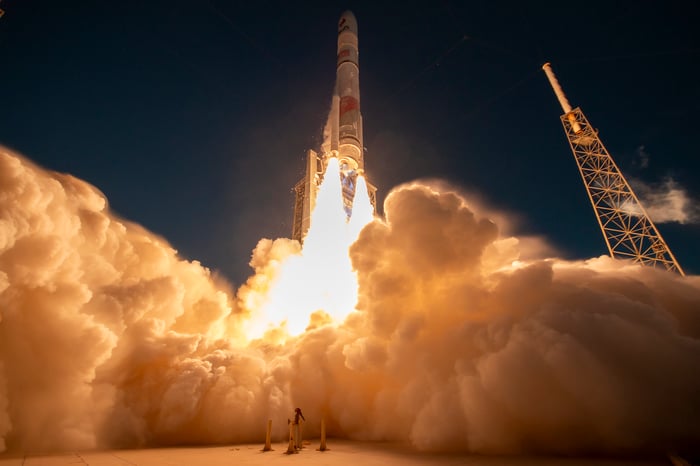
Image source: United Launch Alliance.
It's hard to be Vulcan
Take ULA's Vulcan Centaur rocket, for example -- the new rocket ULA built to replace its outgoing Delta IV and Atlas V launch vehicles. Space, as the saying goes, is hard. It gets even harder when you have to compete with Elon Musk and his cut-rate prices on space launch.
Billed as a solution to the "problem" of low-cost SpaceX Falcon 9 rockets that were undercutting ULA prices, Vulcan was supposed to cut ULA's launch costs below $100 million. Vulcan was supposed to help raise the company's launch cadence, too, providing the revenue ULA needs to remain competitive with SpaceX.
But things are not going well for Vulcan.
Like ULA itself, Vulcan started out well with a basically flawless inaugural launch in January 2024. Then-CEO Tory Bruno said at the time that, if all went well, total ULA launches (Atlas and Vulcan) could approach 20 in 2025 and rise toward 30 per year within just a few more years.
Two years later, Vulcan has flown just four times.
Total.
Vulcan flew twice in 2024, just once in 2025, and so far once in 2026.
Worse news for ULA, half these launches featured notable "anomalies." In October 2024, one of the nozzles that directs exhaust flow from Vulcan's two solid rocket boosters fell off during launch. The rocket still reached its target orbit and completed its mission. But still, it's not good when rocket parts start spontaneously falling off in flight.
Vulcan's third launch, last August, went fine. Its most recent fourth launch last week, though, did not. Video of the launch clearly showed "burn through" at the tail end of another solid rocket booster nozzle. This one didn't quite fall off the rocket, but its performance was still far short of "nominal." (The rocket itself did, again, complete its mission despite the anomaly.)
Notably, in the aftermath of the first nozzle incident in 2024, ULA blamed a manufacturing defect from its supplier, Northrop Grumman (NYSE: NOC). Bruno assured his customers that the booster in that incident "was an outlier" and that ULA "made appropriate corrective actions" -- but it would appear he spoke too soon.
Issues abound
A charitable reading of the facts here would probably blame Northrop Grumman for ULA's issues. Northrop builds the solid rocket boosters that help give Vulcan its initial push toward orbit, after all. The engines that form Vulcan's "core" are supplied by ULA partner and rival Blue Origin, and they have worked flawlessly in all launches to date.
Still, as the company responsible for the launch, the rocket, and ensuring quality control over all parts that go into building that rocket, the responsibility for Vulcan anomalies falls squarely upon ULA.
And if the name of the game is nominal space launches, free from anomalies, well, right now, ULA's batting only .500.
It doesn't help either that ULA's leadership is currently in turmoil after Bruno, its longtime CEO, abruptly jumped ship in January and took a job with Blue Origin instead. His former deputy at ULA, Chief Operating Officer John Elbon, is presumably doing his best to keep the company running smoothly as interim CEO, while a permanent replacement is sought. But the lack of a permanent CEO may be contributing to quality lapses at ULA.
What it means for investors
What does all this mean for investors? Whether or not you believe ULA will get over its current bumps in the space road and "straighten up and fly right" over the long term, in the short term, well, ULA's difficulties couldn't come at a worse time.
Arch-rival SpaceX is gearing up to launch a massive IPO, and anticipation is fierce. With their space venture in a tailspin, the last thing any investor is thinking about right now is investing in Boeing or Lockheed -- not when SpaceX stock will soon be available to buy.
I'd stay far away from both stocks, at least until the SpaceX IPO is out of the way.
Should you buy stock in Boeing right now?
Before you buy stock in Boeing, consider this:
The Motley Fool Stock Advisor analyst team just identified what they believe are the 10 best stocks for investors to buy now… and Boeing wasn’t one of them. The 10 stocks that made the cut could produce monster returns in the coming years.
Consider when Netflix made this list on December 17, 2004... if you invested $1,000 at the time of our recommendation, you’d have $415,256!* Or when Nvidia made this list on April 15, 2005... if you invested $1,000 at the time of our recommendation, you’d have $1,151,865!*
Now, it’s worth noting Stock Advisor’s total average return is 892% — a market-crushing outperformance compared to 194% for the S&P 500. Don't miss the latest top 10 list, available with Stock Advisor, and join an investing community built by individual investors for individual investors.
See the 10 stocks »
*Stock Advisor returns as of February 21, 2026.
Rich Smith has no position in any of the stocks mentioned. The Motley Fool has positions in and recommends Boeing. The Motley Fool recommends Lockheed Martin. The Motley Fool has a disclosure policy.
Recommended Articles


