




Altman Is Also Puzzled: Why OpenAI Is Rushing Toward an Epic IPO While Worldcoin Faces Sunset
OpenAI's IPO valuation at $1 trillion.
TradingKey - According to market reports on May 22, OpenAI, the AI giant co-founded by Sam Altman and Elon Musk, generated $5.7 billion in revenue in the first quarter, far exceeding its competitor Anthropic's $1 billion, which provides support for its soaring IPO valuation.
In April 2026, OpenAI completed a historic financing round involving giants such as Amazon ( AMZN ), Nvidia ( NVDA ), among others, which pushed its valuation directly past $800 billion. However, Wall Street investment banks have revealed that OpenAI's target valuation for this IPO is expected to challenge the $1 trillion mark, surpassing rival Anthropic's $900 billion valuation and becoming the largest listing in the AI industry to date.
Worldcoin market capitalization plummets 98%.
Also originating from the hands of Altman, Worldcoin ( WLD) has met a different fate. In 2019, OpenAI CEO Sam Altman co-founded Worldcoin with Alex Blania, Max Novendstern, and others, with development led by its parent company Tools for Humanity (TFH). Its goal is to provide a decentralized solution for all of humanity to 'prove they are real humans.'
In the early stages, the market indeed bought into Altman's vision. Following the listing of its token, WLD, the price continued to surge, rising from an initial $1.7 to a peak near $12, representing a maximum gain of 600%. However, WLD's price has steadily declined since March 2024, falling to a low of $0.2, a maximum drawdown of over 98%.
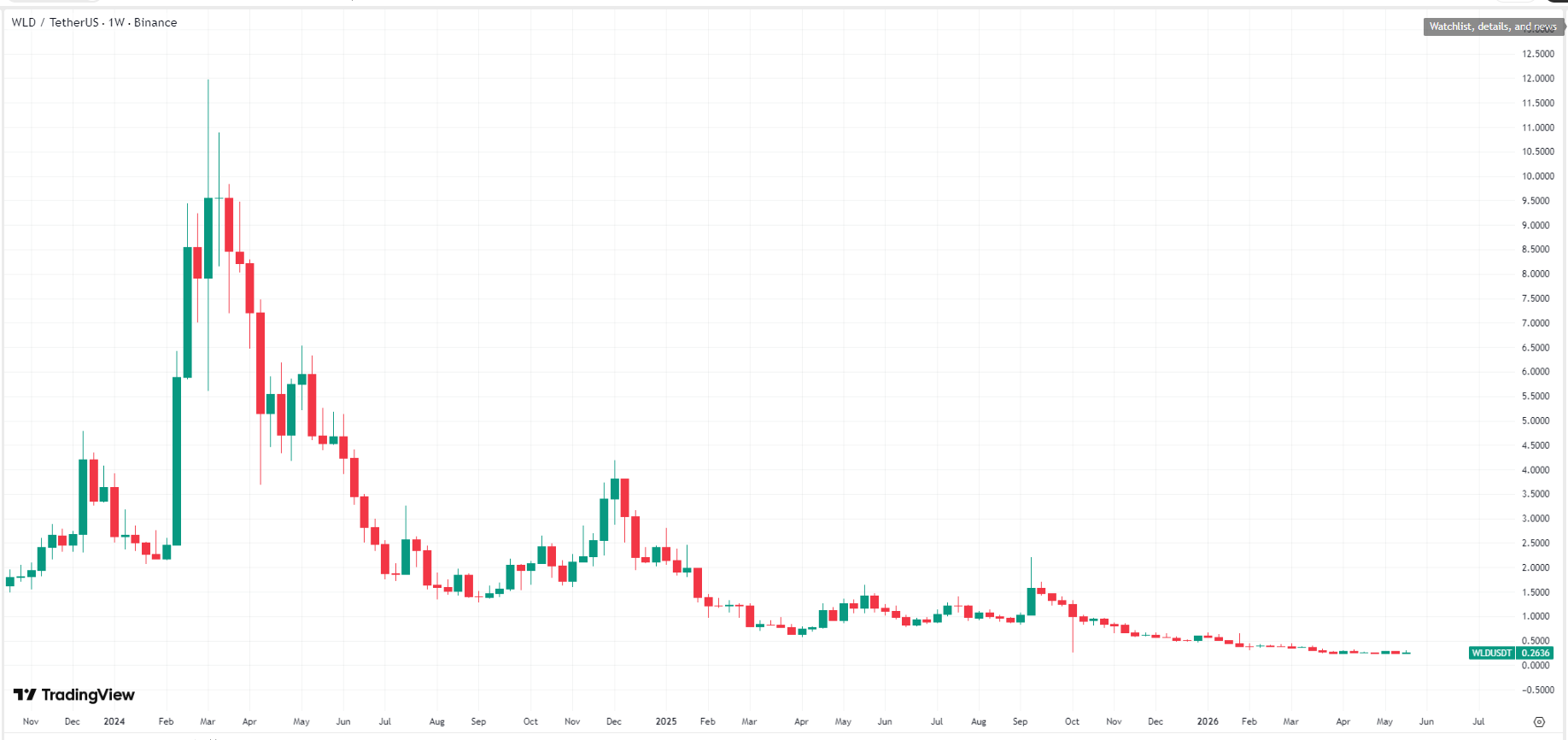
Worldcoin price chart (weekly), Source: TradingView
Why are the fates of OpenAI and Worldcoin so starkly different?
Both OpenAI and Worldcoin are personally steered by Sam Altman. Their development has since diverged sharply, primarily due to significant contrasts in compliance, pain point resolution, and monetization, as follows:
OpenAI | Worldcoin | |
Regulatory Compliance Environment | Despite facing copyright and data scrutiny, it benefits from strategic protection by mainstream Western capital and governments. | Due to the collection of highly sensitive iris data, it has frequently faced snap inspections or bans by various countries for privacy law violations. |
Timeliness of Pain Point Resolution | Enterprises and individuals require AI tools at this very moment to improve productivity and reduce labor costs. | It aims to solve "human verification" issues post-AI proliferation and provide Universal Basic Income (UBI), neither of which are currently essential needs. |
Monetization Capability | Extremely strong, with annualized revenue exceeding $25 billion and a base of hundreds of millions of subscribers and essential enterprise clients. | Extremely weak, lacking direct profit sources and relying mainly on subsidies, leasing of surplus computing power, and enterprise verification integrations. |
Tokenomics Flaws | Equity distribution and return mechanisms are well-regarded by Wall Street. | Regular airdrops of WLD to registered users create persistent selling pressure for liquidation in the market. |
Simply put, OpenAI follows the commercial path most favored by Wall Street—high revenue growth, high user retention, and a formidable moat—whereas Worldcoin has encountered two major pitfalls: "token inflationary selling pressure" and "government regulation of biometric privacy."
Recommended Articles


