




Grayscale says Ethereum, Solana, BNB Chain and Canton are positioned to absorb the first wave of institutional capital
Asset manager Grayscale says that the small group of blockchains already dominating decentralized finance (DeFi) and tokenized assets, Ethereum, Solana, BNB Chain, and Canton Network, are best positioned to absorb the first wave of institutional capital once the United States passes the CLARITY Act, its long-promised crypto rulebook.
The CLARITY Act cleared the Senate Banking Committee on a 15-9 vote on May 14. Now it requires a full Senate floor vote, House reconciliation, and a presidential signature.
However, the current calendar is posing as another constraint. In a May 21 post, Cryptopolitan reported that the bill will now be competing for floor time in June with reconciliation, the Foreign Intelligence Surveillance Act, and the housing bill that passed the House this week.
Which networks does Grayscale say will absorb the first wave of institutional capital?
Ethereum currently leads on tokenized assets with full on-chain functionality, followed by BNB Chain and Solana.
Canton Network has also made a name for itself as a dominant institutional niche. According to Grayscale’s earlier tokenization megatrend report, Canton leads all blockchains in total capital on-chain with over $348 billion in tokenized asset value, anchored by DTCC’s selection of the network under the SEC’s No-Action Letter framework.
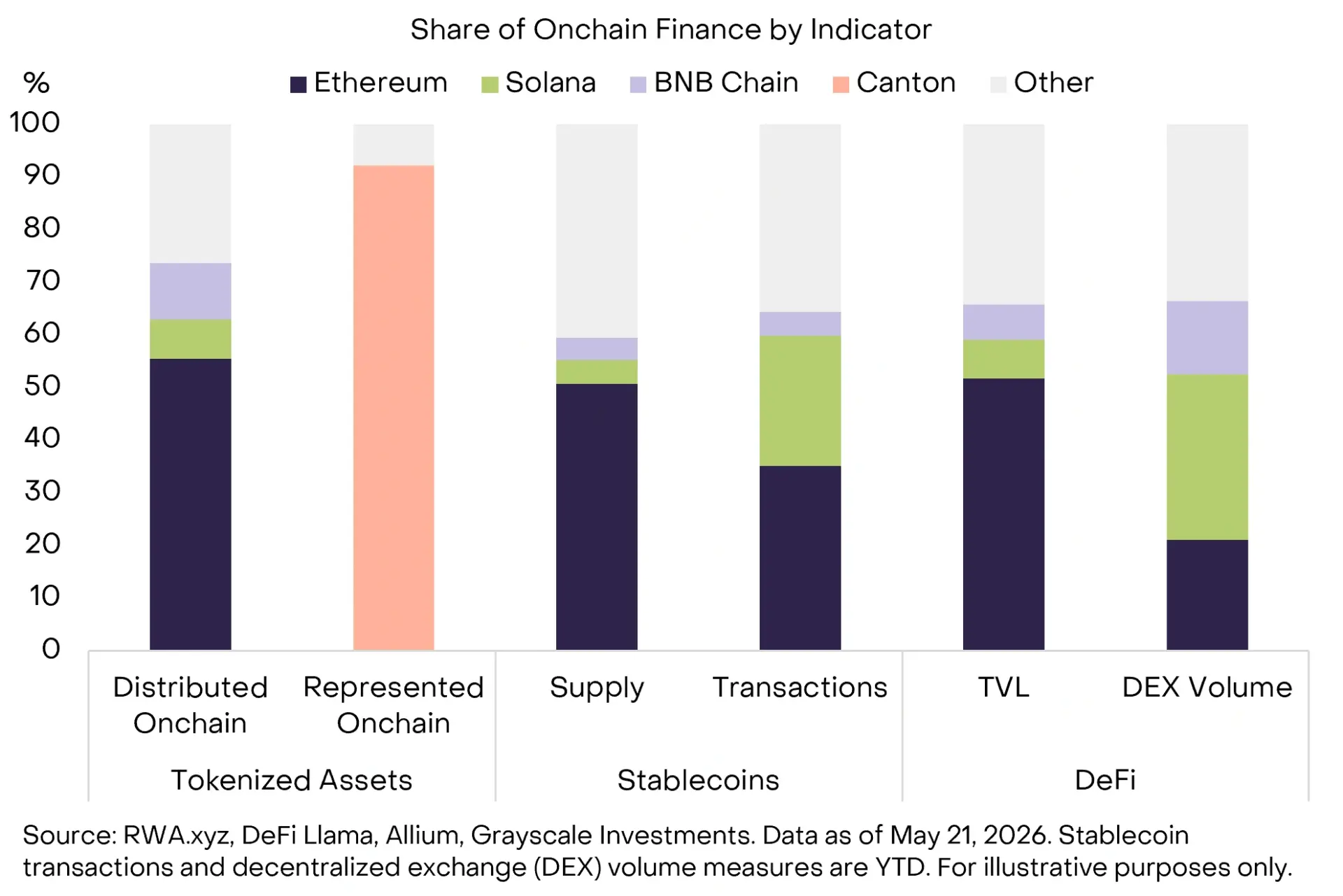
The same blockchains also stand out by supply and transaction volume when it comes to stablecoins. The current TVL in DeFi is around $82.08 billion, and Ethereum, Solana, and BNB Chain are responsible for the bulk of it. They also lead in application activities.
Grayscale highlighted a list of secondary-tier platforms, including Avalanche, Ethereum Layer 2 networks Base and Arbitrum, the perpetuals-focused Hyperliquid, and the stablecoin-heavy Tron as likely beneficiaries.
Zach Pandl, Grayscale’s head of research, pointed out that although Bitcoin does not natively support smart contracts and has a more limited Layer 2 ecosystem, it will still benefit from regulatory clarity as the industry’s most secure asset and leading collateral.
When will the CLARITY Act be passed, and what could derail it?
According to the Crypto in America podcast host, Eleanor Terrett, “The reality of whether the Senate can get two major pieces of legislation done amid time constraints and competing priorities is beginning to set in, and the question of whether one will inevitably slip into July is now being asked.”
She pointed out that there are four working weeks in June and three in July before the August recess.
Senator Cynthia Lummis has called a June floor vote probably pretty optimistic.
DeFi could get regulatory boost too
While these deliberations are ongoing, the SEC has not waited. On March 17, the agency issued a joint interpretation with the Commodity Futures Trading Commission (CFTC) setting out a coherent definition and classification across digital commodities, collectibles, tools, stablecoins, and digital securities.
It also clarified how a non-security crypto asset may become subject to, or cease to be subject to, an investment contract, while also addressing airdrops, protocol mining, staking, and the wrapping of non-security assets.
SEC Chairman Paul S. Atkins stated, “This effort serves as an important bridge for entrepreneurs and investors as Congress works to advance bipartisan market structure legislation, which I look forward to implementing with Chairman Selig in the near future.”
The DeFi space is also making a push to clarify regulation. As Cryptopolitan reported in April, the DeFi Education Fund (DEF) and 35 other co-signatories have urged the Securities and Exchange Commission (SEC) to upgrade its staff guidance on DeFi interfaces into law so that it cannot be rolled back once a new regime comes in.
In its current state, the guidance is only an interim staff statement that will be considered withdrawn after five years from its publication date unless the Commission states otherwise or makes it a rule.
The staff statement that the SEC’s Division of Trading and Markets issued on April 13 clarifies that certain crypto trading interface operators are exempt from registering as broker-dealers.
Don’t just read crypto news. Understand it. Subscribe to our newsletter. It's free.
Recommended Articles


