




Spot Silver Prices Volatile, Losses Narrow After 7% Plunge, Has Safe-Haven and Industrial Narrative Failed?
TradingKey - During the Asian trading session, Spot Silver (XAGUSD) Intraday losses briefly expanded to 7%, hitting $83.05 per ounce, before narrowing. As of press time, silver was trading at $85.8 per ounce. Influenced by the recent tense situation in the Middle East and the complex international environment, global commodities, particularly pure benzene, LPG, ethylene glycol, styrene, and polypropylene, have experienced significant volatility.
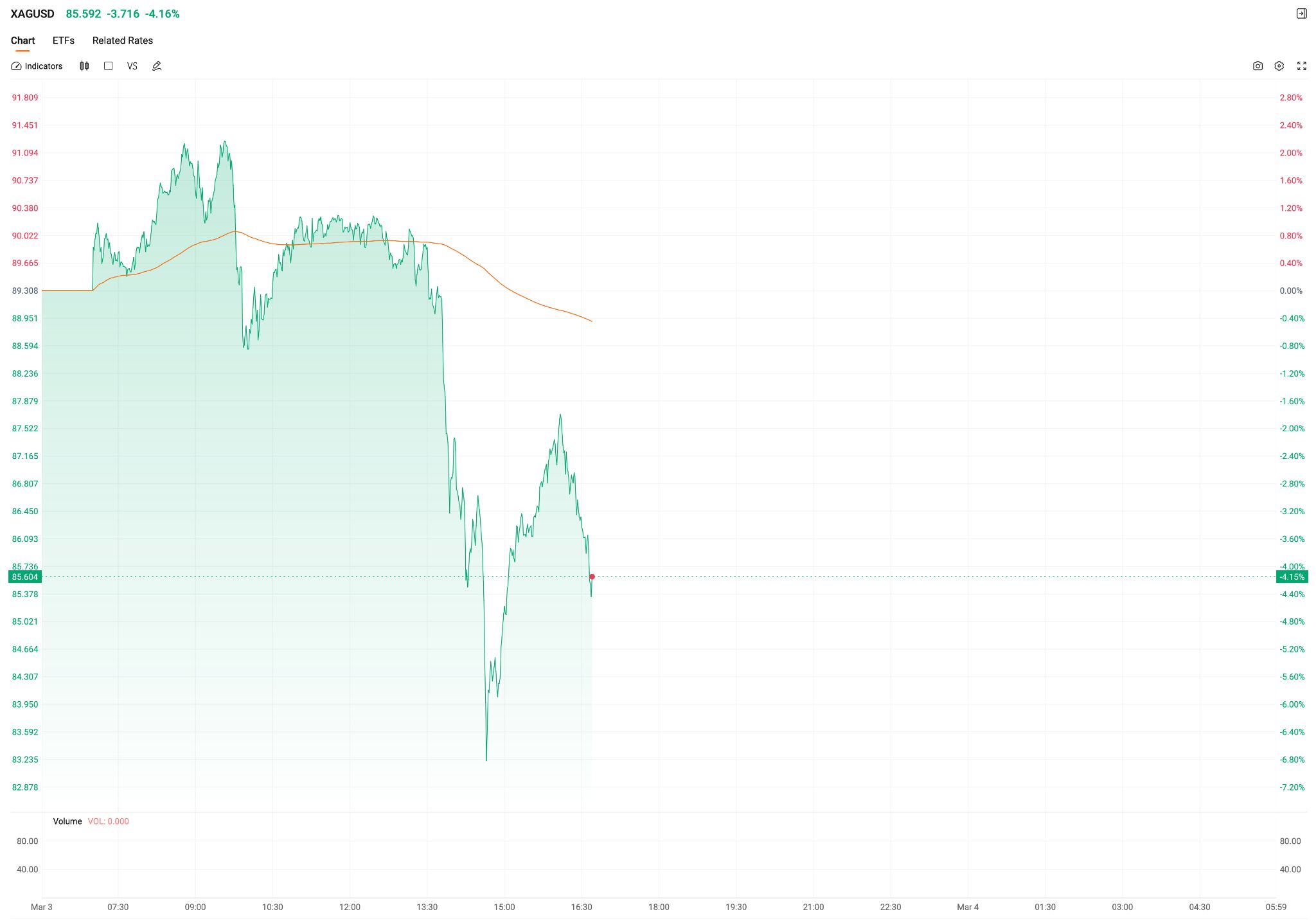
Against a backdrop of a fragmenting global landscape and rising uncertainty over supply chain security and energy corridors, sharp commodity price volatility is not uncommon. Risk premiums are quickly priced into the system, and the high-frequency rotation of funds between different assets often amplifies short-term swings.
The sharp decline in silver seems more like a resonance between liquidity shocks and sentiment trading. Compared to gold, the silver market has a smaller capacity and a higher proportion of leveraged funds. When margin pressure or algorithmic trading is triggered, price elasticity is magnified, resulting in intraday oversold conditions.
Silver's safe-haven logic has not failed, but its transmission sequence has diverged. During phases of extreme risk, funds prioritize core safe-haven assets like gold, leaving silver under short-term passive pressure. However, as market sentiment stabilizes and overall allocation demand for precious metals recovers, silver usually rebounds in tandem.
Regarding industrial applications, the expanding demand for high-conductivity materials in photovoltaics, electric vehicles, and electronics manufacturing ensures that silver's strategic position in the new energy supply chain remains fundamentally unchanged. Short-term price volatility has not altered the directional trend of the supply-demand structure.
Investors should be cautious that silver's previous cumulative gains reached relatively high levels, and prices significantly overshot part of the medium-term logic during periodic spikes. Driven by the dual narratives of safe-haven and industrial demand, capital once pushed its pricing into a high range, and marginal buying strength has begun to fade.
Based on valuation and the supply-demand cycle, fundamental conditions for a sustained unilateral surge in the short term are insufficient. Although industrial demand has medium-to-long-term growth potential, explosive incremental gains are unlikely in a very short cycle. Safe-haven demand is highly sentiment-driven; once risks ease, the premium is at risk of retreating.
It should be emphasized that silver possesses the dual attributes of both a precious metal and an industrial metal. This multi-factor driver mechanism makes silver's volatility naturally higher than that of single-attribute assets, which also means that the magnitude of retracements can be just as significant.
In an environment of heightened uncertainty, sharp volatility itself is the market's way of pricing complex risks. For silver, the real focus should be on whether its rally returns to fundamental support, rather than depending solely on the continuation of safe-haven sentiment.
If risk premiums retreat at the margin while industrial demand fails to accelerate, the probability of short-term high-level fluctuations or even a correction will rise significantly. Furthermore, due to the ongoing recovery of the US dollar, precious metals priced in USD are also likely to face pressure. If dollar demand persists or climbs, silver's short-term rally may hit resistance.
Recommended Articles


