




AUD/USD (AUDUSD) Is up 0.52% on Oct 2: Are Market Expectations Adjusting?
AUD/USD (AUDUSD) is up 0.52% at Oct 2 08:55(ET), now at $0.69647, with a 7-day down of 0.88%.
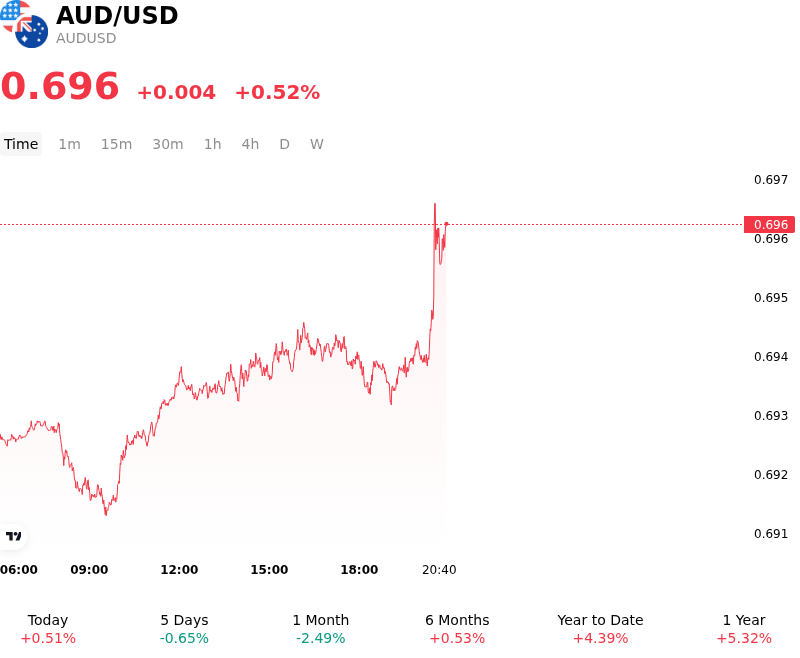
What is driving AUD/USD (AUDUSD)’s stock price up today?
The advance in the Australian dollar against the U.S. dollar was primarily catalyzed by a sharp repricing in Federal Reserve interest rate expectations following significantly weaker-than-expected U.S. labor market data. September nonfarm payroll additions fell well short of market consensus, accompanied by noticeable downward revisions to prior months. The pronounced slowdown in U.S. employment growth triggered a decline in Treasury yields as traders scaled back expectations for near-term Federal Reserve policy tightening, applying immediate downward pressure on the U.S. dollar.
Adding to the pair's upward momentum was the supportive yield differential stemming from the Reserve Bank of Australia's recent hawkish stance. The Australian dollar continued to draw underlying support from the RBA's decision to raise its official cash rate to 4.60 percent—marking its fourth rate hike of the year—to combat persistent domestic inflationary pressures. With Australian short-term yield expectations remaining elevated relative to U.S. yields, market participants favored the Australian currency as U.S. interest-rate momentum faded.
Institutional capital flows and broader market dynamics further reinforced the move. The retreat in the U.S. dollar encouraged short-covering after recent oversold conditions in the currency pair, while firm prices across key industrial commodities supported Australia's trade outlook. Although investors continue to monitor geopolitical risks in the Middle East and global trade conditions, the primary driver for the session remained the U.S. labor market deceleration and the resulting monetary policy divergence that tilted favor toward the Australian dollar.
Technical Analysis of AUD/USD (AUDUSD)
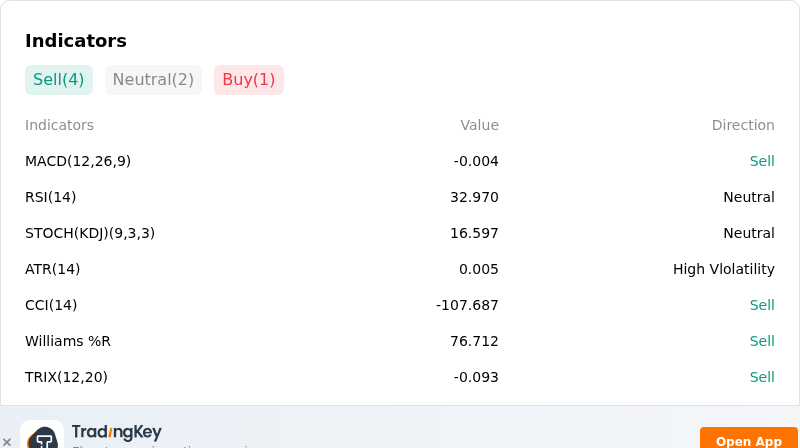
Technically, AUD/USD (AUDUSD) shows a MACD (12,26,9) value of -0.004, indicating a sell signal. The RSI at 32.970 suggests neutral condition and the Williams %R at 76.712 suggests sell condition. Please monitor closely.
More details about AUD/USD (AUDUSD)
Recent Events and Risks:
- Unwind of Hawkish RBA Expectations: Downside pressure on the Australian Dollar has intensified following a sharp narrowing of Australia's August trade surplus to AUD 495 million and a softer monthly trimmed-mean CPI release, driving a rapid unwind of near-term RBA rate hike pricing.
- US Yield Spread Advantage and Energy Inflation: High US Treasury yields—driven by persistent energy-led US inflation risks and firm Federal Reserve policy expectations—continue to support the US Dollar while widening negative yield differentials against Australian debt.
- Domestic Housing and Growth Headwinds: Emerging signs of economic drag from past rate increases, including a 6.1% month-on-month decline in August building permits and falling mortgage originations, raise domestic slowdown concerns and limit the central bank's scope for further monetary tightening.
- Global Risk-Off Sentiment and China Vulnerability: Persistent geopolitical risks in the Middle East and muted structural demand from China continue to weigh on global commodity market appetite, leaving the high-beta Australian Dollar vulnerable to risk-averse positioning.
Recommended Articles


