


Here's How Much Upside Is Left in SpaceX Stock at Its IPO Price, According to an Analyst
Key Points
SpaceX will debut at $135 per share and a market value of about $1.77 trillion.
SpaceX's future relies on the development of its massive, fully reusable Starship rocket.
Low launch costs could make orbital data centers viable, creating a business generating hundreds of billions in annual revenue.
- 10 stocks we like better than Space Exploration Technologies ›
SpaceX (NASDAQ: SPCX) will raise a whopping $75 billion from its public market debut at $135 per share, making it the largest IPO in history. Even with that already huge valuation, many investors expect the stock price to climb quickly. Some see a quick first-day pop in the IPO price, while others expect SpaceX to be a great long-term investment.
In its Securities and Exchange Commission registration filing, SpaceX estimated a total addressable market of $28.5 trillion for its various businesses. If that number's taken at face value, there's a ton of upside potential for the stock, even at a value of about $1.77 trillion at its IPO. But that requires SpaceX to rapidly develop its technology and capture a share of those markets. Here's how much upside one analyst realistically sees for the stock.
Will AI create the world's first trillionaire? Our team just released a report on the one little-known company, called an "Indispensable Monopoly" providing the critical technology Nvidia and Intel both need. Continue »
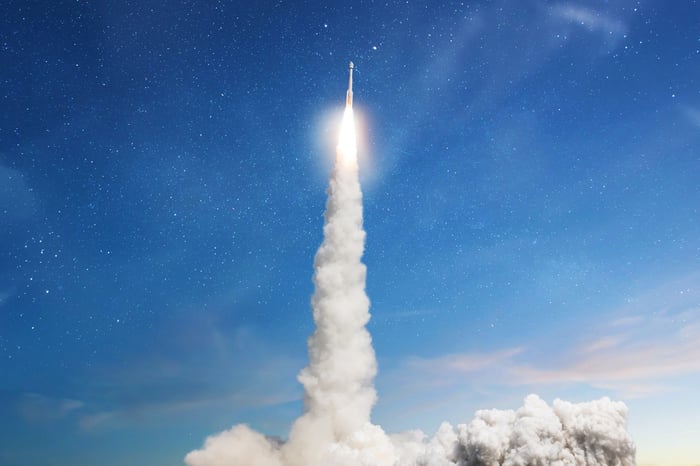
Image source: Getty Images.
What has to go right for SpaceX to take off
A common valuation method is to create a bull case, a bear case, and a base case for a company and use those scenarios to project operating income and cash flow. You can then weight those cases and calculate a weighted average for the stock's fair value. Even if a stock trades above its fair value, it could be worth taking a stake in it to participate in the upside if it has a ton of potential.
Morningstar's analysts laid out their bull case for SpaceX ahead of the IPO. In its most optimistic scenario, SpaceX successfully develops and scales its Starship rocket by 2028. Starship is the company's massive new rocket, designed to carry a payload of 100 metric tons. That's over 4 times the capacity of its Falcon 9 and 1.5 times the capacity of its Falcon Heavy, which are currently in use. Importantly, the rocket is designed to be fully reusable.
Successfully transitioning to Starship could significantly reduce launch costs, which has knock-on effects for the rest of the business. In fact, SpaceX calls out a failure to develop Starship at scale as a key business risk in its S-1 filing. Significant delays or other challenges with Starship "would delay or impede our ability to achieve our other business objectives, such as the deployment of our next-generation satellites, the expansion of our satellite-to-mobile connectivity services, and deployment of in-orbit AI compute infrastructure."
That said, SpaceX plans to move Starship out of testing by the second half of this year. That gives it over two years to scale the business to the point where it's launching multiple times per week, as in Morningstar's bull case.
The second key piece of the bull case is SpaceX's plans for orbital data centers, which it expects to start launching in 2028. The case for orbital data centers centers on higher solar energy efficiency and lower regulatory barriers to their construction. Deploying orbital artificial intelligence (AI) compute at scale requires thousands of launches per year, which is why scaling Starship is the crux of the bull case. But SpaceX will also have to prove economic advantages for hyperscalers looking to use more compute. In its bull case, Morningstar analysts model SpaceX ultimately capturing one-fifth of total AI infrastructure capacity by 2040. It sees the business segment generating $225 billion in annual revenue by 2035.
How much is SpaceX worth in the bull case scenario?
If that bull case comes to fruition, Morningstar's discounted cash flow model estimates the current intrinsic value of SpaceX is $154 per share, or a market value of $2 trillion. That's not a lot of upside, and a lot has to go right for SpaceX to achieve it. The analysts say investors need to expect a 77% chance that its bull case will come to fruition and a 23% chance that its base case will occur in order to justify the $135 IPO price.
Making matters worse, CEO Elon Musk has a history of overpromising and underdelivering. The clearest case is Tesla's (NASDAQ: TSLA) Full Self Driving project. Musk has been predicting autonomous or semi-autonomous features for Tesla vehicles since 2013, and has failed to deliver almost all of them.
It's important to take everything Musk predicts for his businesses with a grain of salt. That includes the total addressable market projections in SpaceX's S-1 filing and statements like last year's post on X that Starship could launch more than once per hour on some days by 2032.
Yes. In about 6 or 7 years, there will be days where Starship launches more than 24 times in 24 hours.
-- Elon Musk (@elonmusk) August 24, 2025
Still, Musk has ultimately delivered technology others have long been dubious about. SpaceX rockets are partially reusable, and development on the fully reusable Starship is progressing. Tesla's autonomous driving technology is competitive with market leaders despite not using expensive advanced sensors.
Musk may ultimately deliver technology that transforms space-based connectivity and charter a new frontier in computing, but the upside is still pretty low to justify betting on that. Investors may want to wait for a better entry point.
Should you buy stock in Space Exploration Technologies right now?
Before you buy stock in Space Exploration Technologies, consider this:
The Motley Fool Stock Advisor analyst team just identified what they believe are the 10 best stocks for investors to buy now… and Space Exploration Technologies wasn’t one of them. The 10 stocks that made the cut could produce monster returns in the coming years.
Consider when Netflix made this list on December 17, 2004... if you invested $1,000 at the time of our recommendation, you’d have $445,672!* Or when Nvidia made this list on April 15, 2005... if you invested $1,000 at the time of our recommendation, you’d have $1,280,566!*
Now, it’s worth noting Stock Advisor’s total average return is 948% — a market-crushing outperformance compared to 206% for the S&P 500. Don't miss the latest top 10 list, available with Stock Advisor, and join an investing community built by individual investors for individual investors.
See the 10 stocks »
*Stock Advisor returns as of June 10, 2026.
Adam Levy has no position in any of the stocks mentioned. The Motley Fool has positions in and recommends Tesla. The Motley Fool has a disclosure policy.
Recommended Articles


