


The Dollar Index answers to the Treasury, not the Fed
- DXY closed 0.86% lower, the weakest close since mid-May.
- Long-end buyback operations at least doubled to 4 billion Dollars.
- Hawkish July minutes landed at 18:00 GMT and moved nothing.
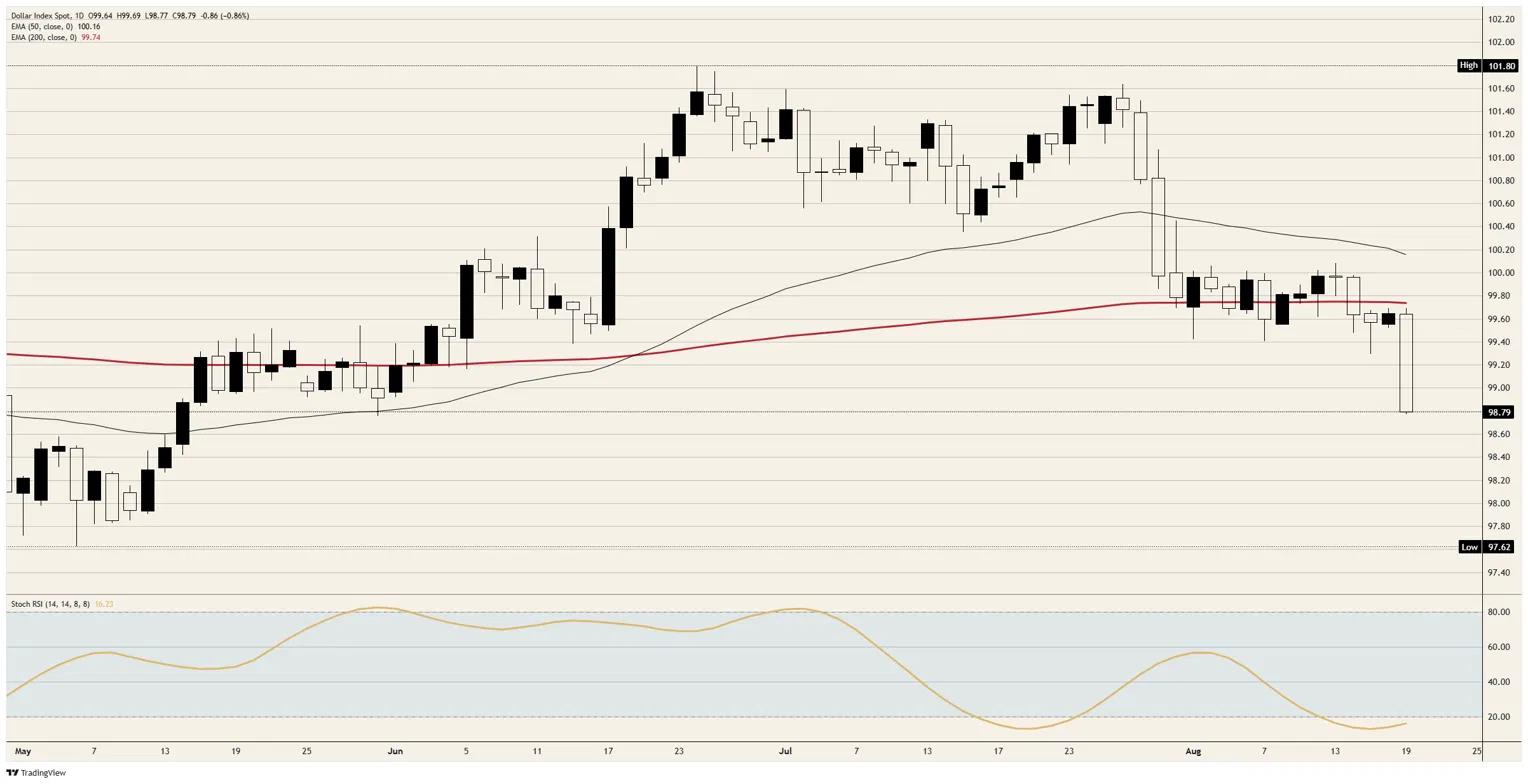
The Dollar Index closed Wednesday 0.86% lower just beneath 98.80, its weakest close since mid-May, and it closed on the session low. The document that did the damage was not a central bank document. A Treasury notice on the government bond buyback programme, released in the middle of the London afternoon, took the currency apart against every major counterpart on the board and left the index almost a full point under its 200-day Exponential Moving Average (EMA).
The debt manager wrote the session
The Treasury said it would increase, by at least double, the size of its liquidity support buyback operations in longer-dated nominal coupons, taking each operation from 2 billion Dollars to at least 4 billion across the 10-to-20-year and 20-to-30-year sectors. The change runs from September 9 through November 4, with anything beyond that left to the November refunding. It arrived barely two weeks after the quarterly buyback schedule had been published, and it arrived in front of a 16 billion Dollar auction of 20-year paper.
Long yields did what an announced buyer makes them do. The thirty-year had printed above 5.33% on August 18, its highest since June 2007, and it gave back close to ten basis points inside the afternoon, with the ten-year easing toward 4.65%. Long yields falling on disinflation leave a currency roughly where they found it. Long yields falling because the issuer had to show up as a bidder are something else entirely, and the foreign exchange market priced the difference within minutes.
The selling was indiscriminate, which is the tell worth keeping. The Swiss Franc took close to 1.8% out of the Dollar on the session, the New Zealand Dollar roughly 1%, and the Mexican Peso ran to a two-year high. Gold climbed toward $4,500 an ounce with Silver alongside it. A currency losing ground to a funding currency, a high-yielder and a metal inside the same afternoon is not repricing a rate spread. It is repricing the issuer.
The minutes nobody traded
The record of the July 28-29 Federal Open Market Committee (FOMC) meeting arrived at 18:00 GMT and described a committee considerably more hawkish than its own vote tally. Several policymakers favoured an immediate increase against the three who actually dissented, many judged that tightening would probably become necessary if inflation failed to decline, and a few argued that moving early would spare the committee larger moves later.
The language matters more than the arithmetic here, because the account of the June meeting credited only a few participants with a hike case. The ladder has climbed a rung while the vote has not moved at all, and two regional presidents without a vote in July have since said they would have backed an increase. The hawkish bloc is wider than the vote count showed, and it is still widening.
For all of that, the currency market treated the release as a non-event. The index was already sitting at its lows when the document landed and it stayed there. Futures had already trimmed September increase odds to roughly a third from around two-thirds in the days after the meeting, and nothing in the record put them back. A committee that switched off forward guidance on purpose now competes for attention with a debt manager who has not.
The week's real tests come after the minutes
Thursday's American calendar opens at 12:30 GMT with initial jobless claims against a 210K consensus and a 209K prior, alongside the Philadelphia Fed manufacturing survey for August, where a consensus of 25 sits against a 41.4 prior. That is a forecast collapse of more than sixteen points in a regional survey, and a print anywhere near it will do more to September pricing than a three-week-old account of a meeting. A regional Fed president speaks at 15:10 GMT.
Friday brings the preliminary August S&P Global Purchasing Managers Index (PMI) series at 13:45 GMT, manufacturing at a 53.8 consensus from 53.9 and services at 54 from 54.6, with the composite prior at 54.5. Both are forecast to soften without breaking, which is the shape that keeps a September hold alive without arming a cut. Beyond that sits the Jackson Hole symposium at the end of the month, the next scheduled chance for the Federal Reserve to take the narrative back off the Treasury.
Dollar Index levels
Resistance: The 99.00 handle is the first line back, with the 200-day EMA near 99.75 above it and the 50-day EMA just above the 100.00 handle capping the recovery case. Nothing short of a reclaim of 99.75 repairs the daily structure.
Support: The session low in the 98.75 area is the immediate shelf, then 98.50 and the 98.00 handle, with the early-May base near 97.60 the only structural level beneath that. Daily Stochastic Relative Strength Index (Stoch RSI) near 16 is already inside oversold territory, which caps how far a first push can run before it pauses.
Bias: Bearish. Rallies into 99.00 and the 200-day EMA near 99.75 are for selling, objectives 98.50 then the 98.00 handle, invalidation on a daily close back above 99.75.
DXY daily chart
US Dollar FAQs
The US Dollar (USD) is the official currency of the United States of America, and the ‘de facto’ currency of a significant number of other countries where it is found in circulation alongside local notes. It is the most heavily traded currency in the world, accounting for over 88% of all global foreign exchange turnover, or an average of $6.6 trillion in transactions per day, according to data from 2022. Following the second world war, the USD took over from the British Pound as the world’s reserve currency. For most of its history, the US Dollar was backed by Gold, until the Bretton Woods Agreement in 1971 when the Gold Standard went away.
The most important single factor impacting on the value of the US Dollar is monetary policy, which is shaped by the Federal Reserve (Fed). The Fed has two mandates: to achieve price stability (control inflation) and foster full employment. Its primary tool to achieve these two goals is by adjusting interest rates. When prices are rising too quickly and inflation is above the Fed’s 2% target, the Fed will raise rates, which helps the USD value. When inflation falls below 2% or the Unemployment Rate is too high, the Fed may lower interest rates, which weighs on the Greenback.
In extreme situations, the Federal Reserve can also print more Dollars and enact quantitative easing (QE). QE is the process by which the Fed substantially increases the flow of credit in a stuck financial system. It is a non-standard policy measure used when credit has dried up because banks will not lend to each other (out of the fear of counterparty default). It is a last resort when simply lowering interest rates is unlikely to achieve the necessary result. It was the Fed’s weapon of choice to combat the credit crunch that occurred during the Great Financial Crisis in 2008. It involves the Fed printing more Dollars and using them to buy US government bonds predominantly from financial institutions. QE usually leads to a weaker US Dollar.
Quantitative tightening (QT) is the reverse process whereby the Federal Reserve stops buying bonds from financial institutions and does not reinvest the principal from the bonds it holds maturing in new purchases. It is usually positive for the US Dollar.
Artigos Recomendados


