


Gold edges higher ahead of US NFP report
- Gold’s rally hit a curb on Thursday and snapped its five-day winning streak.
- Traders are on edge over the upcoming US Nonfarm Payrolls release on Friday.
- Gold is still at odds to print a new all-time high on Friday if Nonfarm Payrolls disappoint.
Gold’s price (XAU/USD) edges higher and trades back up near $2,865 at the time of writing on Friday after its rather sluggish performance the previous day. The pickup in the rally comes ahead of the US Nonfarm Payrolls (NFP) report later in the day. A weaker number would benefit Gold, with rate cut odds from the Federal Reserve (Fed) increasing.
Meanwhile, headlines emerged on Friday that China’s central bank, the People's Bank of China (PBOC), has expanded its Gold reserves for a third month in a row. Even at fresh all-time high prices, the central bank bought roughly 0.16 million troy ounces in January, Bloomberg reports. Meanwhile, threats from US President Donald Trump to slap more tariffs on the Eurozone and other countries are keeping Gold supported as a safe haven for investors should the tariff war escalate further.
Daily digest market movers: Central bank buying
- Gold reserves held by the People’s Bank of China rose by 0.16 million troy ounces last month, according to data released Friday. The central bank resumed adding Gold reserves in November after a six-month halt that ended an 18-month buying spree, Bloomberg reports.
- The US-China trade war, fears that President Donald Trump will follow through on threats to impose tariffs on other nations, and his unconventional geopolitical possible interventions are supporting Gold’s role as a safe haven in uncertain times. The bull run looks set to continue, with prices likely to hit $3,000 an ounce within three months, Citigroup Inc. said in a note, Bloomberg reports.
- Zimbabwe’s Gold output rose to 3,134.34 kg in January, up from 2,375.32 kg a year earlier, Fidelity Gold Refinery said on Friday in an emailed statement, Reuters reported. It was mostly the smaller-scale miners who were good for the increase in output, while the larger mines declined in production.
- At 13:30 GMT, the US Nonfarm Payrolls employment report for January is due. Expectations are for 170,000 new workers in the month compared to 256,000 in December. However, broad expectations are for a much softer number, according to several bank analysts and forecasters.
Technical Analysis: All-time high data-driven
With the Nonfarm Payrolls release on Friday, it is clear that if Gold hits a new all-time high, it will be due to a very weak number in employment data. However, as usual, caution needs to be taken with this build-up in expectations. Even a number in line with consensus could be enough to disappoint markets on their downside expectations, triggering a knee-jerk reaction with Gold facing some profit-taking ahead of the end of the week.
The Pivot Point level on Friday is the first nearby support at $2,854, followed by the S1 support at $2,835. From there, S2 support should come in at $2,815. In case of a correction, the bigger $2,790 level (the previous high of October 31, 2024) should be able to catch any falling knives.
On the upside, the R1 resistance comes in at $2,874, just slightly below the current all-time high at $2,882. In case the rally can pick up where it left off, the upside level to beat in terms of daily pivotal levels is the R2 resistance near $2,893 ahead of $2,900 as a big figure.
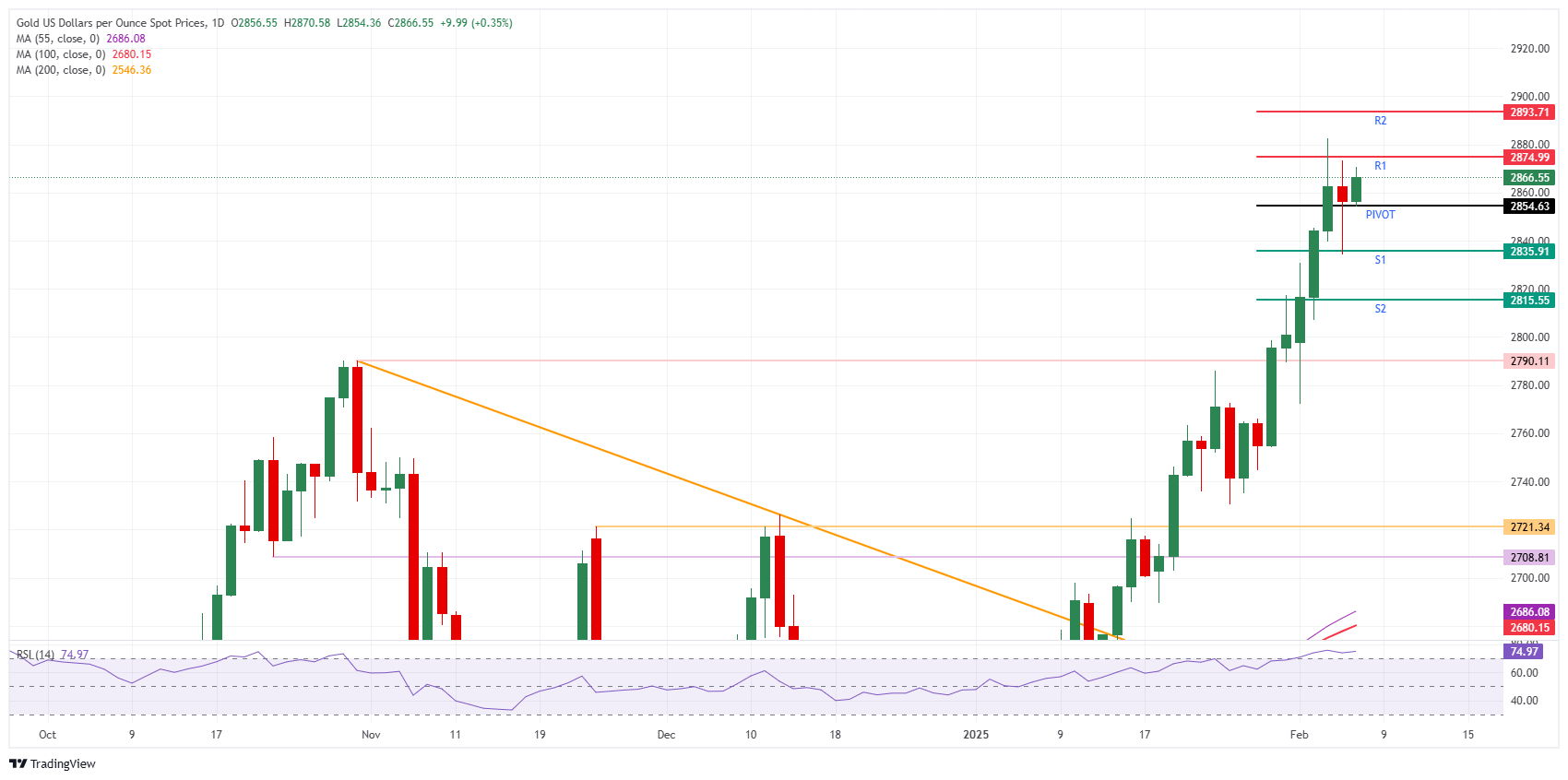
XAU/USD: Daily Chart
Gold FAQs
Gold has played a key role in human’s history as it has been widely used as a store of value and medium of exchange. Currently, apart from its shine and usage for jewelry, the precious metal is widely seen as a safe-haven asset, meaning that it is considered a good investment during turbulent times. Gold is also widely seen as a hedge against inflation and against depreciating currencies as it doesn’t rely on any specific issuer or government.
Central banks are the biggest Gold holders. In their aim to support their currencies in turbulent times, central banks tend to diversify their reserves and buy Gold to improve the perceived strength of the economy and the currency. High Gold reserves can be a source of trust for a country’s solvency. Central banks added 1,136 tonnes of Gold worth around $70 billion to their reserves in 2022, according to data from the World Gold Council. This is the highest yearly purchase since records began. Central banks from emerging economies such as China, India and Turkey are quickly increasing their Gold reserves.
Gold has an inverse correlation with the US Dollar and US Treasuries, which are both major reserve and safe-haven assets. When the Dollar depreciates, Gold tends to rise, enabling investors and central banks to diversify their assets in turbulent times. Gold is also inversely correlated with risk assets. A rally in the stock market tends to weaken Gold price, while sell-offs in riskier markets tend to favor the precious metal.
The price can move due to a wide range of factors. Geopolitical instability or fears of a deep recession can quickly make Gold price escalate due to its safe-haven status. As a yield-less asset, Gold tends to rise with lower interest rates, while higher cost of money usually weighs down on the yellow metal. Still, most moves depend on how the US Dollar (USD) behaves as the asset is priced in dollars (XAU/USD). A strong Dollar tends to keep the price of Gold controlled, whereas a weaker Dollar is likely to push Gold prices up.
Artigos Recomendados


