


Australian Dollar extends losses due to improved risk aversion
- The Australian Dollar remains weaker due to risk aversion following the attempted assassination of Donald Trump.
- The AUD/USD pair may limit its downside as persistently high inflation prompts the RBA to maintain a hawkish stance.
- CME Group’s FedWatch Tool indicates an 85.7% probability of a 25-basis point cut in September, up from 71.0% a week earlier.
The Australian Dollar (AUD) continues to decline for the second consecutive session on Tuesday. The AUD/USD pair loses ground due to a modest rebound in the US Dollar (USD), which could be attributed to increased risk aversion following the attempted assassination of former US President Donald Trump on Saturday. Investors are also looking ahead to the US June Retail Sales data, which are set to be released later today, for further insights.
The AUD/USD pair remains close to its strongest levels as speculation grows that the Reserve Bank of Australia (RBA) might delay joining the global rate-cutting cycle or even raise interest rates again. Persistently high inflation in Australia prompts the RBA to maintain a hawkish stance. In contrast, cooling US inflation strengthened bets for a Federal Reserve rate cut in September.
The US Dollar (USD) may limit its upside due to increasing speculation that the US Fed will lower borrowing costs. According to CME Group’s FedWatch Tool, markets now indicate an 85.7% probability of a 25-basis point rate cut at the September Fed meeting, up from 71.0% a week earlier.
Daily Digest Market Movers: Australian Dollar declines due to risk-off mood
- Fed Chair Jerome Powell mentioned on Monday that the three US inflation readings of this year "add somewhat to confidence" that inflation is on course to meet the Fed’s target in a sustainable manner, suggesting that a shift to interest rate cuts may not be far off.
- Fed Bank of San Francisco President Mary Daly stated that inflation is cooling down in a way that bolsters confidence that it’s on its way to 2%. However, Daly added that more information is needed before making a rate decision.
- In China, a close trade partner of Australia, Gross Domestic Product (GDP) grew 4.7% year-over-year in the second quarter, compared to a 5.3% expansion in the first quarter and an expected 5.1%.
- The National Bureau of Statistics (NBS) reported that China's economy operated generally steadily in the first half of the year, with H1 GDP growth at 5.0% year-on-year. Looking ahead, the NBS highlighted increasing external uncertainties and numerous domestic challenges that China's economy faces in the second half of the year.
- US President Joe Biden on Monday addressed the nation from the White House, where he condemned all political violence and called for unity, per CNBC. Biden further stated that “it’s time to cool it down” and noted not just the weekend attack on Trump but also the possibility of election-year violence on multiple fronts.
- China's Retail Sales (YoY) increased by 2.0% in June, falling short of the expected 3.3% and below May's 3.7%. Meanwhile, the country's Industrial Production for the same period showed a growth rate of 5.3% year-over-year, surpassing estimates of 5.0%, albeit slightly lower than May's 5.6%.
- On Thursday, the data showed that the US Core Consumer Price Index (CPI), which excludes volatile food and energy prices, rose by 3.3% year-over-year in June, compared to May's increase of 3.4% and the same expectation. Meanwhile, the core CPI increased by 0.1% month-over-month, against the expected and prior reading of 0.2%.
Technical Analysis: Australian Dollar hovers around 0.6750
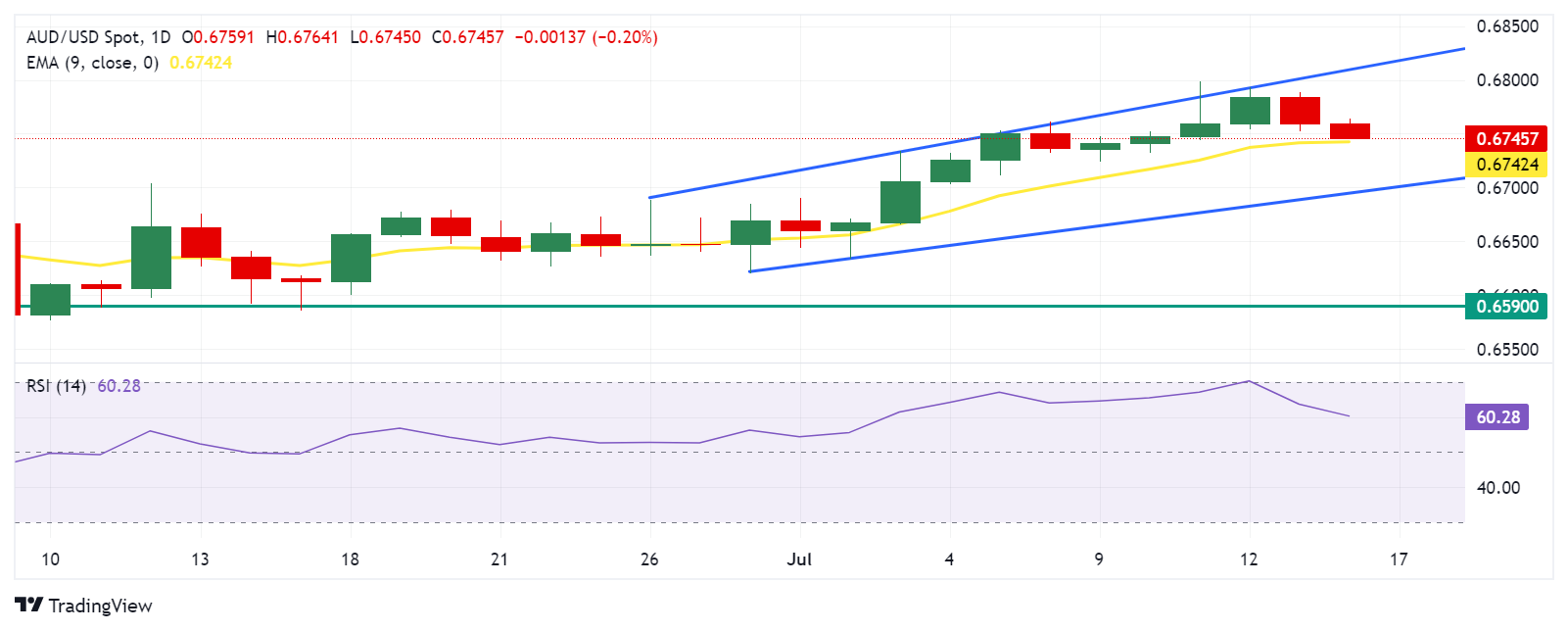
The Australian Dollar trades around 0.6750 on Tuesday. The analysis of the daily chart shows that the AUD/USD pair consolidates within an ascending channel, indicating a bullish bias. However, the 14-day Relative Strength Index (RSI) declines toward the 50 level, suggesting a correction. A further decline could weaken the bullish trend.
The AUD/USD pair may test the psychological level of 0.6800. A breakthrough above this level could support the pair to approach the upper boundary of the ascending channel near 0.6810.
On the downside, immediate support appears around the nine-day Exponential Moving Average (EMA) at 0.6743. Further support is seen near the lower boundary of the ascending channel at 0.6695. A break below this level could push the AUD/USD pair toward the throwback support at 0.6590.
AUD/USD: Daily Chart
Interest rates FAQs
Interest rates are charged by financial institutions on loans to borrowers and are paid as interest to savers and depositors. They are influenced by base lending rates, which are set by central banks in response to changes in the economy. Central banks normally have a mandate to ensure price stability, which in most cases means targeting a core inflation rate of around 2%. If inflation falls below target the central bank may cut base lending rates, with a view to stimulating lending and boosting the economy. If inflation rises substantially above 2% it normally results in the central bank raising base lending rates in an attempt to lower inflation.
Higher interest rates generally help strengthen a country’s currency as they make it a more attractive place for global investors to park their money.
Higher interest rates overall weigh on the price of Gold because they increase the opportunity cost of holding Gold instead of investing in an interest-bearing asset or placing cash in the bank. If interest rates are high that usually pushes up the price of the US Dollar (USD), and since Gold is priced in Dollars, this has the effect of lowering the price of Gold.
The Fed funds rate is the overnight rate at which US banks lend to each other. It is the oft-quoted headline rate set by the Federal Reserve at its FOMC meetings. It is set as a range, for example 4.75%-5.00%, though the upper limit (in that case 5.00%) is the quoted figure. Market expectations for future Fed funds rate are tracked by the CME FedWatch tool, which shapes how many financial markets behave in anticipation of future Federal Reserve monetary policy decisions.
Artigos Recomendados


