


New Zealand Dollar stays near its low as producer prices undershoot
- NZD/USD makes a new low under 0.5500 and is on track for a sixth fall.
- The RBNZ's rate is 2.75%, at least a full point under the Fed's 3.75%-4.00%.
- RBNZ Governor Breman speaks on Wednesday, before the Fed's minutes.
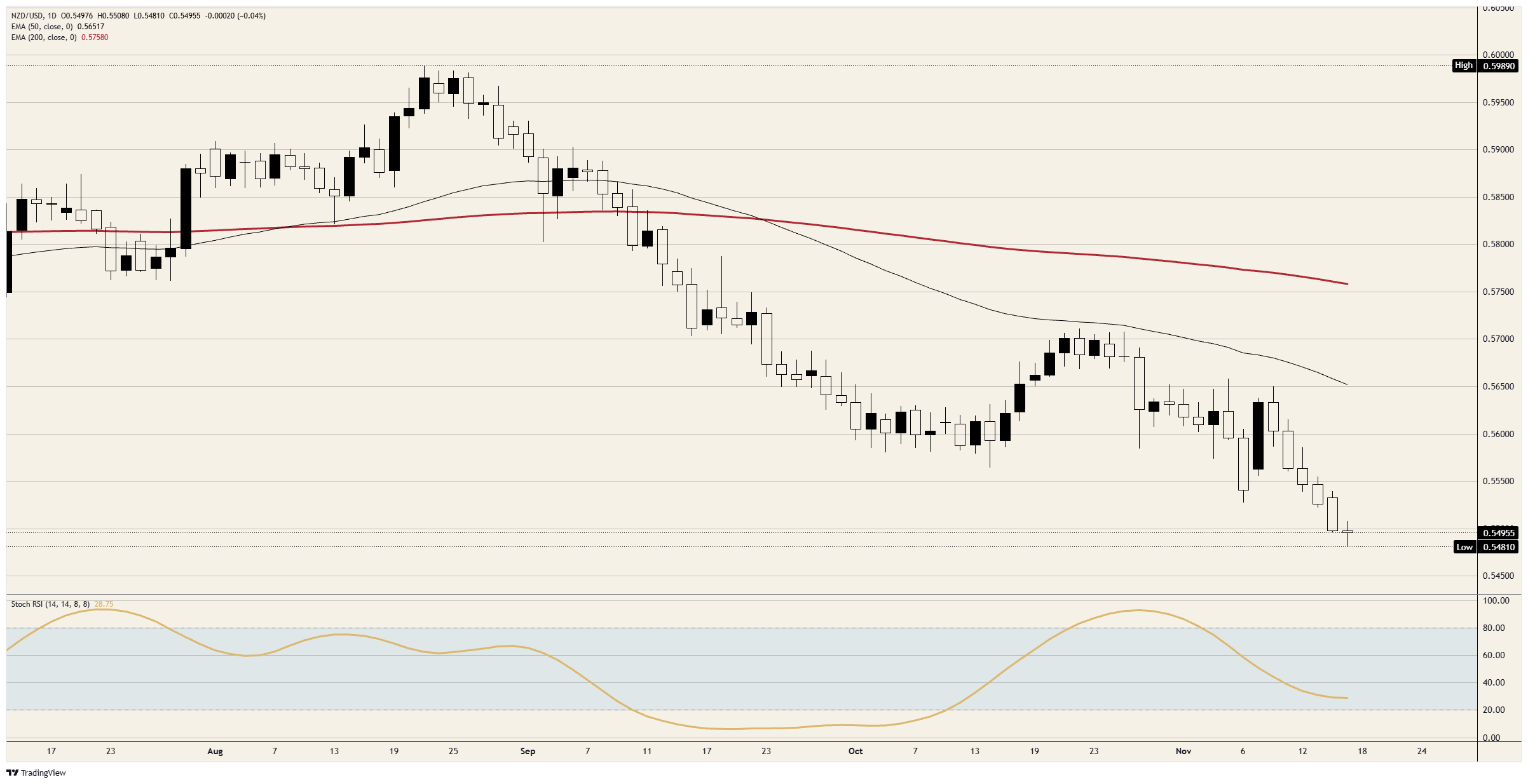
The Pound, the Euro and the Aussie all stopped falling on Tuesday, and the Kiwi is on track for a sixth losing session instead. NZD/USD fell further under 0.5500, to its lowest since at least July, and is trading back near that level. New Zealand's producer prices then came in below forecast.
The Reserve Bank of New Zealand (RBNZ) has held its rate at 2.75% since a 4-3 vote on October 28, putting it 1.00-1.25 percentage points below the Fed's 3.75%-4.00%. Traders have a Fed hike priced for December 9, and the RBNZ's next decision falls on the same date. The Dollar's reversal from a 19-month high lifted the others and left the Kiwi where it was.
Producer output prices rose 0.8% in the third quarter, below the 1.1% forecast and half the 1.6% of the quarter before. The RBNZ's own survey, out the same day, had two-year inflation expectations rising to 2.36%. RBNZ Governor Breman voted with the majority to hold in October and said then that the chances of a December hike were high.
On the calendar
RBNZ Governor Breman speaks at 18:00 GMT on Wednesday, and New Zealand's October trade figures follow at 21:45 GMT. Traders had a hike priced near 90% before October's hold, so what she says about December bears directly on where they put New Zealand's rate.
Wednesday's Fed minutes, at 19:00 GMT, come between the two. Thursday has Australia's October jobs report (00:30 GMT) and US initial jobless claims (13:30 GMT), forecast at 196K. The US items bear on the Fed's side of a gap that is already at least a full point.
On the charts
NZD/USD has fallen in each session since a November 10 high near 0.5650. The August high just under 0.6000 is nearly a tenth above where it trades now. Above the market, the 50-day Exponential Moving Average (EMA) is just over 0.5650 and the 200-day just over 0.5750, and daily momentum is close to oversold.
NZD/USD daily chart
New Zealand Dollar FAQs
The New Zealand Dollar (NZD), also known as the Kiwi, is a well-known traded currency among investors. Its value is broadly determined by the health of the New Zealand economy and the country’s central bank policy. Still, there are some unique particularities that also can make NZD move. The performance of the Chinese economy tends to move the Kiwi because China is New Zealand’s biggest trading partner. Bad news for the Chinese economy likely means less New Zealand exports to the country, hitting the economy and thus its currency. Another factor moving NZD is dairy prices as the dairy industry is New Zealand’s main export. High dairy prices boost export income, contributing positively to the economy and thus to the NZD.
The Reserve Bank of New Zealand (RBNZ) aims to achieve and maintain an inflation rate between 1% and 3% over the medium term, with a focus to keep it near the 2% mid-point. To this end, the bank sets an appropriate level of interest rates. When inflation is too high, the RBNZ will increase interest rates to cool the economy, but the move will also make bond yields higher, increasing investors’ appeal to invest in the country and thus boosting NZD. On the contrary, lower interest rates tend to weaken NZD. The so-called rate differential, or how rates in New Zealand are or are expected to be compared to the ones set by the US Federal Reserve, can also play a key role in moving the NZD/USD pair.
Macroeconomic data releases in New Zealand are key to assess the state of the economy and can impact the New Zealand Dollar’s (NZD) valuation. A strong economy, based on high economic growth, low unemployment and high confidence is good for NZD. High economic growth attracts foreign investment and may encourage the Reserve Bank of New Zealand to increase interest rates, if this economic strength comes together with elevated inflation. Conversely, if economic data is weak, NZD is likely to depreciate.
The New Zealand Dollar (NZD) tends to strengthen during risk-on periods, or when investors perceive that broader market risks are low and are optimistic about growth. This tends to lead to a more favorable outlook for commodities and so-called ‘commodity currencies’ such as the Kiwi. Conversely, NZD tends to weaken at times of market turbulence or economic uncertainty as investors tend to sell higher-risk assets and flee to the more-stable safe havens.
Artigos Recomendados


