


USD/INR opens higher as RBI steps up measures to support Indian Rupee
- The Indian Rupee gains significantly against the US Dollar due to multiple tailwinds.
- RBI tightens hedging rules and directs OMCs to cater US Dollar demand through their special window.
- Investors await the India’s retail CPI data for September.
The Indian Rupee (INR) opens significantly higher against the US Dollar (USD) on Monday. The USD/INR pair falls 1% to near 95.80 as Reserve Bank of India’s (RBI) fresh measures to curb US Dollar demand has brought relief for the Indian currency.
Over the weekend, RBI unveiled measures to shore up the Indian Rupee, which includes catering demand of US Dollars by Public Sector Undertaking (PSU) Oil Marketing Companies (OMCs) through central bank’s special window, easing pressure on the spot market and tighten hedging rules, Reuters report.
According to analysts at ANZ Bank, "Addressing oil companies' dollar requirements removes one of the largest sources of demand from the FX market, which should help reduce volatility but it will show up in a depletion of reserves.”
On the geopolitical front, the sharp decline in oil prices due to the announcement of an energy ceasefire between Russia and Ukraine has also lend strength to the Indian Rupee.
In the opening trade, the MCX Crude Oil contract expiring on October 19 is down 2.22% to near Rs. 8,684. Lower oil prices bode well for currencies from economies, such as India, which rely heavily on oil imports to meet their energy needs.
Meanwhile, investors await India’s retail Consumer Price Index (CPI) data for September, which will be published at 04:00 PM (10:30 GMT).
According to Societe Generale, India’s inflation backdrop is set to deteriorate markedly in September 2026, with the bank projecting that “headline CPI inflation [will] rise sharply to 5.6% yoy, from 4.8% in August, led by food inflation which likely rose to around 7.5% yoy.”
USD/INR Technical Analysis
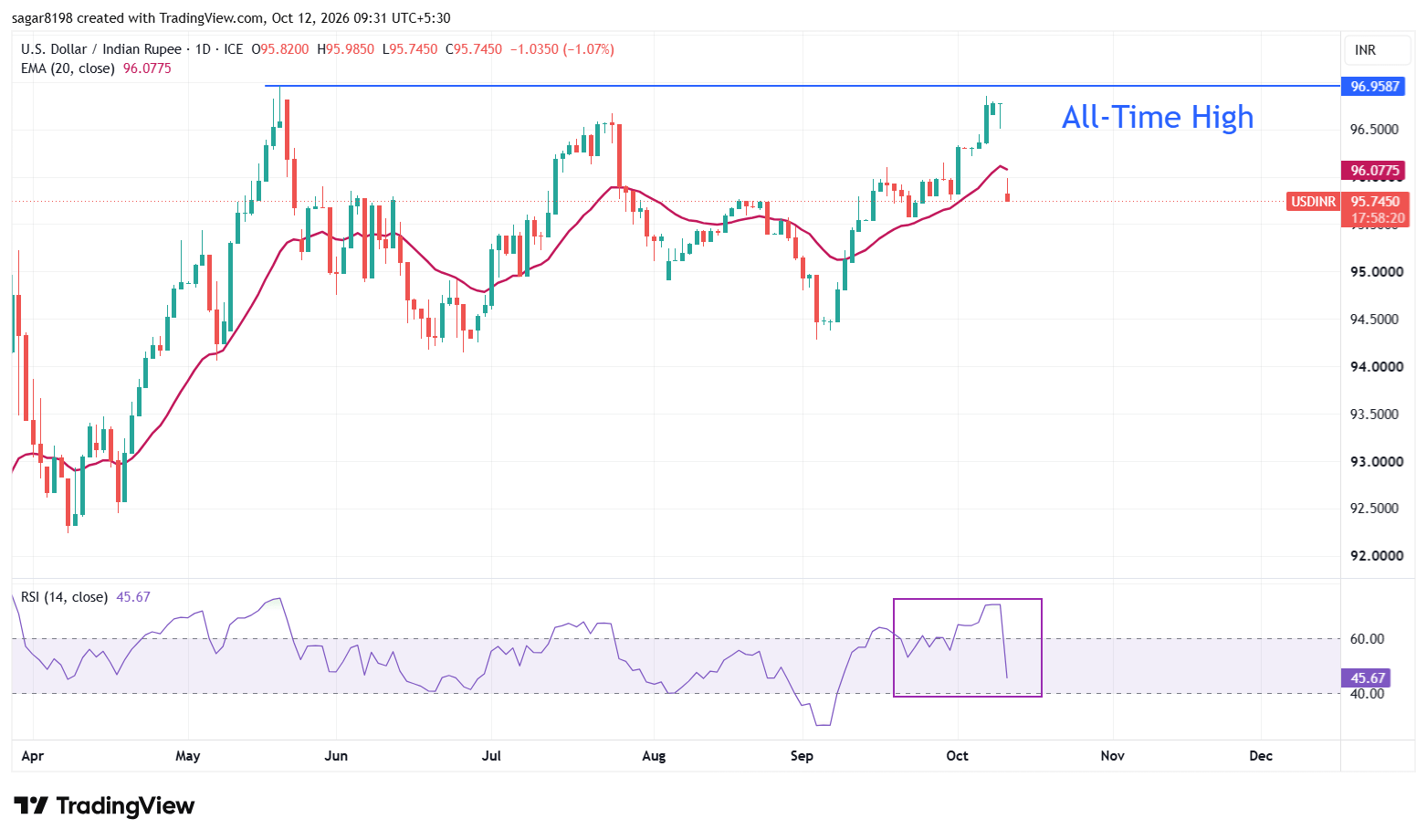
In the daily chart, USD/INR trades at 95.75, turns bearish as spot falls below the 20-period Exponential Moving Average (EMA) at 96.07. The 14-period Relative Strength Index (RSI) slides vertically to near 45.00, indicating some overnight change in fundamentals.
On the upside, initial support is located at the 20-day EMA near 96.0. Looking down, the pair could extend its declines towards 95.00.
(The technical analysis of this story was written with the help of an AI tool. Know more.)
Indian Rupee FAQs
The Indian Rupee (INR) is one of the most sensitive currencies to external factors. The price of Crude Oil (the country is highly dependent on imported Oil), the value of the US Dollar – most trade is conducted in USD – and the level of foreign investment, are all influential. Direct intervention by the Reserve Bank of India (RBI) in FX markets to keep the exchange rate stable, as well as the level of interest rates set by the RBI, are further major influencing factors on the Rupee.
The Reserve Bank of India (RBI) actively intervenes in forex markets to maintain a stable exchange rate, to help facilitate trade. In addition, the RBI tries to maintain the inflation rate at its 4% target by adjusting interest rates. Higher interest rates usually strengthen the Rupee. This is due to the role of the ‘carry trade’ in which investors borrow in countries with lower interest rates so as to place their money in countries’ offering relatively higher interest rates and profit from the difference.
Macroeconomic factors that influence the value of the Rupee include inflation, interest rates, the economic growth rate (GDP), the balance of trade, and inflows from foreign investment. A higher growth rate can lead to more overseas investment, pushing up demand for the Rupee. A less negative balance of trade will eventually lead to a stronger Rupee. Higher interest rates, especially real rates (interest rates less inflation) are also positive for the Rupee. A risk-on environment can lead to greater inflows of Foreign Direct and Indirect Investment (FDI and FII), which also benefit the Rupee.
Higher inflation, particularly, if it is comparatively higher than India’s peers, is generally negative for the currency as it reflects devaluation through oversupply. Inflation also increases the cost of exports, leading to more Rupees being sold to purchase foreign imports, which is Rupee-negative. At the same time, higher inflation usually leads to the Reserve Bank of India (RBI) raising interest rates and this can be positive for the Rupee, due to increased demand from international investors. The opposite effect is true of lower inflation.
Artigos Recomendados


