


The Australian Dollar continues to slide as the Fed enters hike country
- AUD/USD trades under its 50-day average, which it last did in early August.
- RBA cash rate is 4.35%, still above the Fed's new 3.75-4.00% range.
- RBA Governor Bullock speaks Thursday at 23:30 GMT, next rate decision September 29.
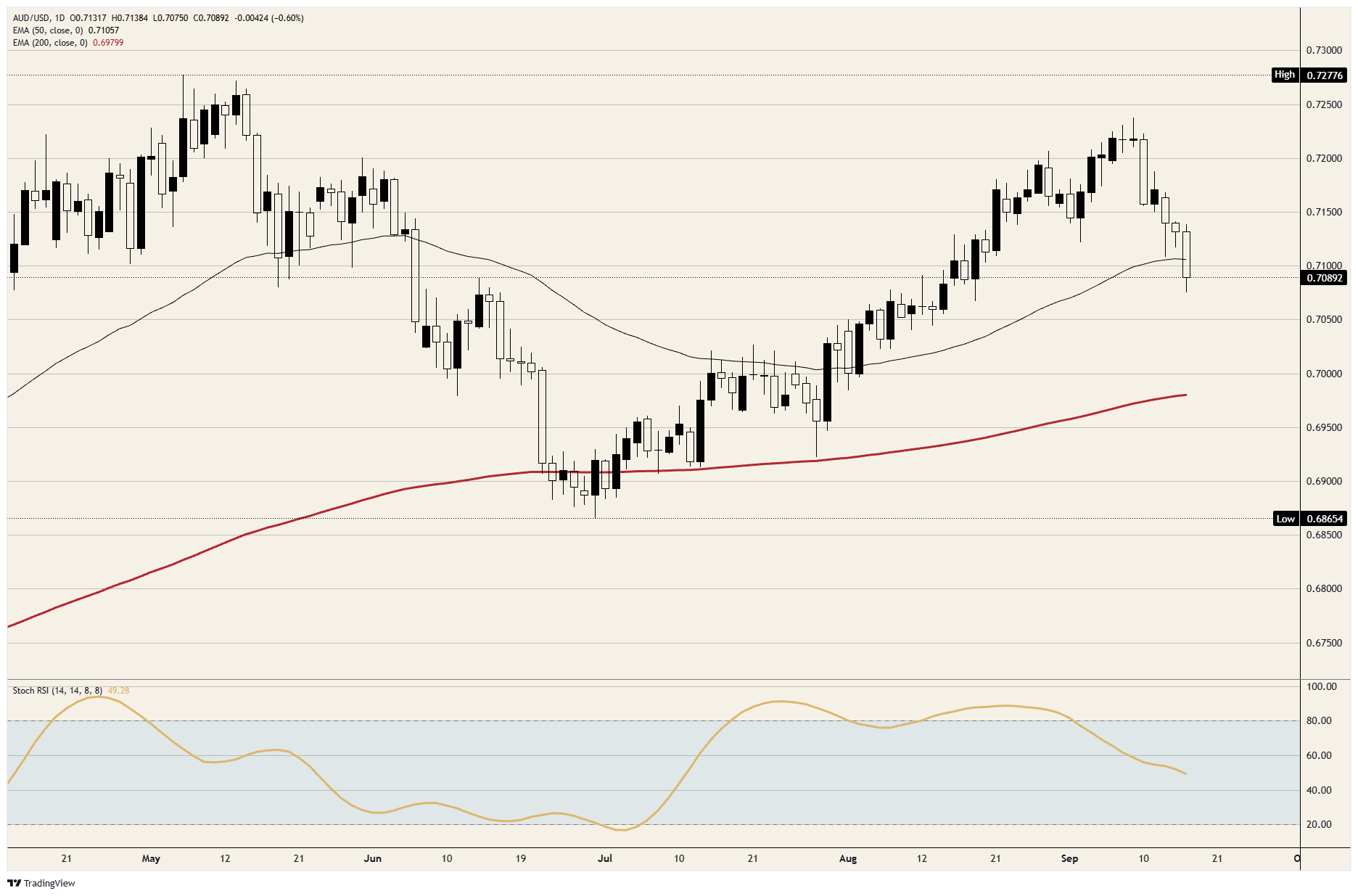
Australia's central bank pays more than the Federal Reserve (Fed) does. The cash rate is 4.35%, the Fed's new range is 3.75-4.00% after Wednesday's quarter-point hike, and most of the big Australian banks expect the RBA to raise again before the end of the year, and none of that has helped. AUD/USD has fallen five sessions in a row from the September high near 0.7250 and is trading just under 0.7100, under its 50-day average for the first time in six weeks.
The rate gap is in the Aussie's favour and it isn't working
The Reserve Bank of Australia (RBA) raised three times earlier this year, held at 4.35% in August, and said it could go again if inflation stayed high. Inflation was 3.5% in July with the underlying measure at 3.6%, so the case for another rise is live. On paper that's a currency with a rate advantage over the Dollar and a central bank that's still leaning toward more. In practice the Aussie trades as a bet on global growth and commodity demand, and on days when the Dollar rallies on higher US rates, it falls with everything else. Wednesday's fall was the largest of the five, which is the run getting faster rather than slowing down. The Fed's projections have one more hike this year, to 4.1%, so the gap narrows from here even if the RBA does nothing. A central bank that pays more than the Fed and plans to pay more still has produced a currency that has lost ground for a week.
A speech, then a fortnight of nothing
RBA Governor Bullock speaks on Thursday at 23:30 GMT, and it's the only Australian event on the calendar before the September 29 rate decision. There's nothing else scheduled at home. The Dollar side is busier: US housing starts and jobless claims on Thursday at 12:30 GMT, a Fed governor speaking on Friday at 07:30 GMT, and US industrial production on Friday at 13:15 GMT. Momentum on the daily chart is halfway down from its September peak and still falling, which means the selling has further to run before it looks stretched. The Aussie has given back about 40% of the rally it built from early July to the start of September.
Levels and bias
Resistance: The 50-day Exponential Moving Average (EMA) near 0.7100, which had held as a floor since early August until Wednesday, then 0.7150, then the September high near 0.7250.
Support: Wednesday's low just above 0.7050, then 0.7000, which is the last round level before the July starting point of the summer rally.
Bias: Bearish below 0.7100. The first objective is 0.7050 and the second is 0.7000. The daily Stochastic Relative Strength Index (Stoch RSI), a momentum gauge, is at 49 and falling from the top of its range, so there's room for more selling before it's stretched. A daily close above 0.7150 would mean the bearish case is wrong.
AUD/USD daily chart
Australian Dollar FAQs
One of the most significant factors for the Australian Dollar (AUD) is the level of interest rates set by the Reserve Bank of Australia (RBA). Because Australia is a resource-rich country another key driver is the price of its biggest export, Iron Ore. The health of the Chinese economy, its largest trading partner, is a factor, as well as inflation in Australia, its growth rate and Trade Balance. Market sentiment – whether investors are taking on more risky assets (risk-on) or seeking safe-havens (risk-off) – is also a factor, with risk-on positive for AUD.
The Reserve Bank of Australia (RBA) influences the Australian Dollar (AUD) by setting the level of interest rates that Australian banks can lend to each other. This influences the level of interest rates in the economy as a whole. The main goal of the RBA is to maintain a stable inflation rate of 2-3% by adjusting interest rates up or down. Relatively high interest rates compared to other major central banks support the AUD, and the opposite for relatively low. The RBA can also use quantitative easing and tightening to influence credit conditions, with the former AUD-negative and the latter AUD-positive.
China is Australia’s largest trading partner so the health of the Chinese economy is a major influence on the value of the Australian Dollar (AUD). When the Chinese economy is doing well it purchases more raw materials, goods and services from Australia, lifting demand for the AUD, and pushing up its value. The opposite is the case when the Chinese economy is not growing as fast as expected. Positive or negative surprises in Chinese growth data, therefore, often have a direct impact on the Australian Dollar and its pairs.
Iron Ore is Australia’s largest export, accounting for $118 billion a year according to data from 2021, with China as its primary destination. The price of Iron Ore, therefore, can be a driver of the Australian Dollar. Generally, if the price of Iron Ore rises, AUD also goes up, as aggregate demand for the currency increases. The opposite is the case if the price of Iron Ore falls. Higher Iron Ore prices also tend to result in a greater likelihood of a positive Trade Balance for Australia, which is also positive of the AUD.
The Trade Balance, which is the difference between what a country earns from its exports versus what it pays for its imports, is another factor that can influence the value of the Australian Dollar. If Australia produces highly sought after exports, then its currency will gain in value purely from the surplus demand created from foreign buyers seeking to purchase its exports versus what it spends to purchase imports. Therefore, a positive net Trade Balance strengthens the AUD, with the opposite effect if the Trade Balance is negative.
Artigos Recomendados


