


Yen waits on Tokyo CPI to bail out the BoJ
- Tokyo Consumer Price Index (CPI) for May lands at 23:30 GMT Thursday, the Yen's last meaningful catalyst before the weekend.
- April's print missed across every measure, pushing June rate hike pricing further out.
- The data is now the Yen's primary lever short of another intervention.
The Bank of Japan (BoJ) has effectively outsourced its next policy decision to the statistics bureau. After two intervention rounds reportedly totaling more than $60 billion in late April and early May, USD/JPY has already clawed back roughly 80% of those declines and now trades near 159.20, well within reach of the politically sensitive 160.00 handle. Governor Kazuo Ueda's recent rhetoric has done little to slow the grind higher, and traders increasingly read his comments as warnings rather than commitments. That leaves Tokyo CPI as the single remaining catalyst capable of forcing a rethink without another check from the Ministry of Finance.
The April miss is still doing the damage
Last month's Tokyo CPI print came in soft across every measure that mattered. Headline at 1.5% YoY, core ex-fresh-food at 1.5% YoY, and the closely watched core-core reading (ex-fresh-food and energy) collapsing to 1.9% YoY against a 2.3% consensus. That core-core slide was the print's most consequential element, the slowest pace since March 2022 and a third consecutive month below the BoJ's 2% target. Rate markets reacted immediately, pushing June hike probabilities further out and stripping the Yen of one of its few non-intervention supports.
Consensus for May has the headline ex-fresh-food measure holding flat at 1.5% YoY. That alone tells you what positioning desks expect.
Why carry traders aren't sweating
The Yen carry trade is currently funded by a roughly 300 basis point differential between the Federal Reserve's (Fed) 3.50% to 3.75% target range and the BoJ's 0.75% policy rate. Every day Tokyo CPI fails to surprise to the upside is another day that math holds, and another day positioning rebuilds toward levels seen before the April 30 intervention. The asymmetry sits firmly with the carry trader. A miss confirms the playbook. A beat creates noise, but a single Tokyo print has never been enough to force a hike Ueda does not want to deliver.
The data would need to surprise meaningfully across both headline and core-core measures, ideally on the back of a clear reacceleration in services inflation, to genuinely shift the policy timeline rather than briefly rattle positioning.
The chart agrees with the macro
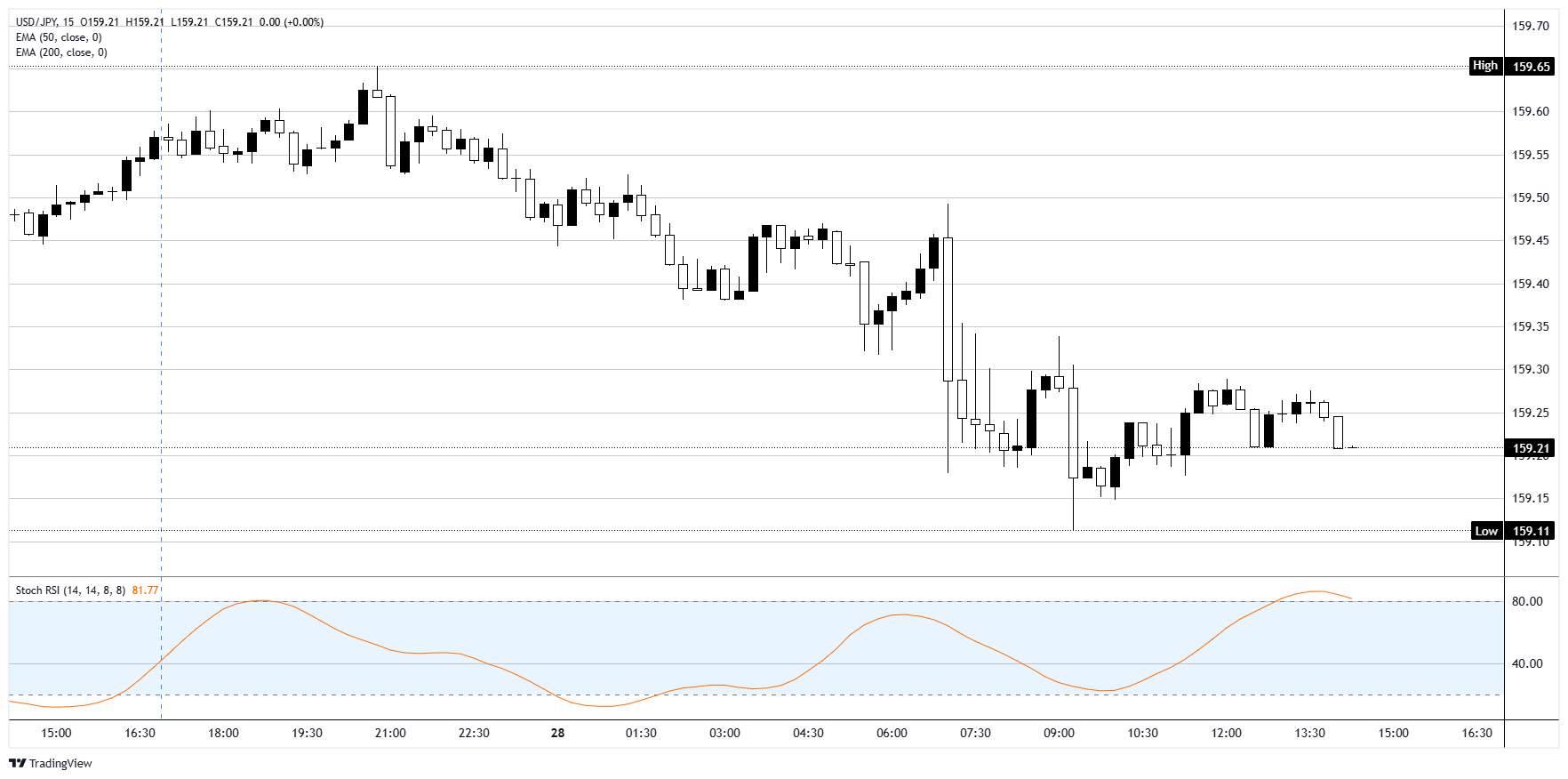
Daily structure shows the pair trading above the 50-period Exponential Moving Average (EMA) near 158.50, with the 200 EMA further below close to 155.50. The Stochastic Relative Strength Index (Stoch RSI) on the daily chart is climbing through the upper band and approaching overbought, hinting at near-term exhaustion without yet flashing reversal. Intraday price has slipped from 159.65 to around 159.20 ahead of the print, suggesting some pre-event position trimming rather than fresh selling pressure.
The 160.00 handle remains the line the Ministry of Finance has clearly drawn. The 158.50 area below acts as first support, and a clean break opens 156.00 again.
Data preview: scenarios that matter
- A consensus-aligned print, with headline ex-fresh-food holding at 1.5% YoY and core-core near 1.9%, likely sees the Yen drift weaker and brings the test of 160.00 forward into next week.
- A meaningful miss, with headline closer to 1.3% and core-core under 1.8%, effectively closes the book on June hike pricing. The pair grinds through 160.00, and Tokyo's next intervention decision moves up the calendar.
- A genuine upside surprise, with headline above 1.7% and core-core back near or above 2.1%, is the cleanest Yen-positive setup available this week and reopens credible June or July hike pricing. The pair retreats toward 158.50 quickly and forces a real rethink of positioning into the BoJ's June meeting.
Bias
The path of least resistance stays higher unless Tokyo CPI delivers an upside surprise broad enough to force a genuine repricing of the BoJ's near-term hike path. Until then, dips remain bids, and the Yen's fate stays in the hands of a statistics bureau the BoJ should have been listening to all along.
USD/JPY 15-minute chart
Japanese Yen FAQs
The Japanese Yen (JPY) is one of the world’s most traded currencies. Its value is broadly determined by the performance of the Japanese economy, but more specifically by the Bank of Japan’s policy, the differential between Japanese and US bond yields, or risk sentiment among traders, among other factors.
One of the Bank of Japan’s mandates is currency control, so its moves are key for the Yen. The BoJ has directly intervened in currency markets sometimes, generally to lower the value of the Yen, although it refrains from doing it often due to political concerns of its main trading partners. The BoJ ultra-loose monetary policy between 2013 and 2024 caused the Yen to depreciate against its main currency peers due to an increasing policy divergence between the Bank of Japan and other main central banks. More recently, the gradually unwinding of this ultra-loose policy has given some support to the Yen.
Over the last decade, the BoJ’s stance of sticking to ultra-loose monetary policy has led to a widening policy divergence with other central banks, particularly with the US Federal Reserve. This supported a widening of the differential between the 10-year US and Japanese bonds, which favored the US Dollar against the Japanese Yen. The BoJ decision in 2024 to gradually abandon the ultra-loose policy, coupled with interest-rate cuts in other major central banks, is narrowing this differential.
The Japanese Yen is often seen as a safe-haven investment. This means that in times of market stress, investors are more likely to put their money in the Japanese currency due to its supposed reliability and stability. Turbulent times are likely to strengthen the Yen’s value against other currencies seen as more risky to invest in.
Artigos Recomendados


