


Twenty-eight names eat the Dow Jones Industrial Average's two blowouts
- DJIA holds near 53,600, up 0.29% against the Nasdaq Composite's 1.1%.
- Salesforce worth close to 250 index points, Nvidia roughly 100, both components.
- Fed keynote and the payrolls benchmark revision both land at 14:00 GMT Friday.
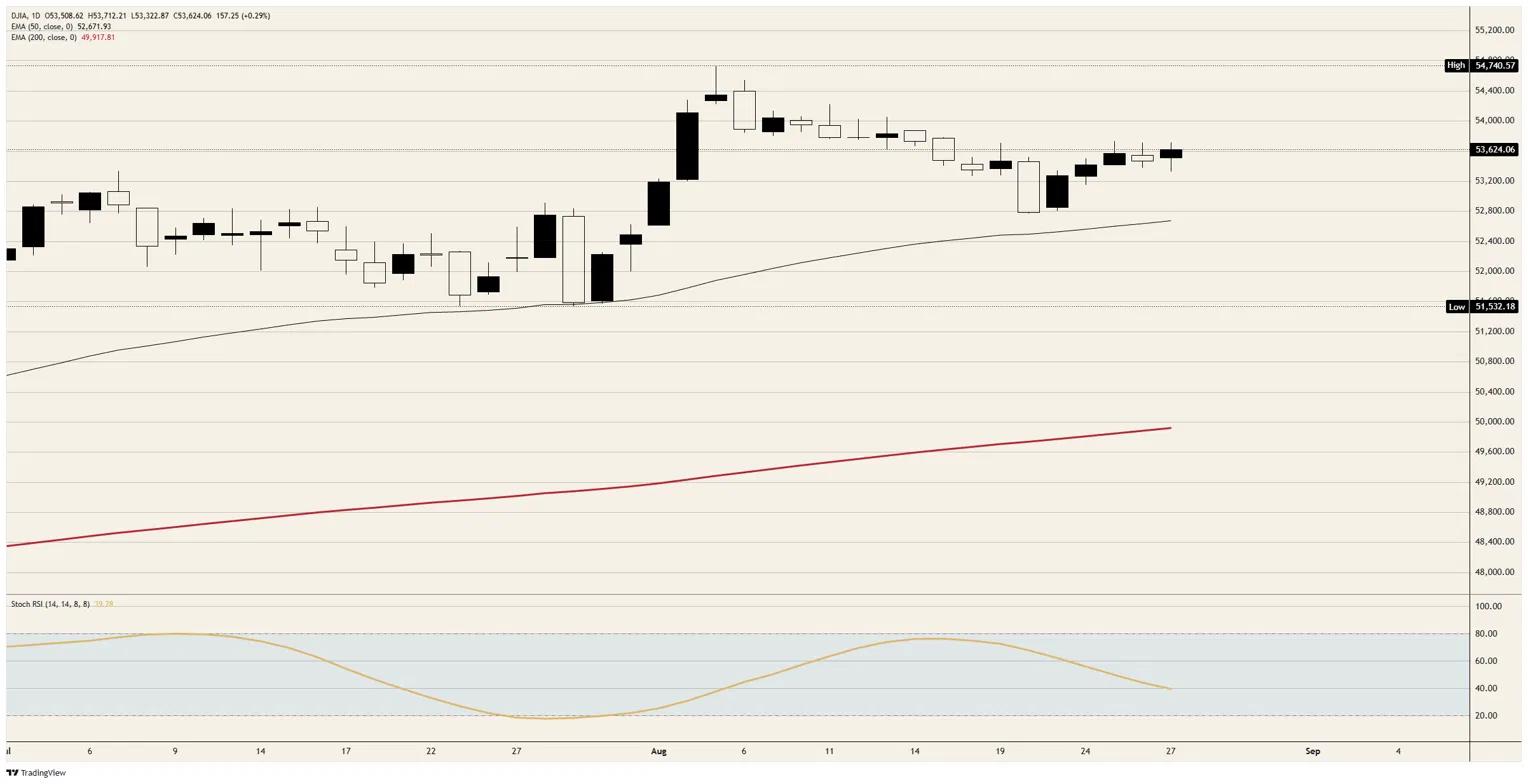
The Dow Jones Industrial Average trades near 53,600 on Thursday, ahead 0.29% on the session across a range running from the 53,300 area to just above 53,700. That is roughly a quarter of what the Nasdaq Composite is putting on, and it arrives on a day when the price-weighted index happens to own both of the loudest earnings reactions on the tape.
Owning both winners is not enough
Salesforce (CRM) trades close to 20% higher after a second-quarter revenue beat, and Nvidia (NVDA) close to 7.5% higher on results carrying a fiscal 2028 growth forecast far above what the sell side had modelled. Both sit inside the thirty. Under price weighting a component contributes Dollars of share-price movement rather than percentage points of market value, and at roughly six index points per Dollar the pair is worth close to 350 points between them.
The index carries about 157 points of that, which leaves twenty-eight other names subtracting close to 200 points among them. The familiar complaint about a price-weighted average is that the winners keep landing outside it, a 27% mover in early August delivering nothing and a record biotech session delivering nothing the week after. On Thursday the membership finally works, both blowouts are components, and the index still runs at a quarter of the tech-heavy benchmark. What separates the averages this time is not the roster but the twenty-eight names paying for the two.
Three speakers, one direction
The annual Jackson Hole symposium opened Thursday and three policymakers reached the wires before the New York open. The 11:30 GMT speech scored hawkish at 7.0 against a 7.1 speaker average, calling inflation stubborn and sticky without asking for a move. The 12:15 GMT speech read neutral at 6.0, exactly its own average. The 14:30 GMT speech scored hawkish at 8.0 against a 7.5 average and went further than either, restating from one of July's three dissenting seats that more than five years above target is not a condition current policy is restraining, and that the moment to act has arrived.
Between the second and third of those, initial jobless claims printed 203K at 12:30 GMT against a 208K consensus and 207K prior, with continuing claims down to 1.78 million. That is not a labour market asking anybody to stop. The session low at the 53,300 area printed in the half hour after the release and before the opening bell, and from there the index took back close to 390 points into a 15:15 GMT high just above 53,700, running straight through the most hawkish scheduled remarks of the day.
The duty aimed at what the tape just bought
A report published Thursday morning has the administration weighing a wider round of semiconductor duties, sourced to eight people and framed as early enough to change substantially. The proposal reaches past chips into the goods built around them: laptops, gaming hardware and data centre servers. The Commerce Secretary is reported to favour tying relief from the duty to committed investment in domestic chip manufacturing, with a phase-in period under discussion.
The January action set 25% on certain advanced computing chips and then carved out the ones bound for data centres, which is the exemption that has let the artificial intelligence (AI) buildout import its hardware duty-free. Reaching the servers themselves takes that carve-out away and moves the cost onto the buyers rather than the supplier. Thursday's tape paid close to 7.5% for the company at the centre of the buildout and roughly 20% for a software name selling into it, on the same morning the framework that taxes their customers' equipment widened.
Friday stacks two red bands in one minute
Friday at 14:00 GMT carries the Fed Chair's first Jackson Hole keynote, delivered as prepared text with no questions taken and set against a symposium theme of financial innovation in payments rather than the policy path. The same minute brings the preliminary estimate of the annual benchmark revision to the establishment survey, the exercise that has taken 818K and then 911K off the payroll level in the past two rounds. One of the two is scheduled to say very little about rates, and the other restates a year of employment history without setting out to say anything about them.
Around it, the Chicago Purchasing Managers Index (PMI) lands at 13:45 GMT with a 57 consensus against 57.6 prior, and the final August Michigan readings follow at 14:00, sentiment at 51 and expectations at 50.6, each matching the preliminary. One-year inflation expectations sit at 4.3% and the five-year at 3.3%, both unchanged and both still pinned. Web-sourced pricing has a September increase running near one chance in three, which makes a speech about payments rails the last scheduled word before the August jobs report.
Levels
Resistance: Just above 53,700 is the cap, and Thursday's high stops within two points of the level that turned the index back on August 19. Beyond it the 53,800 area has held every attempt since mid-August, with 54,100 and the record just short of 54,750 above that.
Support: The session low near 53,300 is the first mark beneath, then the 53,000 handle, with the 50-day Exponential Moving Average (EMA) near 52,700 and rising the last line before the August trend is in question.
Bias: Bearish while just above 53,700 caps. The daily Stochastic Relative Strength Index (Stoch RSI) at 39 is falling out of the upper band with no new high behind it, which is the signature of a second failure rather than a base. Invalidation on a daily close above 53,800.
Dow Jones daily chart
Dow Jones FAQs
The Dow Jones Industrial Average, one of the oldest stock market indices in the world, is compiled of the 30 most traded stocks in the US. The index is price-weighted rather than weighted by capitalization. It is calculated by summing the prices of the constituent stocks and dividing them by a factor, currently 0.152. The index was founded by Charles Dow, who also founded the Wall Street Journal. In later years it has been criticized for not being broadly representative enough because it only tracks 30 conglomerates, unlike broader indices such as the S&P 500.
Many different factors drive the Dow Jones Industrial Average (DJIA). The aggregate performance of the component companies revealed in quarterly company earnings reports is the main one. US and global macroeconomic data also contributes as it impacts on investor sentiment. The level of interest rates, set by the Federal Reserve (Fed), also influences the DJIA as it affects the cost of credit, on which many corporations are heavily reliant. Therefore, inflation can be a major driver as well as other metrics which impact the Fed decisions.
Dow Theory is a method for identifying the primary trend of the stock market developed by Charles Dow. A key step is to compare the direction of the Dow Jones Industrial Average (DJIA) and the Dow Jones Transportation Average (DJTA) and only follow trends where both are moving in the same direction. Volume is a confirmatory criteria. The theory uses elements of peak and trough analysis. Dow’s theory posits three trend phases: accumulation, when smart money starts buying or selling; public participation, when the wider public joins in; and distribution, when the smart money exits.
There are a number of ways to trade the DJIA. One is to use ETFs which allow investors to trade the DJIA as a single security, rather than having to buy shares in all 30 constituent companies. A leading example is the SPDR Dow Jones Industrial Average ETF (DIA). DJIA futures contracts enable traders to speculate on the future value of the index and Options provide the right, but not the obligation, to buy or sell the index at a predetermined price in the future. Mutual funds enable investors to buy a share of a diversified portfolio of DJIA stocks thus providing exposure to the overall index.
추천 기사


