


Crude Oil spikes on a shut Saudi pipeline and unwinds on Trump's posts
- WTI Crude Oil spikes on a shut Saudi pipeline, unwinds on Truth Social, up 1.4%.
- Saudi Arabia pumped 6.238 million barrels a day in August, its lowest since 1990.
- Four ships exited Hormuz over the weekend, against about 100 a day before the war.
West Texas Intermediate (WTI) trades near $98.00, about 1.4% higher on the day. It was more than 4% higher shortly after 12:30 GMT and had given nearly all of that back by 19:00. The gain priced a Saudi pipeline that was shut on Friday and photographed from orbit on Sunday with a burnt-out pumping station. The loss priced four posts on Truth Social between 15:05 and 16:31 GMT. The last of them said the price will drop like a rock once the war is over. The next half hour supplied the drop.
The world's largest exporter has run out of doors
Saudi Crude Oil leaves the country three ways, and all three had a bad week. Tankers can sail out through the Strait of Hormuz, where Iran now requires permission. Four vessels exited that way over the weekend, against about 100 a day before the war began on February 28. Or the barrels cross the peninsula in the East-West pipeline, 7 million barrels a day of capacity, to Yanbu on the Red Sea. From Yanbu they sail south to Asia through Bab el-Mandeb or north to Europe through Suez.
The Houthis took the port of Mokha and Perim Island, in the middle of Bab el-Mandeb, on Thursday and Friday, and declared the strait open to every ship except a Saudi one. Drones from Iraq hit the pipeline's pumping stations on Thursday, the kingdom shut the line on Friday as a precaution, and the restart has no date. Saudi Arabia reported August production of 6.238 million barrels a day, its lowest since 1990, and shipping data put its exports near 3.2 million, the lowest since 2013.
Every Saudi barrel that cannot leave is a barrel an Asian refiner tries to buy on the Atlantic side, and the terminal with room to sell it is the US Gulf Coast. That is the buyer WTI met on the Sunday open. Yanbu learned over the summer to send its barrels north instead of south. As of Friday it receives none.
Four posts moved the price further than a shut pipeline
The sell-off came in four legs, and each began within minutes of a post. The first, at 15:05 GMT, said Ukraine and Russia had agreed to stop hitting each other's energy plants and blamed the world's diesel price on that war rather than this one. Ukraine's president answered an hour later that the halt depends on Russia stopping first. American diesel averaged a record $6.23 a gallon on Monday, and the Gulf exported about a quarter of its pre-war diesel in August. The fuel that decides how hard refineries run was the first thing sold.
The second post, at 15:32 GMT, said Iran wants a deal quickly and badly and that Washington will decide whether to engage. Iran's Revolutionary Guard had announced shortly before 11:00 GMT that it shot down an American drone over the strait. Iran's foreign minister said on Sunday that the strait stays shut until Washington honours a June memorandum that died before it expired in August. The regional meeting that was to draw a Hormuz corridor in Salalah on Monday was postponed on Sunday, at Riyadh's request by Tehran's account.
The third and fourth posts, at 16:25 and 16:31 GMT, said Crude Oil is flowing through Hormuz and that the price falls hard as soon as the conflict ends, which will not be long. On Sunday's version, delivered from a golf course in Ireland, the war ends right after the midterm elections. Not long is November 3.
Wednesday's inventory count and rate decision are three and a half hours apart
The American Petroleum Institute (API) publishes its inventory estimate at 20:30 GMT on Tuesday and the Energy Information Administration (EIA) its official count at 14:30 GMT on Wednesday. The strategic reserve held 285.4 million barrels in the week to September 4, the lowest since November 1982 and 130 million fewer than when the war began. That is the cushion under WTI, and it is 40% full.
The Federal Open Market Committee (FOMC) announces at 18:00 GMT on Wednesday, with a fresh Summary of Economic Projections (SEP), the committee's own forecasts. Futures tied to the Fed's rate put a quarter-point increase to 3.75% to 4.00% at 93%, up from about 70% on Friday. It would be the first increase since 2023. A hike reaches Crude Oil through demand, by making the money that buys trucks, flights and factory hours dearer, and it is the slow brake. It is also the one item on this week's calendar with a published time and a probability, because nobody has offered the pipeline a restart date or the strait a reopening one.
The map into Wednesday
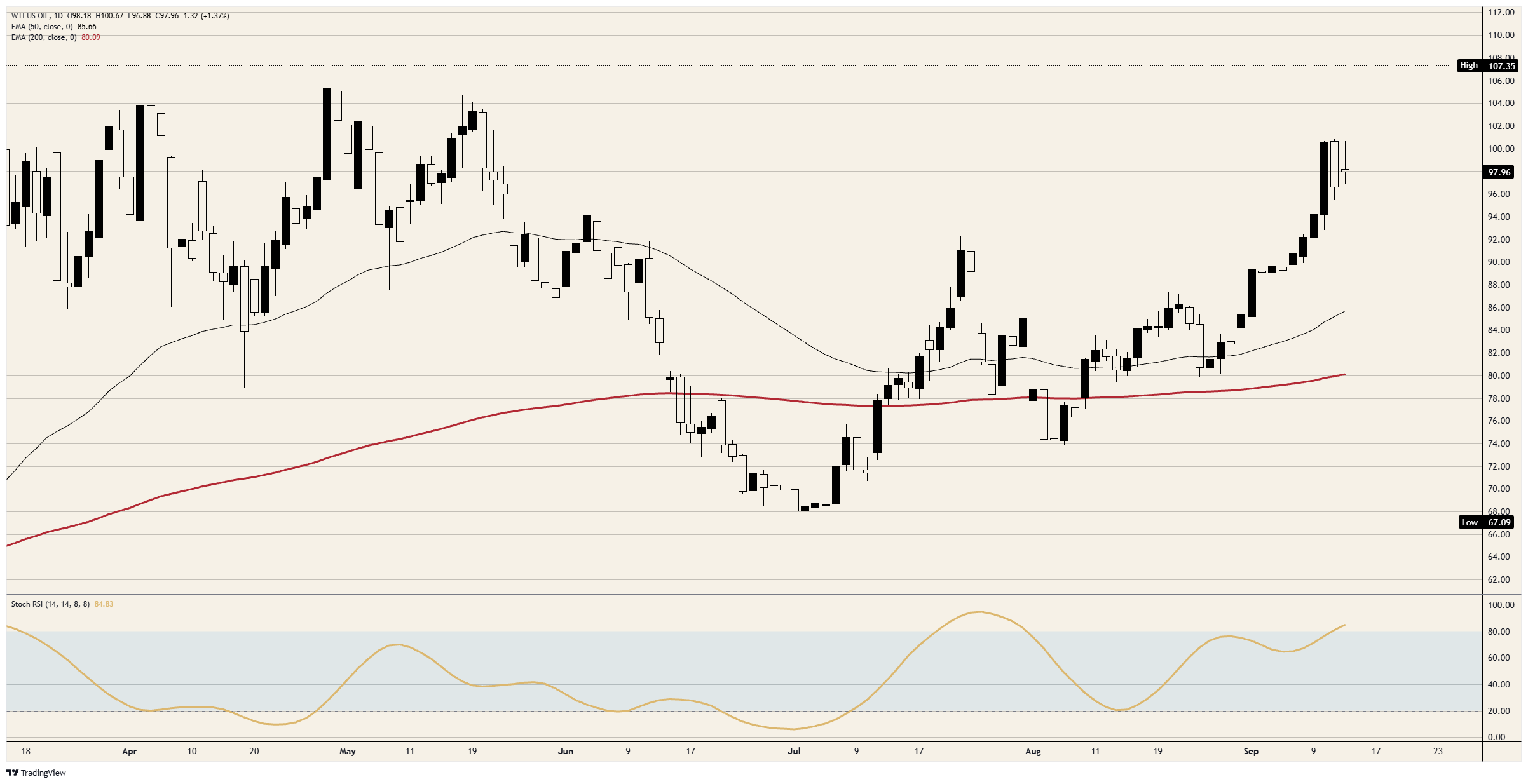
Resistance: The session high just above $100.50 is the third day in a row to trade above $100.00 and the second to be sold back beneath it inside the day, so $100.50 to $101.00 is the cap. Thursday's close was the first above $100.00 since May, and a daily close back above $101.00 reopens the May shelf just above $103.00.
Support: The session low just beneath $97.00 held the New York sell-off. Friday's low just beneath $95.50 is the level that carries the September advance from here, and Thursday's low just beneath $93.00 is the last one before the advance is gone.
Bias: Higher while Friday's low near $95.50 holds, with a daily close above $101.00 the first objective and $103.00 the second. Monday sold a rally of nearly $4.00 inside six hours and still holds above Friday's close. The daily Stochastic Relative Strength Index (Stoch RSI), a momentum gauge, sits near 85 and is still rising, so the trend is intact and the room above it is thin. Invalidation is a daily close beneath $95.50, which would say the market sold the pipeline rather than bought it.
WTI spot daily chart
WTI Oil FAQs
WTI Oil is a type of Crude Oil sold on international markets. The WTI stands for West Texas Intermediate, one of three major types including Brent and Dubai Crude. WTI is also referred to as “light” and “sweet” because of its relatively low gravity and sulfur content respectively. It is considered a high quality Oil that is easily refined. It is sourced in the United States and distributed via the Cushing hub, which is considered “The Pipeline Crossroads of the World”. It is a benchmark for the Oil market and WTI price is frequently quoted in the media.
Like all assets, supply and demand are the key drivers of WTI Oil price. As such, global growth can be a driver of increased demand and vice versa for weak global growth. Political instability, wars, and sanctions can disrupt supply and impact prices. The decisions of OPEC, a group of major Oil-producing countries, is another key driver of price. The value of the US Dollar influences the price of WTI Crude Oil, since Oil is predominantly traded in US Dollars, thus a weaker US Dollar can make Oil more affordable and vice versa.
The weekly Oil inventory reports published by the American Petroleum Institute (API) and the Energy Information Agency (EIA) impact the price of WTI Oil. Changes in inventories reflect fluctuating supply and demand. If the data shows a drop in inventories it can indicate increased demand, pushing up Oil price. Higher inventories can reflect increased supply, pushing down prices. API’s report is published every Tuesday and EIA’s the day after. Their results are usually similar, falling within 1% of each other 75% of the time. The EIA data is considered more reliable, since it is a government agency.
OPEC (Organization of the Petroleum Exporting Countries) is a group of 12 Oil-producing nations who collectively decide production quotas for member countries at twice-yearly meetings. Their decisions often impact WTI Oil prices. When OPEC decides to lower quotas, it can tighten supply, pushing up Oil prices. When OPEC increases production, it has the opposite effect. OPEC+ refers to an expanded group that includes ten extra non-OPEC members, the most notable of which is Russia.
추천 기사


