


Indian Rupee trades close to two-month low ahead of US NFP data
- The Indian Rupee reflects broader strength amid strong FCNR receipts and receded hawkish Fed bets.
- Fed’s Waller says that recent data shows some signs of disinflation.
- Soft US ADP data for August sets a weak bar for the US NFP.
The Indian Rupee (INR) opens on a flat note against the US Dollar (USD) on Friday, but is close to its two-month high of 94.29 posted the previous day. The Indian currency strengthens due to strong inflows of foreign funds through the Reserve Bank of India’s Foreign Currency Non-Resident (FCNR) (B) scheme and diminished Federal Reserve (Fed) interest rate hike expectations.
RBI reports strong foreign inflows through FCNR scheme
Strategists at Societe Generale highlight that the RBI has materially strengthened its firepower, noting that “the RBI yesterday disclosed that it had raised $136.38 billion through its FX mobilisation schemes, including the FCNR(B) window launched in early June, significantly bolstering reserve buffers and intervention capacity.”
Fed Waller says recent data indicates signs of slowing inflationary pressures
On Thursday, Fed Governor Christopher Waller said at the Reuters NEXT Newsmaker event, “Finally seeing some signs of disinflation in recent data.” Waller pushing back upside inflation risks resulted in a sharp decline in the US Dollar, with traders paring hawkish Fed bets.
The CME FedWatch tool shows traders see a one-in-two chance that the Fed will hike interest rates at the September meeting, down from a two-in-a-three chance seen before Fed Waller’s speech.
Regarding the Fed’s monetary policy outlook, Governor Waller said that he would “support holding interest rates steady” at the September meeting if the Consumer Price Index (CPI) growth cools down. Waller also kept the option of a rate hike on the table in case the inflation data remains hot. "If August inflation data shows progress has reversed, small adjustment to policy rate would help ensure progress resumes," Waller said.
US NFP data awaited
The next major driver for the US Dollar’s outlook is expected to be the US Nonfarm Payrolls (NFP) data for August, which will be published at 12:30 GMT.
Brown Brothers Harriman’s Elias Haddad points out that the latest US labor market read from ADP did little to dispel concerns about cooling demand. He notes that “the ADP August private payrolls data showed labor demand remains unimpressive,” with the economy adding “+38k private sector jobs in August (consensus: +47k) vs. +46k in July, the lowest reading since January.” Haddad cautions, however, that “the correlation between monthly change in ADP private payrolls and nonfarm payrolls (NFP) is weak,” limiting the extent to which investors can extrapolate the ADP miss into Friday’s official employment report.
According to estimates, the US economy created 56K fresh jobs after laying off 23K employees in July. The Unemployment Rate is seen as steady at 4.1%.
USD/INR Technical Analysis
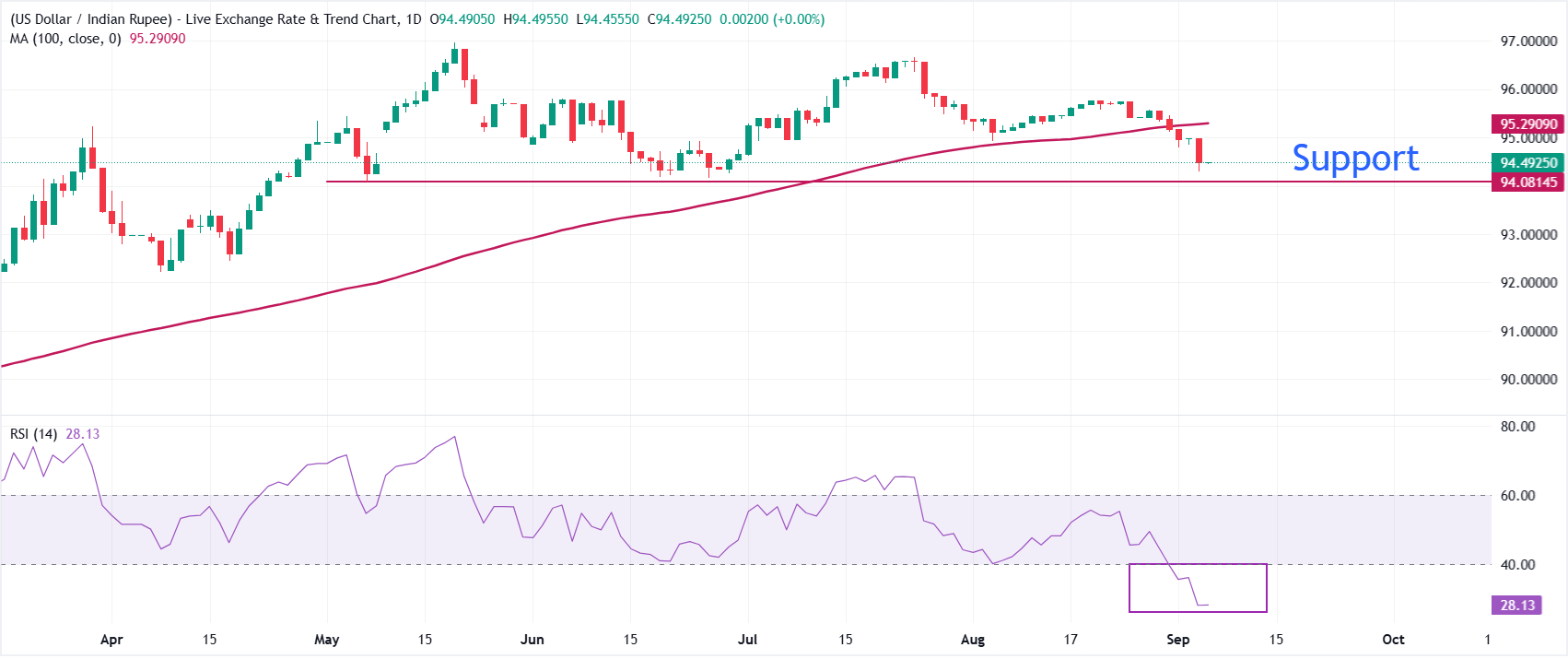
In the daily chart, USD/INR trades at 94.4925, extending a downside bias as price holds below the 100-day simple moving average (SMA) at 95.2909. The break under this medium-term gauge suggests sellers remain in control, while the Relative Strength Index (RSI) near 28 signals oversold conditions that could slow, but not yet reverse, the prevailing downtrend.
On the downside, the immediate focus remains on how price behaves around the current 94.49 area, as a sustained close beneath it would expose further weakness toward the May low at 94.08. On the topside, a recovery back above the 100-day SMA at 95.29 would be needed to ease bearish pressure and hint at a corrective rebound toward higher levels.
(The technical analysis of this story was written with the help of an AI tool. Know more.)
Indian Rupee FAQs
The Indian Rupee (INR) is one of the most sensitive currencies to external factors. The price of Crude Oil (the country is highly dependent on imported Oil), the value of the US Dollar – most trade is conducted in USD – and the level of foreign investment, are all influential. Direct intervention by the Reserve Bank of India (RBI) in FX markets to keep the exchange rate stable, as well as the level of interest rates set by the RBI, are further major influencing factors on the Rupee.
The Reserve Bank of India (RBI) actively intervenes in forex markets to maintain a stable exchange rate, to help facilitate trade. In addition, the RBI tries to maintain the inflation rate at its 4% target by adjusting interest rates. Higher interest rates usually strengthen the Rupee. This is due to the role of the ‘carry trade’ in which investors borrow in countries with lower interest rates so as to place their money in countries’ offering relatively higher interest rates and profit from the difference.
Macroeconomic factors that influence the value of the Rupee include inflation, interest rates, the economic growth rate (GDP), the balance of trade, and inflows from foreign investment. A higher growth rate can lead to more overseas investment, pushing up demand for the Rupee. A less negative balance of trade will eventually lead to a stronger Rupee. Higher interest rates, especially real rates (interest rates less inflation) are also positive for the Rupee. A risk-on environment can lead to greater inflows of Foreign Direct and Indirect Investment (FDI and FII), which also benefit the Rupee.
Higher inflation, particularly, if it is comparatively higher than India’s peers, is generally negative for the currency as it reflects devaluation through oversupply. Inflation also increases the cost of exports, leading to more Rupees being sold to purchase foreign imports, which is Rupee-negative. At the same time, higher inflation usually leads to the Reserve Bank of India (RBI) raising interest rates and this can be positive for the Rupee, due to increased demand from international investors. The opposite effect is true of lower inflation.
추천 기사


