


The Dow gained 500 points and the two AI names that matter fell after hours — Netflix's guide is the tell


Mitrade Insights — Tuesday's session was the best index tape in weeks: the Dow closed 529.85 points higher at 52,495.88 (+1.02%), the S&P 500 added 0.28% to 7,712.57, and the VIX fell 6.13% to 17.31. But the two stocks that actually carry the AI trade went the other way after the bell. Netflix fell 5.8% to $64.74 after guiding fourth-quarter EPS of $0.67, below the street, and SpaceX rose about 8% to near $160 after reporting its first profit as a public company on revenue up 161%. The index was strong; the AI leadership was not.
1. The move: a green index and a red after-hours
| Asset | Last | Change | Context |
|---|---|---|---|
| Dow | 52,495.88 | +1.02% (+529.85) | Best day in weeks; industrials and financials led |
| S&P 500 | 7,712.57 | +0.28% | Breadth improved, tech lagged |
| Nasdaq Composite | 26,424.82 | -0.02% | SOX was down 1.57% intraday |
| VIX | 17.31 | -6.13% | Volatility priced lower |
| 10-year Treasury | 5.117% | -2bp | 5.311% on October 5, so yields gave back only a fifth of the move |
| WTI crude | 97.82 | -5.64% | Settled below $100 for the first time since August |
| Netflix (after hours) | $64.74 | -5.75% | Below the 52-week low of $65.08 |
| SpaceX (after hours) | ~$159.70 | ~+8% | From a $147.79 close |
| Nvidia (after hours) | $221.00 | +2.1% | Ahead of the GTC Berlin keynote |
The gap between those two columns is the whole story. On Tuesday the market was paid to own cyclicals and value, and it was paid for it out of oil: crude settled 5.64% lower, which took a little inflation pressure out of the long end and freed up the rate-sensitive parts of the index. Underneath that, the two names investors use to express the AI trade went in opposite directions.
2. Why: the chain from crude to guidance
The chain. Crude fell 5.64% because the United States waived sanctions and tariffs on Russian energy exports and because a two-week ceasefire was announced; the 10-year yield slipped 2bp to 5.117%. Lower yields are what let the Dow add 500 points. But lower yields do not create earnings, and Netflix's problem was not the rate cycle — it was the forward guide.
The Netflix numbers. Q3 EPS came in at $0.87 against a consensus of $0.82. Revenue was $12.87bn, in line, and up 11.8% year on year — the slowest growth in years. The damage was in the fourth quarter: guidance of $13.4bn revenue, $2.79bn net income and $0.67 EPS, below the average estimate, with sales growth set to decline for a fourth consecutive quarter. The 2026 revenue outlook was narrowed to $51.0bn. Options had implied an 8.4% move going into the print; the implied move came in at roughly 6% down.
The SpaceX numbers. SpaceX reported its first profit as a public company, with revenue up 161% on Starlink and AI growth, and AI revenue up roughly ninefold. Capital expenditure came in below expectations. The stock rose about 8% after hours from a $147.79 close.
The reading. One AI name beats on the first print and rallies; the other beats on the quarter and falls 5.8%. The market is no longer paying for AI revenue — it is paying for the next four quarters' guidance. That is a much higher bar, and it is why the Dow's strength and the AI trade's weakness can sit in the same session.
3. The read-through to the rest of the AI complex
Nvidia is the fulcrum. It closed at $216.47 and traded up about 2.1% after hours ahead of the GTC Berlin keynote at 11:00 CEST (05:00 ET) on October 21, where the German government is backing a nearly $10bn European push and four German startups. Reuters reported that ByteDance, Alibaba and Tencent have together placed more than $35bn of Nvidia chip orders — and that some of those requests may be filled at only 5% to 10% of the requested quantity. Nvidia's share of China's data-centre AI chip market slipped to 34% in the first half of 2026, with Huawei at 28%.
The fragility was visible earlier: South Korea's Elice closed its debut 32% lower, the SOX fell 1.57% intraday, and the Nasdaq could not hold a fraction of a percent on a 500-point Dow day. Meta reports tonight. The 10-year at 5.117% means every dollar of AI capex still has to clear a hurdle rate that has only given back 19 basis points since October 5.
4. Levels: $70 is the gate, $65.08 just went
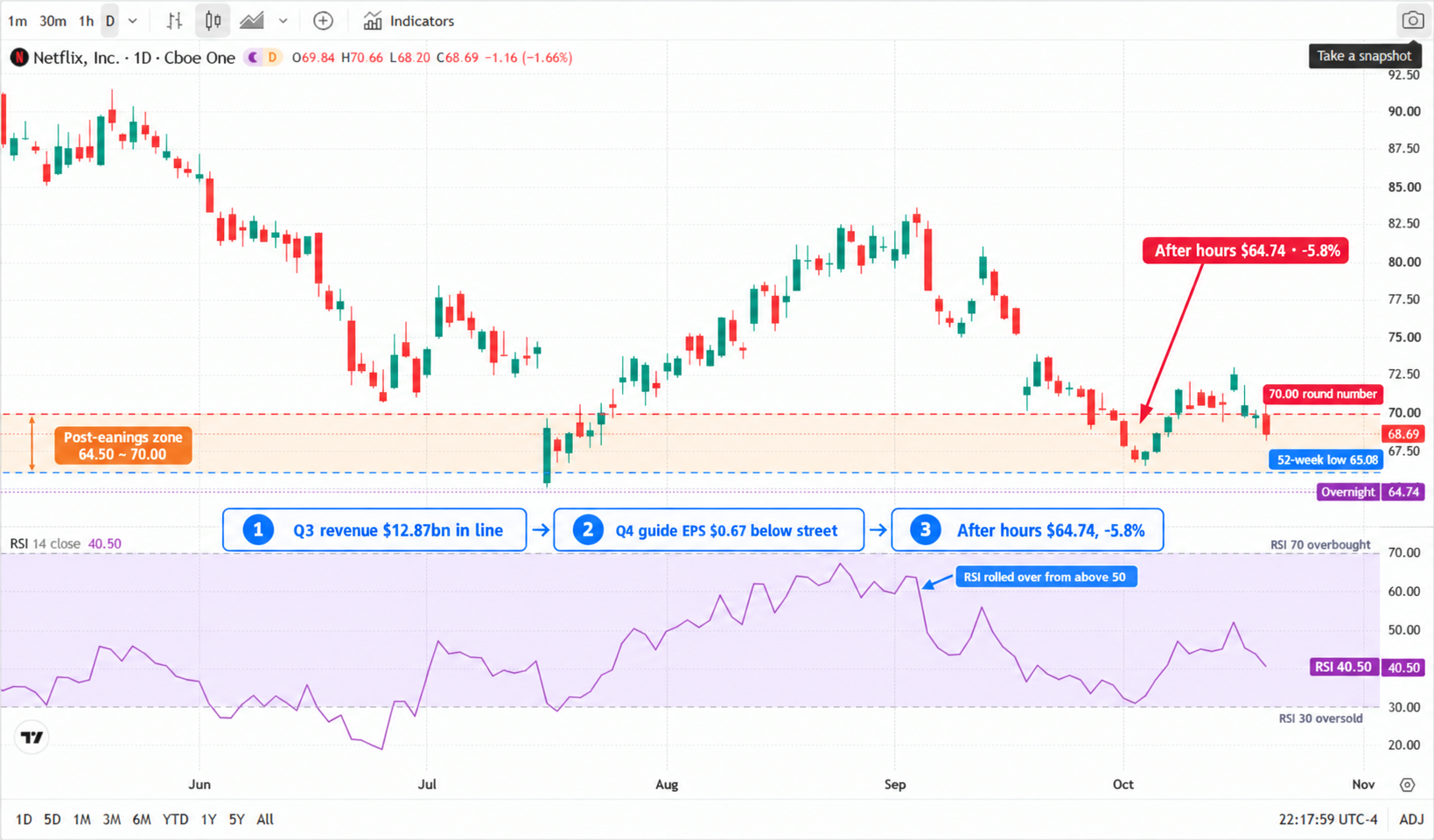
* Chart source: TradingView official chart screenshot, data source NASDAQ (Netflix).
The structure to respect: a close back above $70.00 and the 20-day average at $69.97 would neutralise the immediate downtrend and open the 50-day at $74.85. A break below $65.08 — which the after-hours print has already done — leaves the options-implied downside of roughly $64 as the next reference, with the 200-day average at $82.65 still far overhead. RSI(14) is at 40.50: weak, but not yet oversold.
5. Two scenarios
Scenario A: the guide is bought. If Netflix can hold above $65.08 into Meta's print and the GTC Berlin keynote brings new European order commitments or a capital-return update, the AI leadership re-rates alongside the index. The Dow's 500 points and a recovering Nasdaq are not mutually exclusive.
Scenario B: the bar moves higher. If the keynote restates demand without adding orders, and the 10-year stays near 5.12%, the cost of funding AI infrastructure stays the binding constraint. Netflix's 5.8% drop is then not a company problem but a multiple problem — and SpaceX's 8% rally becomes the anomaly rather than the rule.
The bottom line: the index is strong and the AI trade is not. Netflix did not miss the quarter; it guided below expectations and the market repriced the next four quarters. That is the tell to watch tonight, when Meta reports and Berlin opens.
Read more
Before making any trading decisions, it is important to equip yourself with sufficient fundamental knowledge, have a comprehensive understanding of market trends, be aware of risks and hidden costs, carefully consider investment targets, level of experience, risk appetite, and seek professional advice if necessary.
Furthermore, the content of this article is solely the author's personal opinion and does not necessarily constitute investment advice. The content of this article is for reference purposes only, and readers should not use this article as a basis for any investment decisions.
Investors should not rely on this information as a substitute for independent judgment or make decisions solely based on this information. It does not constitute any trading activity and does not guarantee any profits in trading.
If you have any inquiries regarding the data, information, or content related to Mitrade in this article, please contact us via email: insights@mitrade.com. The Mitrade team will carefully review the content to continue improving the quality of the article.


