


Could Investing $5,000 in MP Materials Help Make You a Millionaire?
Key Points
MP is building a domestic rare-earth supply chain to reduce America's dependence on foreign suppliers.
Its landmark agreement with the Pentagon includes price protections and agreements for future purchases.
However, turning $5,000 into $1 million would require MP's market cap to reach $1.3 trillion.
- Motley Fool Issues Rare "Total Conviction" Buy Alert ›
I'll come out and say it: I don't think investing $5,000 in rare-earth mining stock MP Materials (NYSE:MP) is going to make you a millionaire. And yet -- yet -- it could still be a great long-term investment, especially with Washington throwing its weight behind MP's development. Here's why.
Why Washington is betting big on MP Materials
For those unfamiliar with the company, MP Materials operates the Mountain Pass rare-earth mine in California, one of America's most significant sources of minerals used to make permanent magnets. These magnets are at the heart of MP's story, as they are essential components in an extraordinary range of technology, from electric vehicles and personal computers to fighter jets, drones, and robots.
Missed AI’s "Act 1"? Act 2 Could Be 15x Bigger. Most investors think they missed the AI boat because they didn't buy Nvidia in 2005. But according to our analysts, we’re only at the end of "Act 1"—the R&D phase. "Act 2" is the global rollout. Continue »

Image source: MP Materials.
Over the years, MP has remade itself into an integrated manufacturer of rare-earth materials, with operations in mining, refining, and magnet production. If that doesn't sound particularly exciting, maybe some context will help.
The integrated business that MP is building could help the U.S. government reduce dependence on foreign suppliers of rare-earth materials and magnets. This reliance has become something of a security issue for Washington, especially given that America's largest suppliers of rare-earths are also its most formidable economic rival (yes, China).
In that regard, Washington has put its weight behind MP. In July 2025, the Pentagon struck a landmark agreement with MP, including a 10-year price floor of $110 per kilogram for its neodymium-praseodymium products. It also agreed to purchase or find buyers for all the magnets produced at MP's planned 10X manufacturing facility, which it plans to begin commissioning in 2028.
Meanwhile, MP is working to secure customers. In July, it launched Project Swarm, which allows drone manufacturers to reserve future magnet production from 10X. That same month, MP also signed a long-term agreement to supply gadolinium to a U.S. aerospace and defense customer.
Clearly, MP has a special place in the U.S.'s efforts to build a domestic rare-earth supply chain. So, why isn't it a millionaire maker?
$5,000 in MP probably won't become $1 million
To turn $5,000 into $1 million, MP Materials stock would need to grow 200-fold. Given its current market cap of about $6.5 billion, that would imply a valuation of roughly $1.3 trillion, assuming its share count remains about the same.
No matter how many friends MP has in Washington, a $1.3 trillion valuation would be extraordinary for this company, quite possibly making it the world's most valuable miner. For perspective, none of the biggest mining companies command a market cap even close to that valuation, despite earning significantly more revenue than MP.
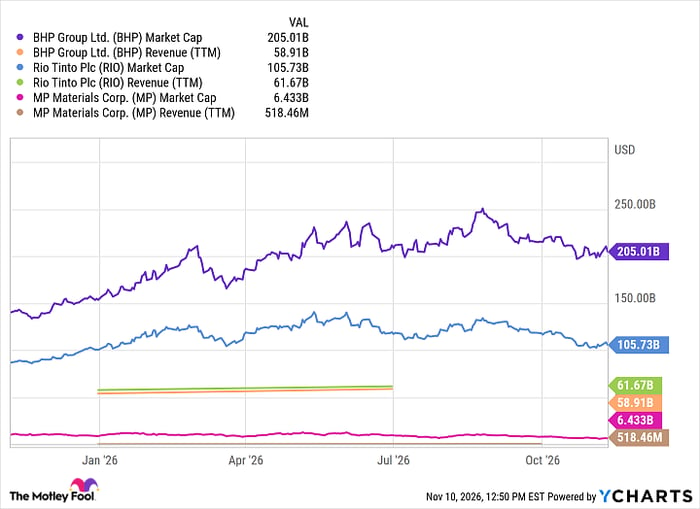
BHP Market Cap data by YCharts
That said, I can envision MP becoming a much larger company in the future, especially if America's push for rare-earth independence continues. MP might not turn $5,000 into $1 million, but for patient investors, it could still deliver substantial returns over the long run.
Missed Nvidia in 2009? This Rare Signal Is Flashing Again
In 2009, a "Double Down" signal flashed for a little-known chipmaker called Nvidia. If you’d invested $5,000 then, you’d be sitting on $2,116,882 today.*
Now, for the first time in years, that same "Total Conviction" signal is flashing for a company 1/100th the size of Nvidia. It’s a key player in the $1.8 trillion space race, and with the stock recently sitting 20% off its highs, the window to get in early is closing fast.
Continue »
*Stock Advisor returns as of November 14, 2026.
Steven Porrello has no position in any of the stocks mentioned. The Motley Fool has positions in and recommends MP Materials. The Motley Fool has a disclosure policy.
Recommended Articles


