


Jensen Huang Might Be the Biggest Wild Card for Nvidia Stock. Here's What to Watch During Earnings on Nov. 17
Key Points
Nvidia shares fell about 5.5% on Monday and are down more than 20% over the past month as the board now investigates whether foreign intelligence targeted CEO Jensen Huang.
Despite the uncertainty, the business is still growing fast: Revenue more than doubled to $96.2 billion in the quarter that ended July 26.
Nvidia's filings have never flagged a risk tied to Huang himself. Its next quarterly filing, due after Nov. 17 earnings, will show whether that changes.
- These 10 stocks could mint the next wave of millionaires ›
Nvidia (NASDAQ:NVDA) investors have had a rough few weeks, with the latest (and perhaps biggest) blow coming over the weekend. CEO Jensen Huang acknowledged infidelity in an email to employees, and Nvidia's board opened an independent investigation into whether foreign intelligence targeted him. The board said it had no reason to believe that national security or Nvidia secrets had been compromised, but investors still have questions.
The stock traded around $176 early Monday afternoon, down about 5.5% on the day and roughly 23% below its Oct. 9 close of $229.28.
The Monday plunge shouldn't come as a surprise after this weekend's news: Huang co-founded Nvidia in 1993 and has run it ever since. Few large companies are as closely tied to one leader, which is why its earnings report on Nov. 17 matters more than usual.
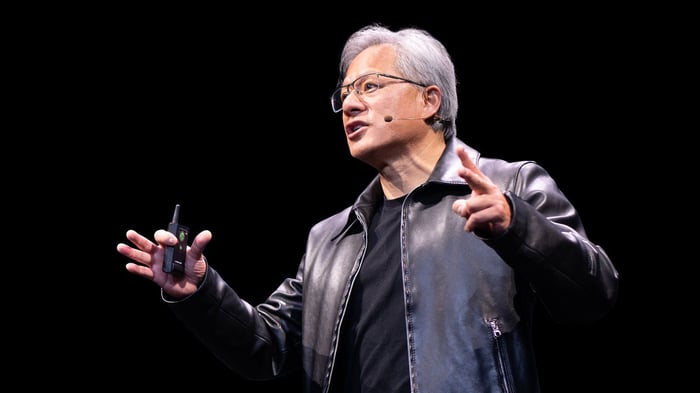
Image source: Nvidia.
Missed Nvidia in 2009? This Rare Signal Is Flashing Again. In 2009, a "Double Down" signal flashed for a little-known chipmaker called Nvidia. For the first time in years, that same "Total Conviction" signal is flashing for a company 1/100th the size of Nvidia. Continue »
The Business Hasn't Slowed Down
Despite the looming uncertainty, it's important to remember that whatever is happening around Huang, Nvidia's numbers have been remarkable. In its fiscal second quarter, which ended July 26, revenue rose 106% from a year earlier to $96.2 billion. Data centers brought in $89.0 billion of that, about 92%, and net income reached $59.7 billion, up 126% year over year.
Over the past four reported quarters, Nvidia earned $7.91 per diluted share. At $176, that's about 22 times trailing earnings, a modest multiple for a company still doubling its sales.
What Nvidia's Filings Say About Huang
The weekend's news isn't only about Huang's personal life. The woman he acknowledged having a relationship with, Alice Huang, is a former executive at Megaspeed, a Singapore-based buyer of Nvidia chips that the Commerce Department has investigated for allegedly helping Chinese companies circumvent U.S. export controls. That ties the allegations to one of the biggest risks Nvidia already warns investors about: its chips ending up where they're not allowed.
Nvidia filings have flagged that risk for a while. In its 10-Q filed in November 2025, as smuggling reports and prosecutions mounted, it added that reports of diversion could hurt the business "even when unsubstantiated and untrue." More recently, it added that it has been helping authorities with "attempted diversion" but doesn't have "physical control of our products after sale."
What the filings don't do is name Huang as a risk. The only related line is a general one, unchanged since at least early 2025: Nvidia is "highly dependent on the services of our long-standing executive team," according to its latest annual report.
What to Watch on Nov. 17
Earnings against expectations. Analysts expect $2.49 per share, roughly double the $1.24 Nvidia reported on the same basis a year earlier. After a more than 20% drop, a clear beat could steady the stock.
The outlook. Guidance for the current quarter will show whether demand from Nvidia's biggest customers is still accelerating. Most of its sales ride on the AI spending budgets of a few giant tech companies, so any sign they're slowing would matter more than the investigation.
The earnings call. Huang usually leads Nvidia's calls alongside CFO Colette Kress, so the first thing to notice is simply whether he's there and sounds like himself. After that, listen for whether executives address the board's investigation, how long it might take, and whether anything about his role has changed. Analysts may also ask about succession, a topic Nvidia's annual report touches on only in general terms. Companies often decline to discuss an ongoing inquiry, so a short "we can't comment" wouldn't be alarming on its own. Avoiding the subject entirely, while the stock is down over 20% in a month, would leave investors guessing.
The new 10-Q. The quarterly filing will be the first since the investigation began, and in the past two quarters, Nvidia has filed it the same day as earnings, so look for it on Nov. 17. Start with the risk factors. Each 10-Q says that, aside from the risks it lists, nothing material has changed since the annual report, so any new risk regarding Huang or the investigation will stand out. Also check the legal proceedings section, where companies describe investigations and lawsuits. If Nvidia adds a risk factor about Huang, it's telling investors it sees a real risk. And if anything about his role changes before then, Nvidia would have to disclose it within days in a separate filing called an 8-K.
What It Means for Investors
The business case hasn't changed: Nvidia is still the leader in AI chips, and the stock sits near the low end of its 52-week range of $164.27 to $243.37. But the investigation adds a risk no one can yet price, and export rules governing the sale of chips to China keep changing.
For most long-term investors, the sensible move is to buy gradually rather than all at once, and to keep Nvidia a reasonable part of a diversified portfolio of tech stocks. If you already own it, there's no reason to panic-sell a business growing this fast. And for investors who want exposure to AI stocks without riding on one CEO, a basket of semiconductor stocks spreads that risk.
Missed AI’s "Act 1"? Act 2 Could Be 14x Bigger
Most investors think they missed the AI boat because they didn't buy Nvidia in 2005.
But according to our analysts, we’re only at the end of "Act 1"—the R&D phase. "Act 2" is the global rollout, a massive technology build-out that Google’s CEO says could be more profound than fire or electricity.
While everyone watches the chip designers, one "backbone" company provides the critical technology that Nvidia and AMD literally cannot function without. We’ve detailed this under-the-radar player in our new AI Playbook.
Continue »
Jonathan Ponciano has no position in any of the stocks mentioned. The Motley Fool has positions in and recommends Nvidia. The Motley Fool has a disclosure policy.
Recommended Articles


