


Prediction: This Glorious Growth Stock Is Going to Soar in 2027
Key Points
Duolingo's digital language education platform is incredibly popular, boasting 64.9 million daily active users.
User growth is currently accelerating thanks to a strategy shift by management, but it's coming at the expense of monetization.
Despite recent gains, Duolingo stock continues to trade at an attractive valuation, which leaves significant room for upside in 2027 and beyond.
- Motley Fool Issues Rare "Total Conviction" Buy Alert ›
Duolingo (NASDAQ: DUOL) operates the world's largest digital language education platform. Its mobile-first approach places fun, highly interactive lessons at the fingertips of practically anybody with a smartphone, and making this style of education accessible has been the secret to its long-term success.
Duolingo plummeted to a 52-week low of $90.03 in April, which represented a whopping 83% decline from last year's record high. Investors were concerned about the consequences of management's new strategy to focus on user growth instead of monetization, and they were also worried that artificial intelligence (AI) could disrupt its business.
Missed Nvidia in 2009? This Rare Signal Is Flashing Again. In 2009, a "Double Down" signal flashed for a little-known chipmaker called Nvidia. For the first time in years, that same "Total Conviction" signal is flashing for a company 1/100th the size of Nvidia. Continue »
However, Duolingo has put those concerns to rest by posting strong operating results, particularly in the recent third quarter (ended Sept. 30). Its stock has now soared by 83% from its 52-week low (as of the market close on Nov. 4), and here's why I predict the recovery will continue in 2027.

Image source: The Motley Fool.
Management's strategy is bearing fruit
Duolingo makes money in two ways. It sells subscriptions to users who want to accelerate their learning by unlocking extra features, and it shows advertisements to free users. Paying members make up the bulk of the company's revenue, so investors were understandably worried when management decided to focus more on growing the overall user base, rather than converting free members into subscribers.
Historically, Duolingo has spent very little money on marketing because its widespread, organic social media presence has been enough to attract new users. However, the company grew its marketing spending by 20% during the third quarter, so management is now leaning into paid channels to accomplish its goals.
Moreover, Duolingo continues to make product changes geared toward attracting and retaining free users. For example, the proportion of voice-based speaking exercises on the platform have doubled since the start of 2026. These are typically more popular than tap-based or written exercises because they help users learn more quickly.
Speaking exercises were previously only available to paying subscribers through features like Video Call, but the declining cost of AI is enabling the company to roll them out more broadly. Therefore, Duolingo is proving it can use AI to its advantage, contrary to the opinion of some analysts over the past year.
Duolingo had a record 64.9 million daily active users (DAUs) during the third quarter, up 29% from the year-ago period. It was the second-consecutive quarter in which user growth accelerated, so management's strategy is working exactly as intended. But there is a trade-off, because both revenue and the paying user base grew by just 14%. Simply put, by offering more paid features for free, users have less incentive to subscribe.
But management believes Duolingo can reach 100 million DAUs in 2028 because of this strategy. If it succeeds, new competitors will find it harder to disrupt the platform. Plus, when management turns its attention back to monetization, it will have far more users to convert into paying subscribers. Therefore, I think the company's revenue growth could reaccelerate in the future.
Duolingo stock is still attractively valued, setting the stage for further gains
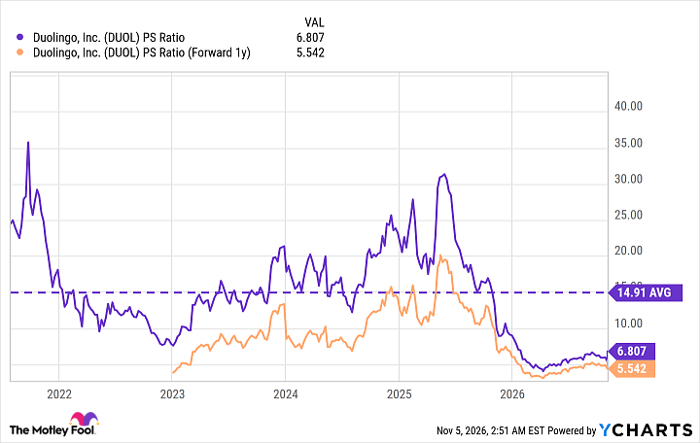
Duolingo generated $1.18 billion in revenue over the last four quarters, placing its stock at a price-to-sales (P/S) ratio of 6.8. That is less than half its average of 14.9 since going public in 2021. Moreover, Wall Street's average estimate (provided by Yahoo! Finance) suggests Duolingo could grow its revenue to $1.37 billion in 2027, placing its stock at a forward P/S ratio of 5.5.
That means even if the stock doubles over the next 12 months, its P/S ratio will still be below its long-term average. That leaves plenty of room for upside next year.
DUOL PS Ratio data by YCharts
Longer term, if Duolingo reaches 100 million DAU and finds a way to convert its free users into paying subscribers at the same rate it did prior to management's strategy shift, then the company's revenue is likely to grow significantly after 2028.
Duolingo stock peaked at $540 last year, and I think it could return to that level in the future, so investors who are willing to hold the stock for a long-term period of three years or more could earn significant returns.
Should you buy stock in Duolingo right now?
Before you buy stock in Duolingo, consider this:
The Motley Fool Stock Advisor analyst team just identified what they believe are the 10 best stocks for investors to buy now… and Duolingo wasn’t one of them. The 10 stocks that made the cut could produce monster returns in the coming years.
Consider when Netflix made this list on December 17, 2004... if you invested $1,000 at the time of our recommendation, you’d have $341,966!* Or when Nvidia made this list on April 15, 2005... if you invested $1,000 at the time of our recommendation, you’d have $1,146,819!*
Now, it’s worth noting Stock Advisor’s total average return is 852% — a market-crushing outperformance compared to 203% for the S&P 500. Don't miss the latest top 10 list, available with Stock Advisor, and join an investing community built by individual investors for individual investors.
See the 10 stocks »
*Stock Advisor returns as of November 8, 2026.
Anthony Di Pizio has positions in Duolingo. The Motley Fool has positions in and recommends Duolingo. The Motley Fool has a disclosure policy.
Recommended Articles


