


Palantir Drops 8% Pre-Market, Nearing Two-Month Low as 96% Q3 Revenue Surge Fails to Lift Stock
TradingKey - Palantir (PLTR) reported third-quarter results that beat market expectations across the board, but its stock suffered a sell-off following the earnings release. In pre-market U.S. trading on November 3, the company's shares fell nearly 8%. Despite revenue, adjusted earnings per share, and future performance guidance all coming in above Wall Street estimates, the market failed to respond positively, reflecting that investors' growth expectations for this AI software company are already quite high.
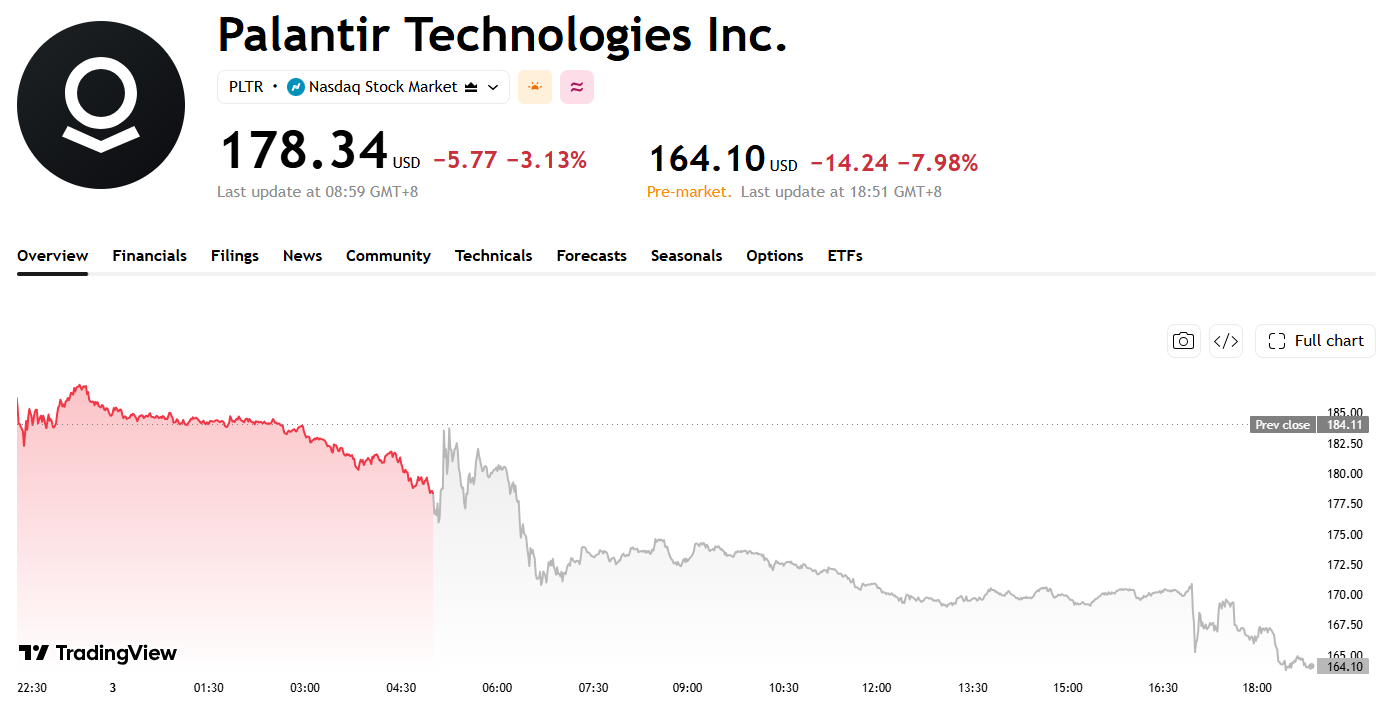
Source: TradingView
According to the latest earnings report, Palantir's third-quarter revenue reached $2.313 billion, up 96% year-over-year, beating market expectations of $2.18 billion and continuing its rapid expansion. Adjusted earnings per share came in at $0.44, also exceeding analysts' previous expectations of $0.41. The most prominent shift in earnings growth came from the U.S. commercial market, where revenue surged 148% year-over-year to $984 million, not only topping market expectations of $937 million, but also surpassing U.S. government revenue for the first time. During the same period, U.S. government revenue was $953 million.
The U.S. commercial business becoming Palantir's largest revenue source for the first time indicates a shift in the company's growth engine. In the past, government contracts were its key revenue pillar; now, rapidly rising enterprise demand for AI platforms is driving the expansion of its commercial business. This change also means that Palantir is gradually broadening its customer base and no longer relying primarily on procurement demand from government agencies.
The company's outlook for future performance was equally positive, with Palantir raising its full-year 2026 revenue guidance to between $8.530 billion and $8.534 billion, significantly higher than its previous guidance of $8.150 billion to $8.158 billion and topping the market's previous expectation of around $8.2 billion. For the fourth quarter, the company expects revenue to reach $2.649 billion to $2.653 billion, above the average analyst estimate of $2.46 billion compiled by LSEG. The simultaneous upward revisions to both full-year guidance and the next quarter's outlook further reflect management's confidence in AI software demand and the pace of business expansion.
However, the stellar operational data failed to prevent the stock price from falling. Palantir's revenue nearly doubled this quarter, and the growth rate of its U.S. commercial business was also remarkable. But investors are clearly looking beyond whether the company beat analyst expectations to gauge whether the current share price fully reflects its future growth potential. When the market holds high expectations for an AI company's performance, even strong financial results may not immediately translate into stock price gains.
The company needs to sustain high growth and convert demand for AI products into stable enterprise revenue to support market expectations for its future profitability. Especially after the U.S. commercial business has become the primary growth engine, investors will pay closer attention to whether enterprise customer expansion can continue and whether the current growth velocity can be maintained over the coming quarters.
Recommended Articles


