


Apple beat, then fell: the memory bill is the AI trade's new tell

Mitrade Insights — Apple's fiscal Q4 was a clean beat: revenue $114.48 billion, up 12% year on year, and EPS $2.10 versus $1.99 expected. The stock still closed 1.83% lower at $338.32 and was last quoted near $329.28 overnight. The reason is not demand. It is the guide: gross margin for the December quarter is 45%–46%, down from 47.9% actual, with management pointing to higher memory costs and the Siri AI ramp. The AI boom has become a cost line for Apple — and the market is only starting to price it.
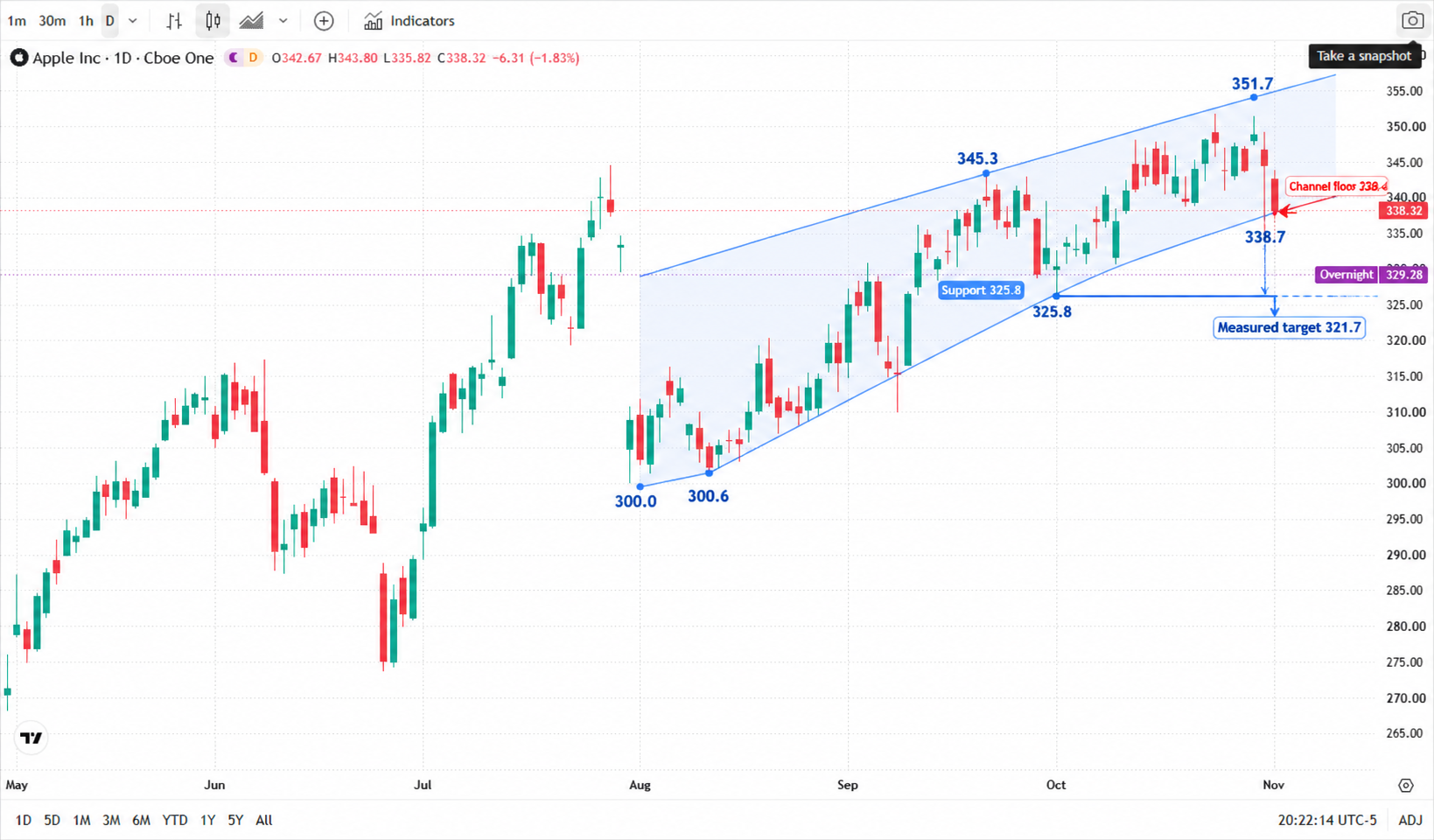
* Chart source: TradingView (AAPL daily).
The chart frames the trade: Apple closed on the lower rail of a six-month rising channel near $338.4, with the first support at $325.8 and the upper rail near $355.1.
$114.5 billion wasn't the problem — the 45%–46% margin line was
The revenue line was strong across the board. iPhone revenue was $57.58 billion, up 17%; Mac was $10.79 billion, up 24% and a record; Services was $31.57 billion, up 10% and an all-time high. Greater China was $17.54 billion, up 21%, but below the $18.5–$18.7 billion consensus. iPad fell 10% and Wearables/Home fell 8%.
iPhone 57.6B, Mac 10.8B, China 17.5B
This is also the first earnings report under CEO John Ternus, which makes the margin guide a statement about the new operating model, not just a one-quarter swing. The mix matters more than the total. iPhone and Mac carried the quarter, while iPad and Wearables missed. China grew but missed a high bar. That is a good quarter, not a flawless one. The market's reaction concentrated on the one line that guides the next quarter: gross margin.
Management guided December-quarter revenue growth of 7%–10%, but Services growth of only 8%–9%, below the roughly 10.7% consensus. Services is Apple's highest-margin business. Slower Services growth plus a lower hardware margin is a double squeeze on earnings quality — even if revenue lands in line.
| Q4 metric | Actual | Consensus / guide | Read-through |
|---|---|---|---|
| Revenue | $114.48B | ~$113.39B | Beat |
| EPS | $2.10 | $1.99 | Beat |
| iPhone | $57.58B | ~$56B | Beat |
| Mac | $10.79B | ~$9.5B | Big beat |
| Greater China | $17.54B | $18.5–$18.7B | Miss |
| Gross margin (guide) | 45%–46% | 47.9% actual | The problem |
| Services growth (guide) | 8%–9% | ~10.7% | Slowdown |
The memory bill: how AI capex became Apple's cost line
Apple does not build AI data centers at the scale of Microsoft, Amazon, or Oracle. Its quarterly capex was just $2.24 billion, while quarterly R&D rose 32% to $11.73 billion. But Apple buys the memory that goes into every iPhone, Mac, and iPad — and the AI buildout is competing for the same DRAM and NAND supply.
Why HBM demand sets iPhone margins
The AI boom has redirected memory capacity toward high-bandwidth memory and enterprise storage. That tightens consumer memory supply and raises Apple's bill of materials. Management explicitly flagged higher memory costs in the December-quarter margin guide. The irony is structural: Apple is not spending like an AI hyperscaler, but it is paying the input-cost consequences of one.
On the same day, Marvell agreed to buy Lumentum for about $115 billion in stock, and Oracle filed to raise $20 billion in debt and equity for AI infrastructure. Both were punished — Marvell fell 12.7%, Lumentum 18.6%, Oracle 8.8%. The market is no longer paying for AI ambition alone; it is asking who bears the cost. For Apple, the answer is the gross-margin line.
338.4 is the channel floor; 325.8 is the first crack
Apple's six-month chart is a clean rising channel. The lower rail sits near $338.4 at the last candle; the upper rail is near $355.1. The stock closed at $338.32, essentially on the floor. The first support below the channel is $325.8, the October 1 low; a channel-width measured move points to about $321.7.
What would prove the bear case wrong
The bear case is that Apple is de-rating from a "services compounder" to a "hardware company with an AI cost problem." The falsifier is straightforward: if Apple holds $338.4 for two consecutive closes and reclaims $348.15 (the Oct 13 high), the margin guide was conservative and the channel remains intact. If it closes below $325.8, the channel has failed and the measured target near $321.7 comes into play. The middle zone — holding the floor but failing at $348.15 — is the most likely near-term outcome.
Read more
Before making any trading decisions, it is important to equip yourself with sufficient fundamental knowledge, have a comprehensive understanding of market trends, be aware of risks and hidden costs, carefully consider investment targets, level of experience, risk appetite, and seek professional advice if necessary.
Furthermore, the content of this article is solely the author's personal opinion and does not necessarily constitute investment advice. The content of this article is for reference purposes only, and readers should not use this article as a basis for any investment decisions.
Investors should not rely on this information as a substitute for independent judgment or make decisions solely based on this information. It does not constitute any trading activity and does not guarantee any profits in trading.
If you have any inquiries regarding the data, information, or content related to Mitrade in this article, please contact us via email: insights@mitrade.com. The Mitrade team will carefully review the content to continue improving the quality of the article.


