


Tech Sell-Off: 2 Growth Stocks Investors Might Wish They'd Bought on the Dip
Key Points
Growing concerns about the sustainability of the artificial intelligence (AI) infrastructure spending boom are pressuring the stock market right now.
A prolonged sell-off in the broader market might give investors an opportunity to buy high-quality stocks at a discount.
Duolingo and SentinelOne are two stocks that might be worth scooping up while fear is the prevailing sentiment.
- 10 stocks we like better than Duolingo ›
Many of the artificial intelligence (AI) stocks that led the broader market higher over the last few years are currently pulling back, which is weighing on indexes like the S&P 500 and the technology-heavy Nasdaq-100. In fact, the Nasdaq-100 plunged by 5.5% last week alone, and more downside might be ahead.
But the broader market has always recovered to new highs over the long term, so sell-offs tend to be buying opportunities. I'm going to share two stocks that could become absolute bargains if the tech sell-off intensifies, particularly because they stand to benefit from the expanding adoption of AI over the long term. Read on.
Missed Nvidia in 2009? This Rare Signal Is Flashing Again. In 2009, a "Double Down" signal flashed for a little-known chipmaker called Nvidia. For the first time in years, that same "Total Conviction" signal is flashing for a company 1/100th the size of Nvidia. Continue »

Image source: Getty Images.
1. Duolingo: A leader in digital language education
Duolingo (NASDAQ: DUOL) operates the world's largest digital language education platform, placing highly interactive lessons at the fingertips of practically anyone with a smartphone. Despite rallying over the last six months, Duolingo stock remains 73% below last year's record high. Investors have been worried that AI could disrupt its platform, but management's medium-term growth forecast suggests those concerns might be overblown.
Duolingo had 58.7 million daily active users (DAU) as of June 30, a 23% increase from the same time last year. The company is currently prioritizing user growth ahead of monetization, a strategy it hopes will see its DAU hit 100 million by 2028. If it achieves that target, management will have a much larger user base to monetize through subscriptions, potentially fueling a significant increase in its revenue and earnings.
AI will play a central role in the Duolingo experience going forward. Paying subscribers can already access a feature called Video Call, where a digital avatar named Lily will help them practice their foreign language speaking skills. But the company plans to introduce more speaking exercises into the free version of the app because they are more engaging, which could attract more users.
Duolingo generated $1.14 billion in revenue over its last four reported quarters, placing its stock at a price-to-sales (P/S) ratio of just 6, a steep discount to its five-year average of 14.4. Plus, Wall Street expects the company to grow its revenue to $1.37 billion in 2027 (according to Yahoo! Finance), so its stock looks even cheaper on a forward basis with a P/S ratio of just 4.7.
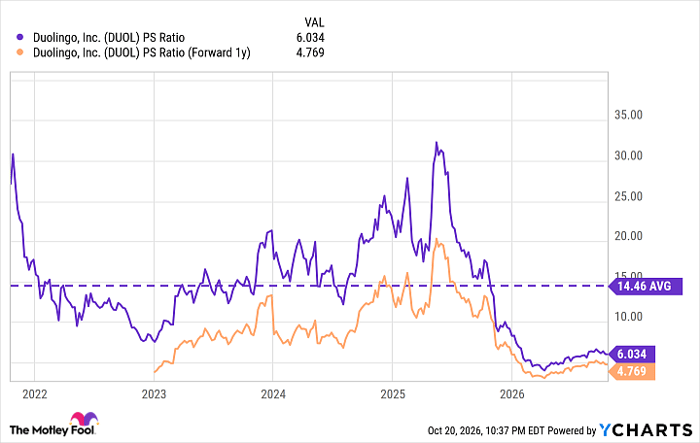
DUOL PS Ratio data by YCharts
Moreover, Duolingo is quite profitable. With earnings of $8.46 per share over the last four quarters, its price-to-earnings (P/E) ratio is 16.6, making it cheaper than both the S&P 500 and the Nasdaq-100 which have P/E ratios of 23.5 and 30.2, respectively. Therefore, I think Duolingo stock is already in bargain territory, so any further downside could be a golden long-term buying opportunity for investors.
2. SentinelOne: Securing the AI revolution
Cyber hackers are more dangerous than ever, because they are using AI to constantly probe corporate networks for vulnerabilities. Moreover, every time businesses plug their internal data into a third-party AI model to deploy a chatbot or agent, they risk having it leaked or stolen by malicious actors. SentinelOne (NYSE: S) is a leading cybersecurity vendor that secures the entire enterprise from both internal and external AI threats.
SentinelOne's Singularity platform protects cloud networks, employee identities, endpoints, and everything in between. Its priority is to prevent breaches from external threats, but it features advanced remediation tools to help enterprises rapidly restore their digital infrastructure in the event of a successful attack to limit downtime. Singularity comes with an integrated AI assistant called Purple AI, which uses advanced reasoning to autonomously investigate incidents and take decisive action when required.
SentinelOne also developed a series of new tools to protect enterprises when they are deploying AI. Prompt security defends against a technique called prompt injection, where hackers attempt to trick chatbots or agents into revealing sensitive data by disguising their malicious requests as genuine commands. This tool also keeps an inventory of every approved AI application within the organization, so it immediately knows if an unauthorized agent has infiltrated the corporate network.
SentinelOne had a record $1.2 billion in annual recurring revenue (ARR) at the conclusion of its fiscal 2027 second quarter (ended July 31), a 22% increase from the year-ago period. However, ARR from its AI products like Purple AI and Prompt Security almost tripled, so they are quickly becoming a key source of growth for the company.
SentinelOne stock is one of the cheapest in the cybersecurity industry. Its P/S ratio is just 6.7, whereas CrowdStrike, Palo Alto Networks, and Zscaler have P/S ratios of between 10.2 and 43.3.
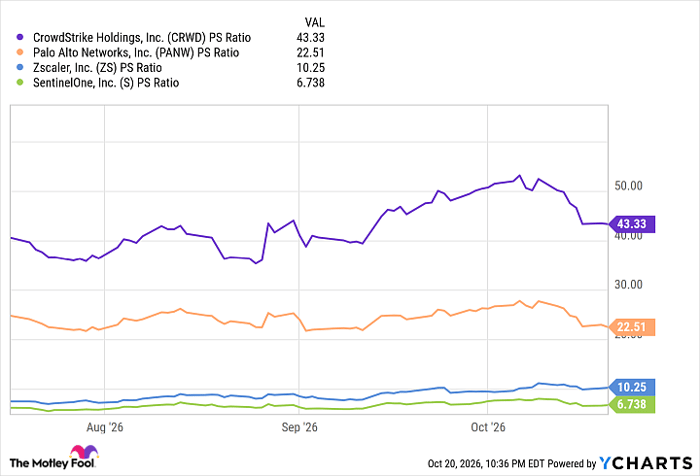
CRWD PS Ratio data by YCharts
Cybersecurity will be increasingly important as AI adoption grows, so SentinelOne stock could be a great long-term buy during the tech sell-off.
Should you buy stock in Duolingo right now?
Before you buy stock in Duolingo, consider this:
The Motley Fool Stock Advisor analyst team just identified what they believe are the 10 best stocks for investors to buy now… and Duolingo wasn’t one of them. The 10 stocks that made the cut could produce monster returns in the coming years.
Consider when Netflix made this list on December 17, 2004... if you invested $1,000 at the time of our recommendation, you’d have $350,756!* Or when Nvidia made this list on April 15, 2005... if you invested $1,000 at the time of our recommendation, you’d have $1,363,905!*
Now, it’s worth noting Stock Advisor’s total average return is 922% — a market-crushing outperformance compared to 213% for the S&P 500. Don't miss the latest top 10 list, available with Stock Advisor, and join an investing community built by individual investors for individual investors.
See the 10 stocks »
*Stock Advisor returns as of October 23, 2026.
Anthony Di Pizio has positions in Duolingo. The Motley Fool has positions in and recommends CrowdStrike, Duolingo, and Zscaler. The Motley Fool recommends Palo Alto Networks. The Motley Fool has a disclosure policy.
Recommended Articles


