


Not Intel. Not AMD. This Is the CPU Stock I'd Buy for the AI Agent Era.
Key Points
Intel and AMD have been benefiting from the rapidly growing demand for server CPUs for AI data centers, which handle agentic AI and inference workloads.
Arm Holdings, however, is expected to dominate the server CPU market in the long run.
Third-party estimates indicate that Arm has already overtaken AMD and Intel's x86-based processors in server CPUs.
- Motley Fool Issues Rare "Total Conviction" Buy Alert ›
Artificial intelligence (AI) has evolved from the chatbots that were popular during the early days of the technology's rollout, when generative AI-based chatbots and assistants, such as ChatGPT, provided a single response to the user's input.
AI has now become more capable. Chatbots can perform complex, multi-step tasks to achieve goals by collecting data, using models to break down the objective into steps, and employing external tools such as databases and search engines to provide results. These AI agents can operate autonomously or semi-autonomously to plan tasks and perform actions using software tools.
Missed Nvidia in 2009? This Rare Signal Is Flashing Again. In 2009, a "Double Down" signal flashed for a little-known chipmaker called Nvidia. For the first time in years, that same "Total Conviction" signal is flashing for a company 1/100th the size of Nvidia. Continue »
Not surprisingly, demand for agentic AI is expected to surge due to its benefits. According to a third-party estimate, the agentic AI market could clock a 40% compound annual growth rate (CAGR) over the next seven years, generating $206 billion in revenue in 2033. The agentic AI market's rapid growth has created a surge in demand for server central processing units (CPUs), which explains why Advanced Micro Devices (NASDAQ: AMD) and Intel (NASDAQ: INTC) have been enjoying phenomenal growth in their server CPU business.
Image source: Getty Images.
Agentic AI has been a tailwind for AMD and Intel
CPUs play a critical role in agentic AI, helping manage the multi-step workflow by coordinating hardware and software resources needed to perform the complex tasks. This is why the ratio of CPUs to GPUs (graphics processing units) in AI servers running agentic AI workloads is shifting from 1:4 earlier to 1:2 or even 1:1, suggesting a 2-4x jump in server CPU demand.
AMD and Intel have been winning big from this shift. AMD's data center revenue grew by 107% year over year in the second quarter of 2026. CEO Lisa Su remarked on the recent earnings call:
In server, we delivered our fifth consecutive quarter of record server CPU revenue with cloud and enterprise sales each growing more than 70% year-over-year, exceeding the outlook we provided last quarter.
Meanwhile, Intel recorded an impressive year-over-year increase of 59% in its data center and AI (DCAI) business in Q2 to $6.3 billion. The company believes that its current generation of server CPUs, codenamed Granite Rapids, will help it sustain the impressive growth of the data center business. Intel is ramping up the production of these server CPUs, and it is working with key server OEMs (original equipment manufacturers) such as Dell Technologies, Lenovo, Hewlett Packard Enterprise, and others to bring Granite Rapids to the market.
What's worth noting is that both Intel and AMD could continue to benefit from the fast-growing server CPU market in the long run. That's because AMD expects the server CPU market to clock an annual growth rate of 50% through 2030, generating $220 billion in annual revenue by the end of the decade. However, I think that the biggest winner of the agentic AI-driven server CPU market's growth won't be Intel or AMD.
Instead, British technology company Arm Holdings (NASDAQ: ARM) seems like the better semiconductor stock to buy for the agentic AI era.
Arm Holdings could crush Intel and AMD in server CPUs
Arm Holdings is known for providing intellectual property and instruction set architectures that semiconductor companies use to design chips for smartphones, data centers, and automotive applications. Arm is a direct competitor to AMD and Intel, as it offers reduced instruction set computing (RISC) architecture. AMD and Intel's x86 platform is based on complex instruction set computing (CISC).
AMD and Intel's x86 architecture processes complex instructions, while Arm's architecture is known for rapidly executing parallel instructions in small batches. As a result, Arm-based server CPUs are ideal for running agentic AI tasks, especially because they deliver 30% to 60% higher energy efficiency than x86 chips. Not surprisingly, the share of Arm server CPUs has increased from just 5% in 2020 to approximately 20% currently, according to Silicon Analysts.
In fact, market research firm IDC noted earlier this year that the revenue of Arm-based server platforms hit $53 billion in the first quarter of 2026, well above x86's revenue share of $34.6 billion. Given that Arm makes money by licensing its IP to customers like Nvidia and also receives royalties on each chip designed using its architecture, it is poised to win big from the growing adoption of Arm-based server CPUs in the agentic AI era.
Moreover, the company has started making its own server CPU, primarily targeting agentic AI and inference. Arm expects more than $2 billion in revenue from sales of its server CPU over the next couple of fiscal years. Notably, the company saw a $1 billion revenue opportunity a few months ago for its latest product in fiscal 2027 and 2028, but it has doubled its estimate thanks to the addition of new customers for its agentic AI-focused server processor.
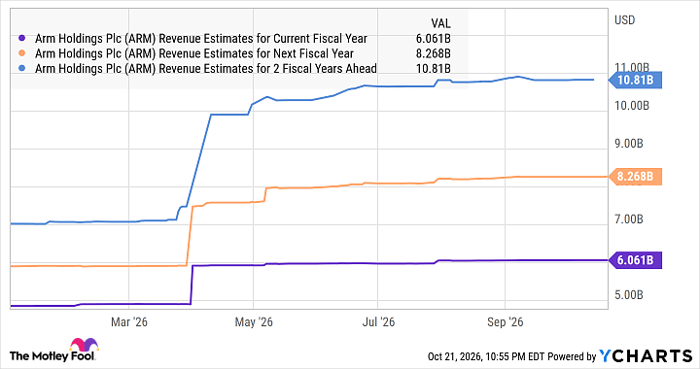
So, it is easy to see why analysts expect Arm's revenue growth to accelerate following an estimated 23% increase in the current fiscal year to $6.06 billion.
Data by YCharts
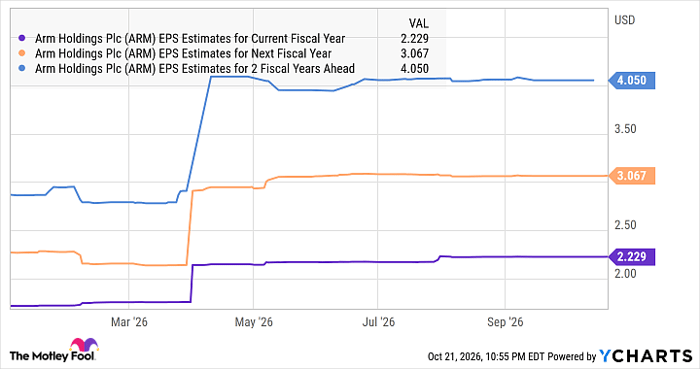
Additionally, its bottom-line growth rate is poised to improve in the future, following an estimated increase of 26% in the ongoing fiscal 2027.
Data by YCharts
However, investors should note that they will have to pay a heavy premium to buy Arm. It is trading at 235 times earnings right now, though the forward earnings multiple of 103 points to a nice improvement in the bottom line. Also, Arm's growing influence in the lucrative server CPU market justifies the valuation.
Counterpoint Research expects Arm-based CPUs to corner 90% of the custom server CPU market by 2029, overtaking x86 processors from AMD and Intel. The firm adds that Arm-based CPUs deliver 2x higher performance-per-watt compared to comparable x86 offerings. All this makes Arm stock a solid buy for investors looking to capitalize on the agentic AI market's growth, as it can outperform AMD and Intel in this space and justify its premium valuation over the long run.
Should you buy stock in Arm Holdings right now?
Before you buy stock in Arm Holdings, consider this:
The Motley Fool Stock Advisor analyst team just identified what they believe are the 10 best stocks for investors to buy now… and Arm Holdings wasn’t one of them. The 10 stocks that made the cut could produce monster returns in the coming years.
Consider when Netflix made this list on December 17, 2004... if you invested $1,000 at the time of our recommendation, you’d have $350,756!* Or when Nvidia made this list on April 15, 2005... if you invested $1,000 at the time of our recommendation, you’d have $1,363,905!*
Now, it’s worth noting Stock Advisor’s total average return is 922% — a market-crushing outperformance compared to 213% for the S&P 500. Don't miss the latest top 10 list, available with Stock Advisor, and join an investing community built by individual investors for individual investors.
See the 10 stocks »
*Stock Advisor returns as of October 22, 2026.
Harsh Chauhan has no position in any of the stocks mentioned. The Motley Fool has positions in and recommends Advanced Micro Devices, Arm Holdings, Hewlett Packard Enterprise, Intel, and Nvidia. The Motley Fool has a disclosure policy.
Recommended Articles


