


1 Green Flag and 1 Red Flag for Bloom Energy Investors
Key Points
Bloom Energy is scheduled to report Q3 2026 financial results on Oct.22.
Shares of Bloom Energy have risen more than 166% since the start of the year.
Distinguishing itself from hydrogen peers, Bloom has reported increasing revenue and earnings.
- 10 stocks we like better than Bloom Energy ›
While many fuel cell investors are still waiting for their investments to flourish, Bloom Energy (NYSE: BE) shareholders have enjoyed an impressive performance of late. Since the start of 2026, Bloom Energy shares have soared more than 166%.
But it's foolish to assume that simply because Bloom Energy shares have rocketed higher, the stock is a screaming buy. Let's take a closer look at both the good and the bad ahead of the company's reporting of its third-quarter 2026 financial results on Oct. 22.
Missed Nvidia in 2009? This Rare Signal Is Flashing Again. In 2009, a "Double Down" signal flashed for a little-known chipmaker called Nvidia. For the first time in years, that same "Total Conviction" signal is flashing for a company 1/100th the size of Nvidia. Continue »

Image source: Getty Images.
Generating steady free cash flow distinguishes Bloom from fuel cell peers
When evaluating the fundamentals of companies, investors can sometimes struggle to find any semblance of financial well-being. But that's hardly the case with Bloom Energy.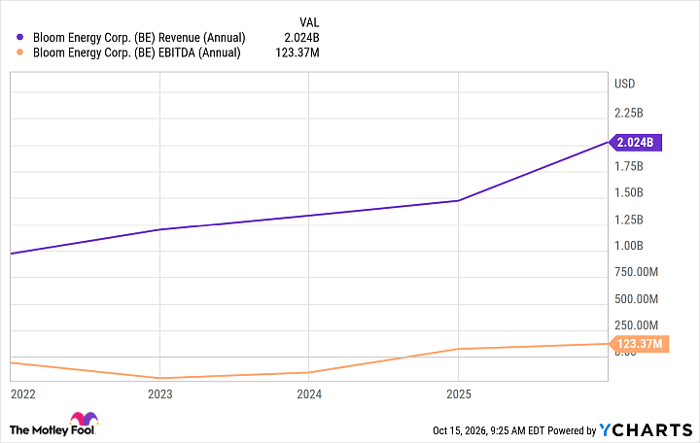
BE Revenue (Annual) data by YCharts.
From growing both revenue and earnings before interest, taxes, depreciation, and amortization (EBITDA) to maintaining a strong balance sheet (Bloom's net debt-to-EBITDA ratio was a conservative 0.35 at the end of Q2 2026), there are numerous indications of the company's impressive financial health. It's what's found on the cash-flow statement, however, that stands out as a bright, green flag.
Generating $175 million in free cash flow for Q2 2026, Bloom Energy has repeatedly produced free cash flow on a trailing-12-month basis for more than a year, proving that its ability to generate organic cash is more than a flash in the pan. 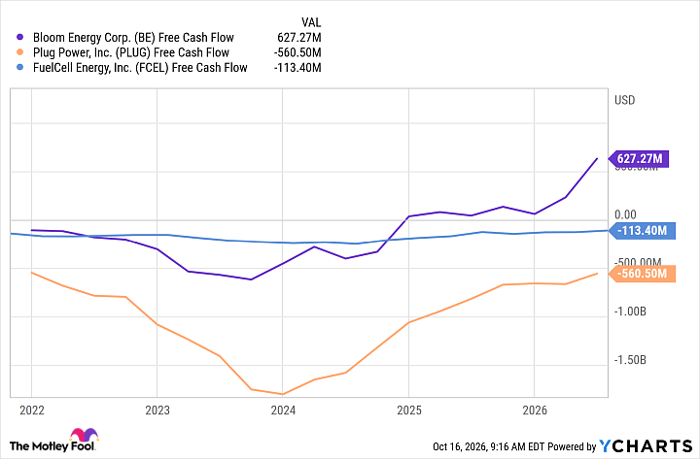
BE Free Cash Flow data by YCharts.
Plus, Bloom Energy's consistent free-cash-flow generation is uncommon among hydrogen-focused companies like Plug Power and FuelCell Energy, which have resorted to raising capital through substantial equity and debt issuances to keep the lights on.
Bloom stock's price tag may have some seeing red
In stellar financial health and with a significant market opportunity (Fortune Business Insights projects the fuel cell industry will grow from $16.8 billion in 2026 to $139 billion in 2034), Bloom Energy is certainly an alluring growth stock. The strong fundamentals, however, come at a cost.
Bloom Energy shares are currently changing hands at 347 times trailing earnings. As if its price-to-earnings (P/E) ratio wasn't steep enough, consider the steep cash-flow multiple: Bloom shares are priced at 109 times operating cash flow.
Because Bloom hasn't consistently generated earnings and positive operating cash flow for several years, it's impossible to compare the stock's current valuation to historical earnings-and cash-flow-based valuations. With respect to sales, though, investors can gain some insight. Trading at a notable premium to its five-year average sales multiple of 3.3, Bloom Energy's stock is changing hands today at 24.3 times trailing sales.
While the stock's valuation will surely deter value investors, those who don't typically prioritize bargain-bin stocks may also find the fuel cell stock's price tag prohibitive.
Should investors power their portfolios with Bloom Energy?
Since its initial public offering (IPO) in 2018, Bloom Energy has ascended into rarified air for hydrogen stocks, demonstrating both robust revenue and earnings growth, though the company's free-cash-flow production that is one of the most alluring qualities right now.
Although Bloom stock is pricey, it's not so pricey that those with multi-year investing horizons should look elsewhere to scratch their itch for quality growth stocks.
Should you buy stock in Bloom Energy right now?
Before you buy stock in Bloom Energy, consider this:
The Motley Fool Stock Advisor analyst team just identified what they believe are the 10 best stocks for investors to buy now… and Bloom Energy wasn’t one of them. The 10 stocks that made the cut could produce monster returns in the coming years.
Consider when Netflix made this list on December 17, 2004... if you invested $1,000 at the time of our recommendation, you’d have $380,363!* Or when Nvidia made this list on April 15, 2005... if you invested $1,000 at the time of our recommendation, you’d have $1,315,732!*
Now, it’s worth noting Stock Advisor’s total average return is 919% — a market-crushing outperformance compared to 211% for the S&P 500. Don't miss the latest top 10 list, available with Stock Advisor, and join an investing community built by individual investors for individual investors.
See the 10 stocks »
*Stock Advisor returns as of October 19, 2026.
Scott Levine has no position in any of the stocks mentioned. The Motley Fool has positions in and recommends Bloom Energy. The Motley Fool has a disclosure policy.
Recommended Articles


